
Why 24/7 Customer Support Matters for Your Shopify Store's Growth in 2026
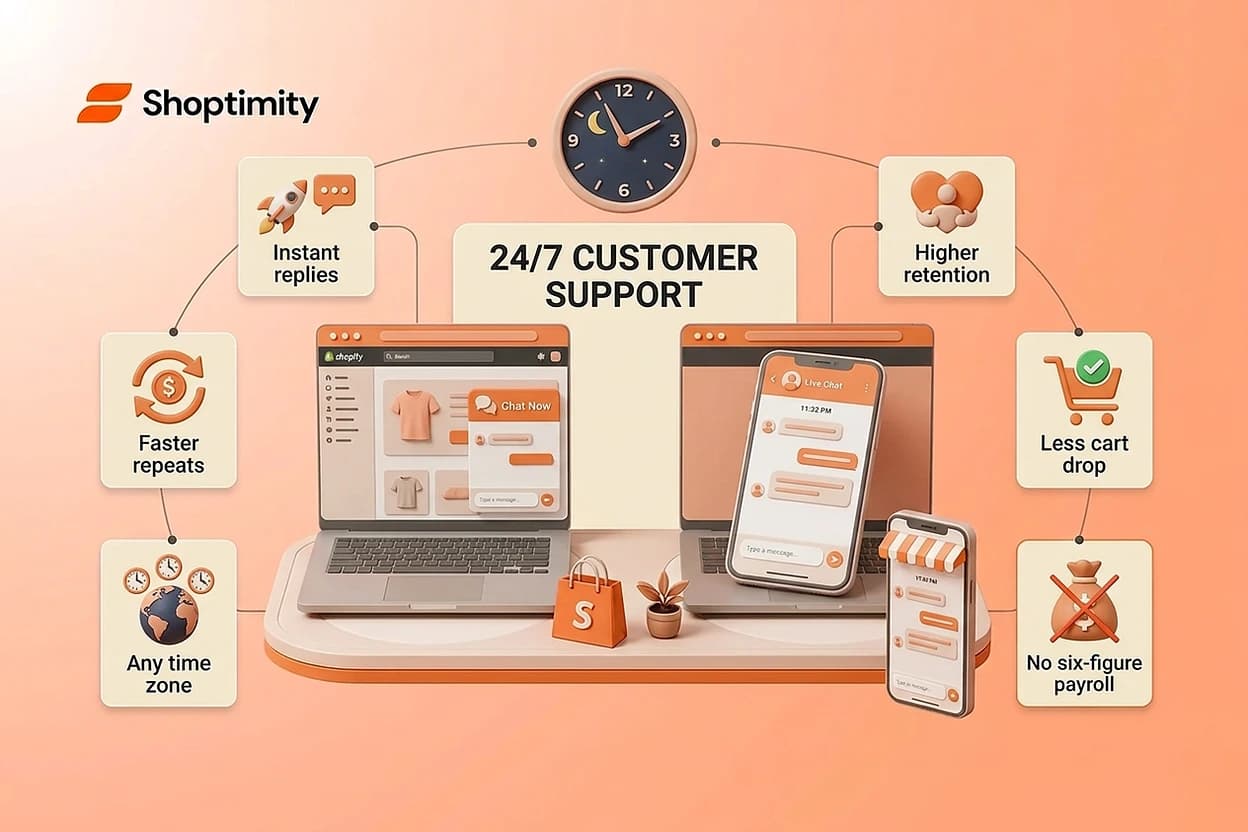
Your customer buys at 11 PM on a Friday. By Saturday morning, they have a question about their order. If no one answers until Monday, you've just lost their trust, a repeat purchase, and likely a referral. Conversely, brands that offer instant, round-the-clock support see measurably higher customer retention, faster repeat purchases, and stronger word-of-mouth growth. In 2026, we provide 24/7 customer support because customers expect it, and the data proves it converts.
TL;DR:
- 24/7 support reduces cart abandonment and increases customer lifetime value by making buyers confident they'll get help when needed.
- Response time matters: every hour of delay costs conversions and customer satisfaction points.
- You don't need a full in-house team; smart support systems, built-in tools, and the right platform can deliver round-the-clock responsiveness without a six-figure payroll.
- Brands that prioritize support see higher repeat purchase rates, lower churn, and more positive reviews.
What Is 24/7 Customer Support for E-Commerce?
24/7 customer support means your Shopify store has a way to respond to customer inquiries at any time, day or night, across any time zone. It's not necessarily a human team working three shifts; it's a combination of live chat, email systems, help documentation, chatbots, and staff coverage that ensures no customer message goes unanswered for more than a few hours.
For high-ticket dropshippers and brand builders, this isn't a nice-to-have. It's the difference between a customer who completes checkout at 2 AM and a customer who abandons their cart because the thought "What if something goes wrong?" crosses their mind. When customers know they can reach you whenever they need to, purchase hesitation drops. Brands selling premium products especially can't afford long response delays; a $500 order deserves faster support than a $50 one.
How 24/7 Support Directly Impacts Your Revenue
The connection between support availability and sales isn't just about customer satisfaction. It's about money.
Faster response times shrink time-to-conversion. A customer ready to buy at 10 PM who gets a live response in minutes is far more likely to complete their purchase than one who gets an email back 14 hours later. By then, they've moved on to a competitor.
Reduced cart abandonment is the immediate win. When customers know they can message you before hitting "Buy," objections evaporate. A quick clarification about sizing, shipping times, or product specs often closes the sale in minutes.
Higher repeat purchase rates follow because customers who receive responsive support buy again. They remember the brand that answered their question at an odd hour. They refer their friends. They leave positive reviews that other shoppers read.
Lower churn rates protect your bottom line. For subscription-based or membership models, responsive support directly reduces cancellation rates. A customer considering cancellation who reaches a live person and gets their problem solved often stays. That's retained revenue every single month.
One key insight from brands running high-ticket stores: the moment a customer reaches out, they're signaling strong purchase intent. Slow responses at that moment feel like rejections. Fast ones feel like VIP treatment.
Common Mistakes Brands Make With Customer Support
Most growing e-commerce teams start by ignoring support until it becomes a crisis. Then they either hire a full support staff (expensive and inflexible) or implement a support system poorly (leaving customers frustrated).
Mistake 1: Assuming customers can wait until business hours. Your store is open 24/7. Customers expect support to match. If you're silent outside 9-5, you're leaving sales on the table.
Mistake 2: Implementing chatbots without a fallback. An AI chatbot that can't escalate to a human, or that gives nonsense answers, actively damages trust. Customers hate it more than no chatbot at all.
Mistake 3: Siloing support from your product. If your support team doesn't know your theme features, your refund policy, or how your product actually works, they'll give wrong answers. Customers notice immediately.
Mistake 4: Measuring support by volume, not by outcome. Responding to 100 tickets in a day means nothing if 50 of them need a second response. Measure resolution rate, response time, and customer satisfaction instead.
Building a 24/7 Support System Without Breaking Your Budget
You don't need to hire a night shift. Here's how brand-focused stores structure this:
Layer 1: Self-Service Systems are your foundation. A comprehensive FAQ, clear shipping and return policies, and well-organized help documentation answer 40-60% of customer questions before they ever reach your team. Invest time here first.
Layer 2: Smart Automation handles the routine. Automated emails for order confirmations, shipping updates, and refund status reduce the support load significantly. Chatbots that handle "Where's my order?" or "What's your return policy?" free your team for complex questions.
Layer 3: Live Chat and Email cover the rest. You don't need someone monitoring live chat all night. A well-timed auto-response ("We'll get back to you within 2 hours") sets expectations and prevents frustration. Stagger team availability: one person 8 PM-midnight, another midnight-6 AM, your main team during peak hours.
Layer 4: Proactive Outreach turns support into growth. If a customer experiences a problem (late shipping, damaged item), reach out before they complain. This transforms a potential negative into a loyalty builder.
When you select a platform like Shoptimity, look for one that builds support into the foundation. When we provide 24/7 customer support for our subscribers, it means your team isn't scrambling to piece together separate tools; the support channel is already there, integrated, and ready to scale with your store.
The key metric: aim for a first response within 1-2 hours, regardless of when the question arrives. That single number, response time, drives more customer confidence than anything else.
You now understand why responsive support matters to your bottom line. Your next step is to audit how your current support system actually performs. Set a timer: when a customer messages you at 9 PM on a Wednesday, how long until they get a useful response? If the answer is "several hours," you've found your biggest opportunity for growth.
Ready to build support into your store's foundation? Explore Shoptimity's subscription plans and start your free trial today. Every plan includes 24/7 support for your team so your customers never wait.
Continue Reading
Top Shopify Theme for Wholesale: A 2026 Buyer's Guide
You've just spent weeks sourcing inventory and building supplier relationships. But when you launch ...
What Makes a Shopify Store Best Converting: The 2026 Framework for High-Ticket Dropshippers
The difference between a best converting Shopify store and an average one isn't traffic or luck, it'...
Best Shopify Themes for Canadian Fashion Brands in 2026
Your Shopify theme isn't just decoration. It directly affects whether customers trust your brand, ho...