
How Much Does It Cost to Create an Online Store in 2026?
The price to start an online store ranges wildly: anywhere from under $100 to $250,000 or more. But here's what really matters: most merchants don't fail because they spend too little. They fail because they build on the wrong foundation, then spend way too much fixing it.
TL;DR: A realistic all-in cost to create an online store is $50–$150/month for a small-to-growing store using a hosted platform like Shopify. The platform fee (Basic plan at $29–$39/month) is usually the smallest line item. Apps, themes, and payment processing fees often cost 2–3x more than the plan itself. Choose a theme with built-in conversion features instead of stacking single-purpose apps, and you'll cut your monthly total without cutting features.
What Is an Online Store?
An online store isn't just a website with a shopping cart bolted on. It's a complete system: a storefront, product catalog, checkout flow, payment processing, inventory management, and the tools to drive traffic and convert visitors into buyers.
When you're budgeting for how much does it cost to create an online store, you're budgeting for a toolkit that has to do all of this at once. That's why two stores at the same revenue level can have wildly different costs. The setup matters.
Platform Choice Drives Your Total Cost
Your platform is the biggest cost lever. The three main approaches are hosted platforms (Shopify, Wix, BigCommerce), open-source solutions (WooCommerce on WordPress), and custom builds.
Hosted platforms run $29–$300+/month in subscription fees. Shopify's Basic plan costs $39/month ($29/month if billed annually), making it the default for most new stores. Wix eCommerce runs $29–$159/month depending on features. BigCommerce plans start similarly. All three include hosting, SSL certificates, and security updates built in.
Open-source platforms like WooCommerce technically cost less to start (sometimes free). You host it yourself on WordPress, which means your hosting bill runs $5–$250/month depending on traffic volume. But open-source doesn't mean free support. You own every update, every security patch, and every troubleshoot. Many merchants upgrading from WordPress to Shopify discover they've been spending half their salary on maintenance they didn't realize was there.
Custom builds start at $25,000 and climb to $250,000+ for enterprise systems. You only go this route if your requirements don't fit any platform, which for most dropshippers, brand builders, and scaling merchants, they do.
For starting out, a hosted platform saves you the headache and the hidden engineering costs.
The Hidden Costs Everyone Forgets
The platform fee is only the beginning. Most merchants' true monthly spend is 2–3 times higher because of three categories they underestimate.
Apps and subscriptions. A standard conversion stack (product reviews, countdown timers, sticky add-to-cart buttons, trust badges, upsell offers) costs $50–$100/month when bought as separate third-party apps. Each app is a subscription. Each one injects extra code that slows your site down. On Shopify, the average established store runs 4–6 paid apps. At $15–$25 per app monthly, that's easily $60–$150 in app costs alone, more than your Shopify plan itself.
This is the cost you can actually eliminate. A modern theme built with conversion features native to the storefront cuts app dependency in half. High-performance themes with built-in product quick view, smart filters, and dynamic galleries mean you're not stacking single-purpose apps to add basic functionality.
Your theme. Free themes on Shopify (like Dawn) cost nothing upfront but lock you into app dependency. Premium one-time themes on the Shopify Theme Store run $250–$400. A subscription theme model like Shoptimity at $19/month (7-day free trial) provides continuous updates, access to every theme in the library, and 30+ built-in conversion tools for less than two standalone apps. The math shifts based on how many features you need built-in versus bolted on.
Payment processing fees. Every Shopify store pays credit card fees (2.5–2.9% plus 30 cents per online transaction with Shopify Payments, depending on plan). If you don't activate Shopify Payments and use a third-party gateway instead, you pay an extra surcharge on top: 2.0% on Basic, 1.0% on Grow, and 0.6% on Advanced plans. At $10,000/month revenue on Basic, that surcharge alone costs $200/month. Always activate Shopify Payments if you're in a supported region.
Domain registration ($10–$20/year), email marketing ($20–$100+/month as your list grows), and advertising (usually the largest expense once you're driving real traffic) round out the picture.
Real Monthly Budgets by Growth Stage
Most merchants fit into one of three profiles:
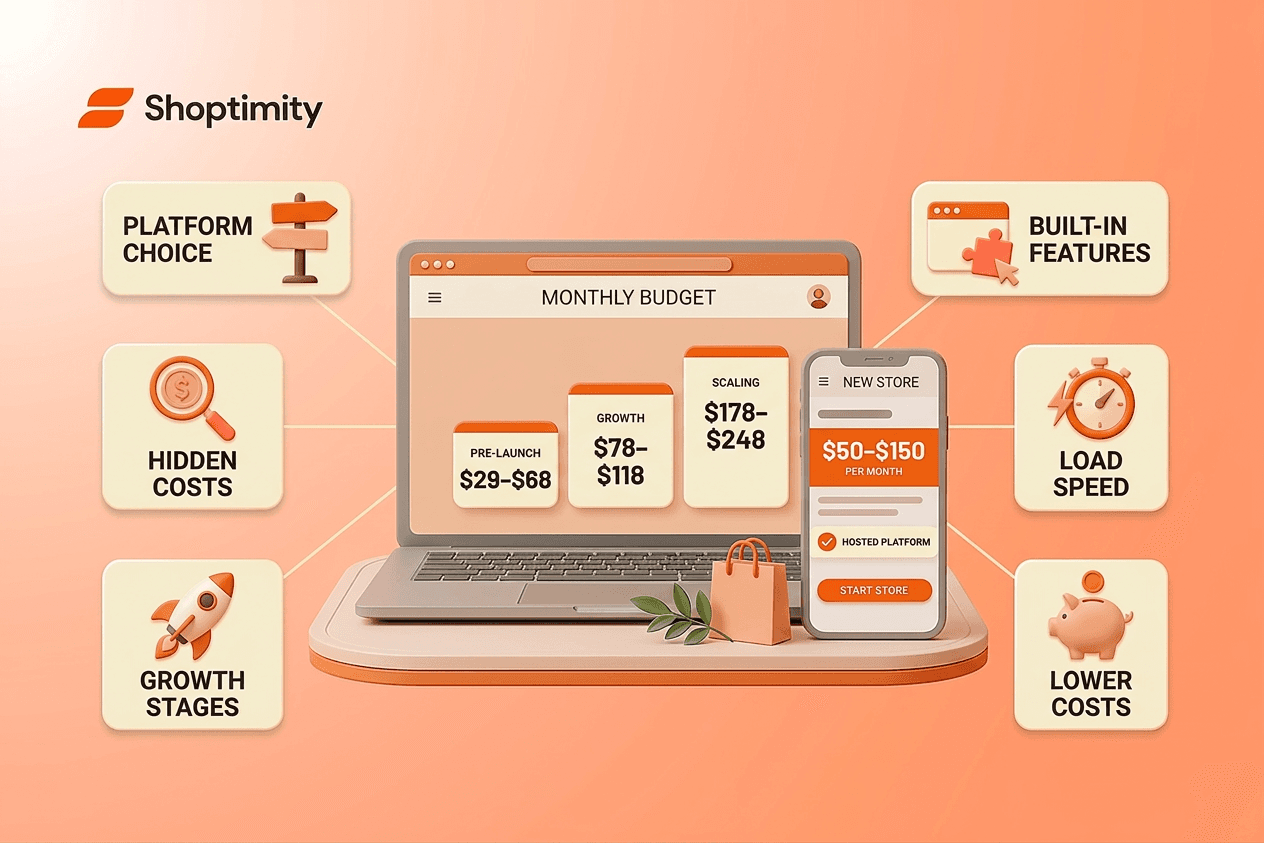
Pre-launch or testing phase: Basic plan at $29/month, zero or minimal apps, free theme or a $19/month subscription theme. Total: $29–$68/month. You're validating demand before building out.
Early growth (first few months of revenue): Basic plan at $29–$39/month, 2–5 paid apps at $30–$60/month combined, a conversion-focused subscription theme ($19/month). Total: $78–$118/month. You're solving for cart abandonment and average order value now.
Scaling ($5k–$25k/month revenue): Grow plan at $79/month (billed annually), a more capable app stack ($80–$150/month), a premium theme ($19/month on subscription). Total: $178–$248/month. You've shifted to Shopify Payments, so you're also factoring payment processing at scale.
These are fixed monthly costs. Payment processing, advertising, and email marketing scale separately with revenue.
Cut Your Costs Without Cutting Features
Here's where most merchants go wrong: they start with a free theme to save $300, then spend $1,500 stacking apps to add the features a $300 theme would've included.
If you're choosing a theme, compare total cost of ownership, not just the price tag. A free theme that forces you into 8–12 apps ($50–$150/month) costs $600–$1,800 over a year. A $300 one-time theme that requires only 2–3 apps ($20–$50/month) costs $240–$600 in apps plus the upfront fee, often less total. Plus you get faster load times and simpler maintenance.
For dropshipping specifically, theme load speed directly impacts ad ROI. A slow checkout increases bounce rates. A fast storefront converts more of your paid traffic. The difference between a 2-second and 4-second page load can kill profitability on high-ticket dropshipping where customer acquisition cost is already high.
The single fastest way to cut your true monthly cost is to choose a theme with conversion features built in, not free, not custom, but thoughtfully designed with the features you actually need already included.
Launch Your Store on the Right Budget
You now know that theme choice and app stack are the biggest cost levers. See how Shoptimity's built-in conversion tools cut the app bloat that drains most merchants' budgets—and start with a 7-day free trial.
7-day free trial · all themes included · cancel anytime
Continue Reading
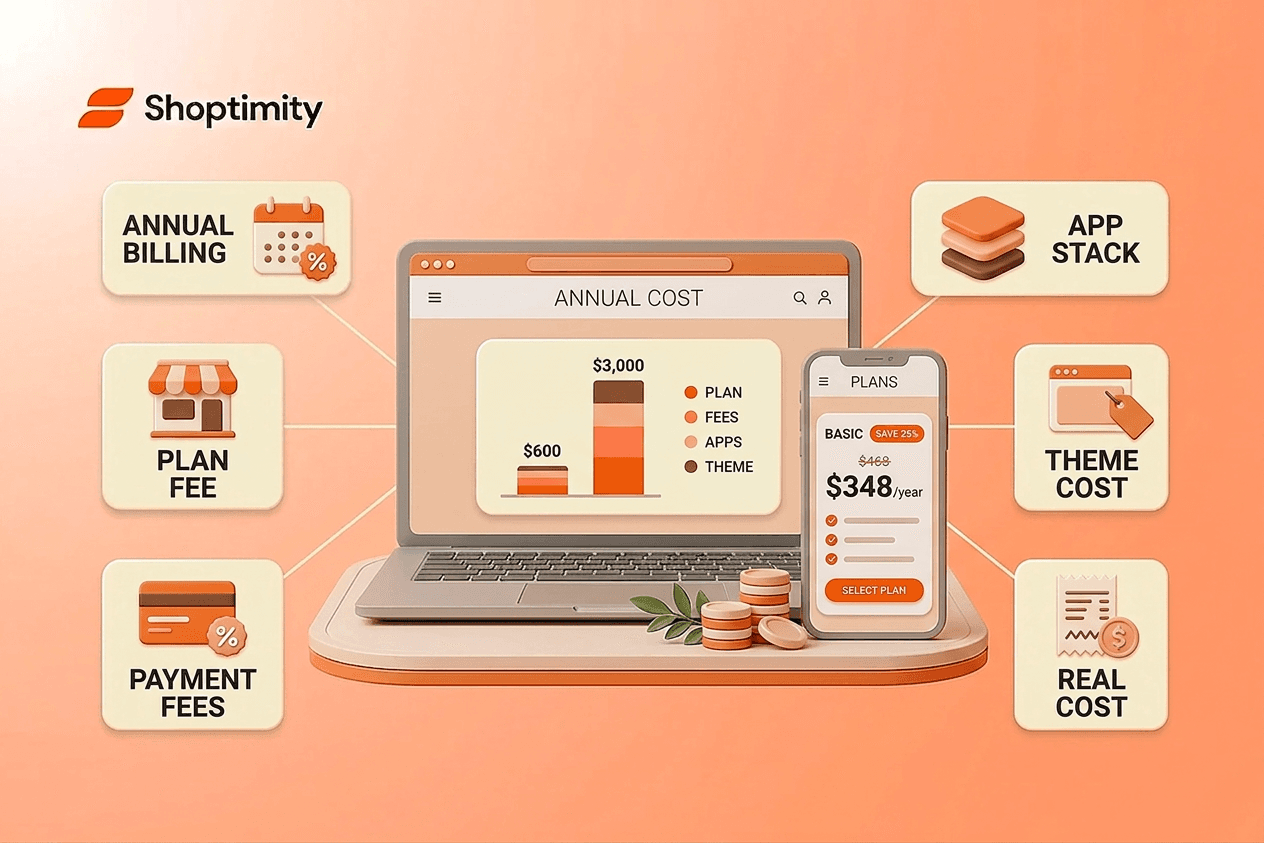
How Much Is Shopify Annually? The Real Cost Breakdown for 2026
Shopify's advertised price starts at $5 per month. That number is misleading. The truth: a realistic...
What Makes a Shopify Store Best Converting: The 2026 Framework for High-Ticket Dropshippers
The difference between a best converting Shopify store and an average one isn't traffic or luck, it'...
The Right Dropshipping Shopify Theme Saves You Thousands in Wasted Ad Spend
When a cold visitor lands on your dropshipping store, they have seconds to decide if you're legitima...