
Pre-Built Templates & Sections: Why High-Ticket Dropshippers Launch Faster in 2026
You're sitting on a solid product, you've validated the niche, and your supplier is locked in. The last thing you need is to spend three months building your Shopify store from scratch. Yet most high-ticket dropshippers do exactly that, wrestling with blank page builders, stacking third-party apps, and iterating endlessly on design details that don't move conversion rates.
Pre-built templates and sections are why the fastest-growing stores don't have this problem.
TL;DR:
- Pre-built templates let you launch a conversion-ready store in days, not months
- Templated sections come with trust, urgency, and upsell blocks already coded, no app subscriptions required
- High-ticket products (priced $200–$5,000+) demand professional design and fast load times; templates deliver both out of the box
- Avoid the trap of customizing templates endlessly; choose one aligned with your niche and launch within a week
What Are Pre-Built Templates & Sections?
A pre-built template is a complete, fully designed storefront you install and customize rather than build from zero. Pre-built sections are the individual design blocks within that template: hero banners, product galleries, trust badges, countdown timers, upsell blocks that snap together like a construction kit.
Instead of designing a homepage layout yourself or installing an app for each conversion feature you need, a modern pre-built template ships with 60+ to 80+ ready-made sections covering product pages, collections, checkout optimization, and trust-building. You pick the sections you want, arrange them, swap colors and copy, and you're live.
This is radically different from starting with a blank canvas. Merchants using conversion-focused pre-built templates save 10–20 hours on initial setup alone, and that time savings compounds as you scale.
For high-ticket dropshipping, where every element of your site signals trust and professionalism, a pre-built template ensures nothing is left to chance.
Why Pre-Built Templates Matter for High-Ticket Dropshipping in 2026
High-ticket items command premium pricing, often between $200 and $3,000 or more. This means your customer has one chance to trust you. A slow or amateur-looking site is a refusal-in-progress.
The research is clear: a one-second delay in page load can cut mobile conversion rates by 7–10%. That's not vanity. On a store doing $50,000 a month in revenue, a 7% conversion drop is $3,500 walking out the door.
Pre-built templates eliminate this risk. They're built for speed (aiming for 85+ PageSpeed Mobile scores), mobile-first from day one (70%+ of e-commerce traffic is mobile), and loaded with conversion features tested across thousands of stores. You're not guessing about layout or design; you're shipping a proven blueprint.
Most high-ticket dropshippers don't need another design tool. They need to launch and validate fast, then iterate on what converts.
Pre-built templates do exactly that. They're also niche-specific: a luxury jewelry template looks and performs nothing like a smart-home-gadgets template. A pre-built template respects those differences instead of forcing you to hack a generic theme.
How Pre-Built Templates Accelerate Your Launch Timeline
Time-to-revenue is everything in dropshipping. Every week you spend in design is a week you're not testing ads, refining your pitch, or chasing customers.
Launch Within Days Instead of Weeks
Picking a pre-built template, customizing the colors and copy, and publishing takes 1–2 days. A blank-canvas approach takes 2–4 weeks minimum, even if you're experienced.
Agentic AI theme generation has accelerated this further in 2026. You describe the store you want in plain English, and the AI builds the complete storefront, sections and all. You then drop straight into editing mode to refine it.
Pre-Built Sections Do Heavy Lifting for You
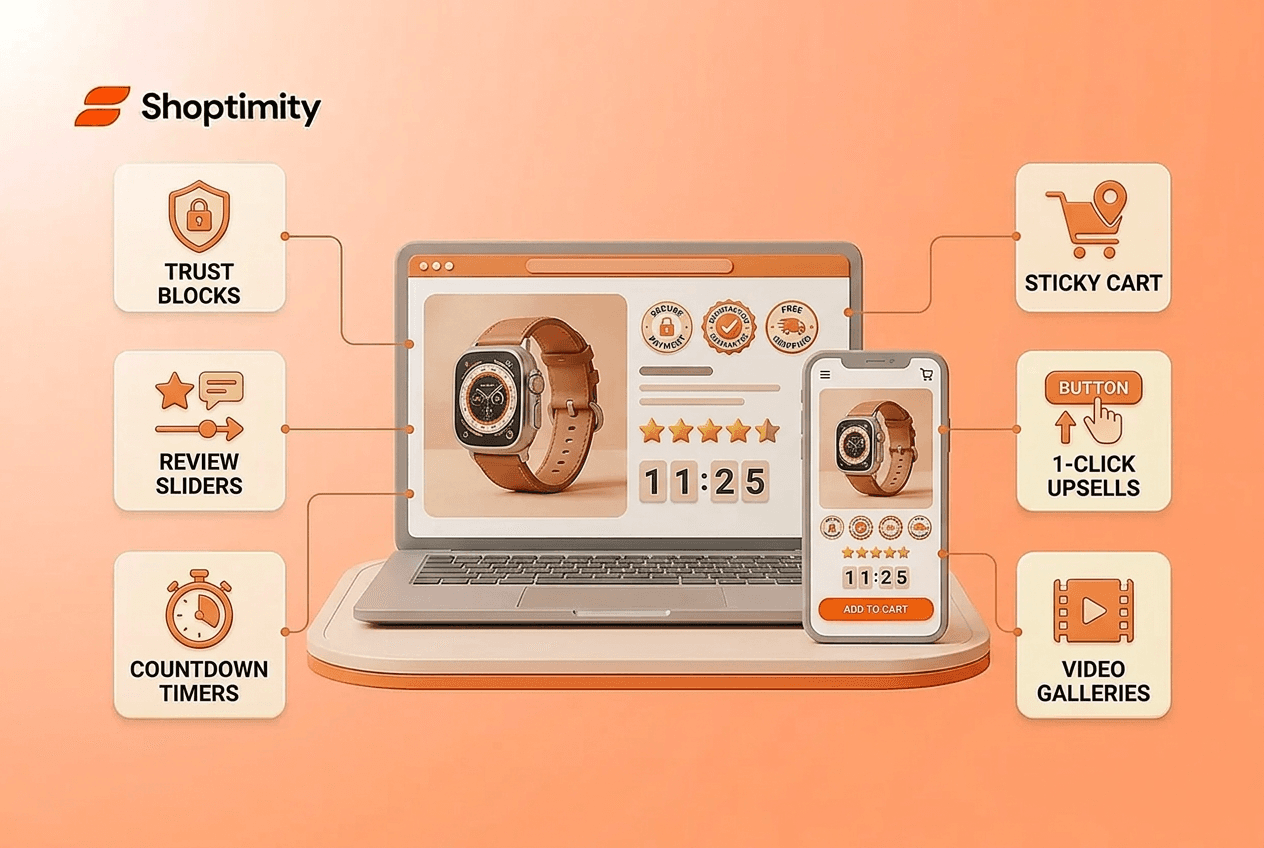
A pre-built template ships with sections already coded for the things that move revenue: sticky add-to-cart buttons, product quick-view, image zoom, review sliders, countdown timers, quantity breaks, and upsell blocks. You don't install an app for each. You don't fiddle with integrations. You don't pay $30–$50 a month per feature.
Third-party app bloat is the silent killer of high-ticket stores. Each app adds load time, increases security surface area, and stacks onto your monthly bill. Pre-built templates use native Shopify Online Store 2.0 sections, meaning all conversion tools are baked into one subscription at one monthly cost.
Templated Sections Let You Iterate Without Starting Over
A pre-built template isn't a cage; it's a foundation. Every section can be hidden, reordered, duplicated, or removed. Need to move your trust badges above the fold? Drag them up. Want to test a different hero image? Swap it. Want to duplicate a section to A/B test two layouts? One click.
This speed of iteration separates stores doing $10K a month from stores doing $100K. You're not waiting for a developer or rewriting CSS. You're testing and shipping.
Conversion Features Built Into Pre-Built Sections
Here's what separates a generic template from one built for high-ticket conversions:
Trust & Social Proof Blocks
High-ticket customers need reassurance. A pre-built template includes native review sliders, testimonial sections, and trust-badge modules without third-party apps. Retailers can showcase customer photos, video testimonials, and guarantee statements without loading a single plugin.
Urgency & Scarcity Signals
Countdown timers, stock indicators, and "limited availability" badges are baked into pre-built sections. These aren't fluff. A high-ticket store testing urgency cues sees concrete, measured impact on hesitant buyers.
Mobile-First Product Galleries
High-ticket products need to shine on mobile. Pre-built templates include smart product galleries with zoom, multi-angle views, and fast load times. Video plays a critical role too. Every high-performing store in 2026 has video on the homepage and product pages, and pre-built templates leave room for these without bloating performance.
Sticky Add-to-Cart & One-Click Upsells
The add-to-cart button stays in frame as the customer scrolls. Pre-built upsell sections let you build one-click upsells without pricey third-party apps, bundling complementary products to lift average order value.
Common Mistakes When Choosing Pre-Built Templates
Over-Customizing Before Launch
The biggest mistake is treating a pre-built template like a blank canvas and spending three weeks on minute details. Your headline font, your exact shade of blue, your spacing, these don't move revenue. Ship the template as-is with minimal tweaks, run ads, and iterate based on actual customer behavior.
Launch with 80% of the template default, then customize based on data.
Ignoring Performance Benchmarks
Not all pre-built templates perform equally. Check the mobile PageSpeed score and actual load times on real products before committing. A beautiful template that loads in 3 seconds will tank your conversion rate on high-ticket items, where trust depends partly on perceived professionalism and speed.
Picking the Wrong Template for Your Niche
A jewelry template optimized for white space and luxury won't convert for smart-home gadgets, where customers need spec comparisons and tech education. Most template providers now offer niche-specific presets. Choose the one closest to your category, not the one that looks prettiest.
Underestimating the Value of Built-In Conversion Tools
Stacking individual conversion apps costs $50–$150 a month and creates maintenance headaches. A pre-built template with native trust blocks, urgency features, and upsell sections often costs a fraction of that and performs better because every feature was designed to work together.
===
You now understand why launching with a pre-built template isn't cutting corners; it's playing chess while others are still setting up the board. The merchants crushing it in high-ticket dropshipping in 2026 aren't spending time on design. They're shipping fast, running ads, and optimizing based on real data.
Start a 7-day free trial and pick a pre-built template built for high-ticket conversions. You'll see why thousands of dropshippers across jewelry, furniture, fitness, and smart-home niches have ditched blank builders and landed revenue weeks earlier.
Continue Reading
Top Shopify Theme for Wholesale: A 2026 Buyer's Guide
You've just spent weeks sourcing inventory and building supplier relationships. But when you launch ...
What Makes a Shopify Store Best Converting: The 2026 Framework for High-Ticket Dropshippers
The difference between a best converting Shopify store and an average one isn't traffic or luck, it'...
The Right Dropshipping Shopify Theme Saves You Thousands in Wasted Ad Spend
When a cold visitor lands on your dropshipping store, they have seconds to decide if you're legitima...