
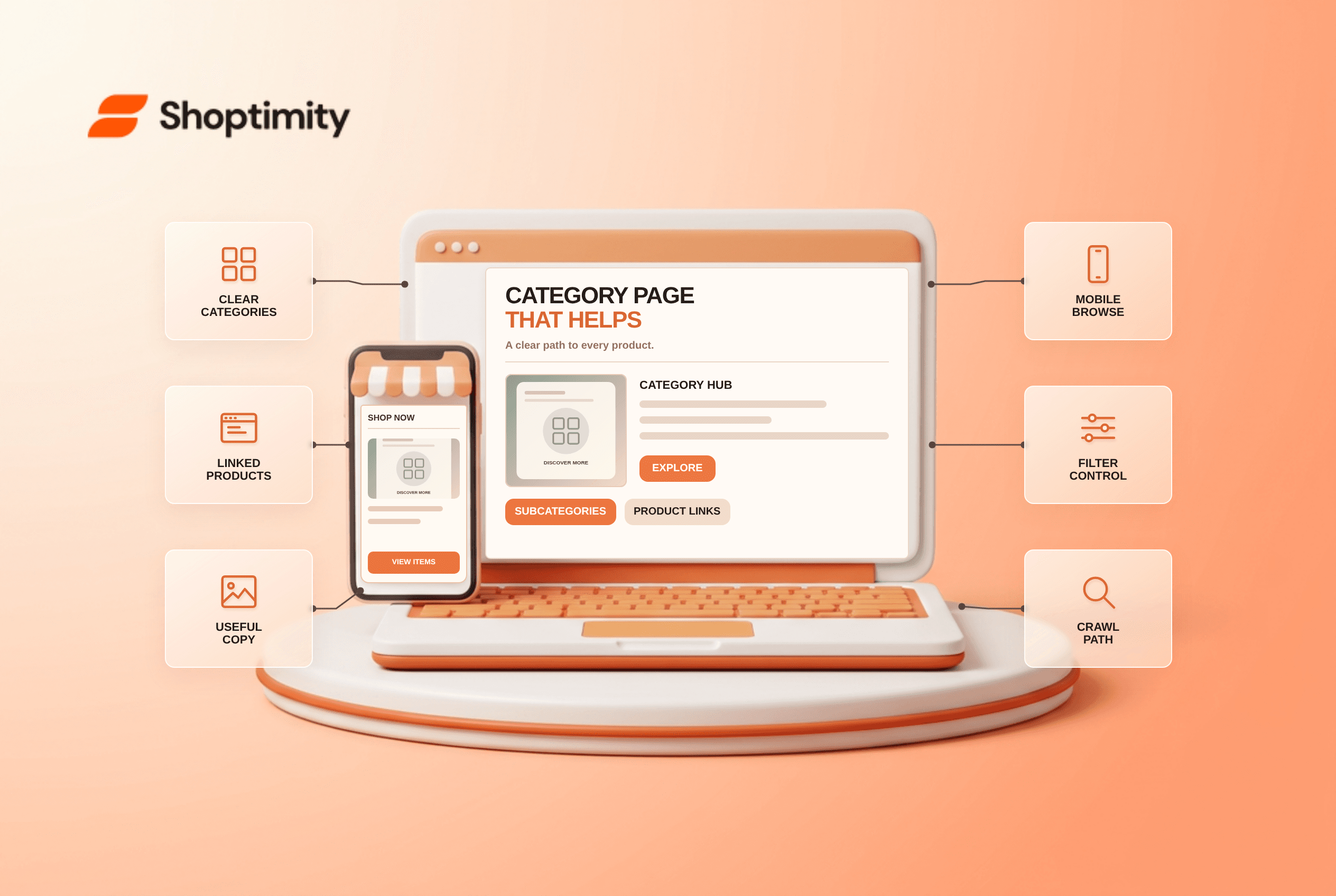
Ecommerce category page SEO works best when a category actually helps shoppers find a group of products. Name it in customer language, link to relevant subcategories and products, and make those links crawlable. Add concise guidance that explains the selection, then control filter URLs that create near-duplicate pages. A wall of keywords cannot compensate for a product grid that shoppers or crawlers cannot navigate.
Is this a category hub or a product listing page?
Choose the page's job before writing the heading. An intermediary category hub directs visitors to narrower categories; a product listing page lets them scan, sort and filter actual items. Baymard's 2026 category-page guide distinguishes these roles and notes that 76% of sites in its benchmark fail to make subcategories the primary content on intermediary pages. That figure describes Baymard's evaluated sites, not Shoptimity merchants.
A broad “Home” category with several product families benefits from visible subcategory tiles. A narrow “Ceramic Mugs” listing should show products and relevant filters without forcing another navigation decision. If your catalog has only a handful of items, a separate hub for every tiny group can create thin pages with no meaningful purpose.
What should the category page include?
Put the find-a-product path ahead of promotional decoration. An effective category layout gives the user an understandable title, subcategory or product links, and enough context to choose the next step:
- Write a descriptive H1 and title for a real product family. Avoid using internal collection names that customers would not recognize.
- Place subcategory links near the top if this page is a hub; on a product listing, show the products promptly.
- Give each product a crawlable HTML link with descriptive anchor text and a useful thumbnail. Do not rely on a search box as the only route.
- Add concise, category-specific buying information: sizes, uses, materials or compatibility that actually differ among the products.
- Check pagination or load-more behavior so later products can be discovered without a click-only script barrier.
- Audit mobile sorting, back navigation and breadcrumb paths. Make it clear which category the shopper is in after applying a filter.
According to Google's ecommerce site-structure guidance, menus should link to categories, categories to subcategories and subcategories to product pages. Google says its crawler generally does not submit queries into a site's search box. We checked that documentation alongside public UX research; we did not crawl your store or examine Search Console.
What should happen to filter URLs?
Decide which filtered combinations deserve search visibility. A size or color control helps shoppers, but every combination need not become an indexable landing page. Google's faceted-navigation documentation explains that filter parameters can produce very large URL spaces and waste crawling. It describes ways to prevent crawling when filtered pages are not needed in Search and technical conventions when they are.
The trade-off is not “block all filters.” A genuinely useful, curated filtered destination with stable stock and distinct intent may justify its own page. For ordinary ad hoc combinations, choose a consistent URL, canonical and crawl policy with your technical team. Do not add robots.txt rules without checking whether they would also hide valuable product links.
How do you check whether the page helps?
Try a task from the landing page, not just a keyword report. Pick a product type and ask a shopper to find an in-stock item using categories, then try it on a phone. A blank result, misleading label or buried subcategory is a concrete defect. Inspect index coverage and query data once available; none was provided for this guide. Shoptimity themes can present a category layout, while our mega-menu guide covers navigation decisions outside the landing page itself.
Our recommendation is to fix access and labels before expanding category prose. A category with 500 words of generic introductions but hidden product links does not solve either the shopper's or the crawler's problem.
Ready to build a faster, higher-converting store?
Every Shoptimity theme ships with conversion widgets built in — so you get speed and features without stacking apps.
7-day free trial · all themes included · cancel anytime
Continue Reading
Top Shopify Theme for Wholesale: A 2026 Buyer's Guide
You've just spent weeks sourcing inventory and building supplier relationships. But when you launch ...
Ecommerce Return Status Updates: Separate Request and Refund
Ecommerce return status updates should separate request, label, receipt, inspection and refund so sh...
Ecommerce Delivery Delay Updates: Show the New Reality
Ecommerce delivery delay updates should replace stale promises with a dated revised estimate, clear ...