
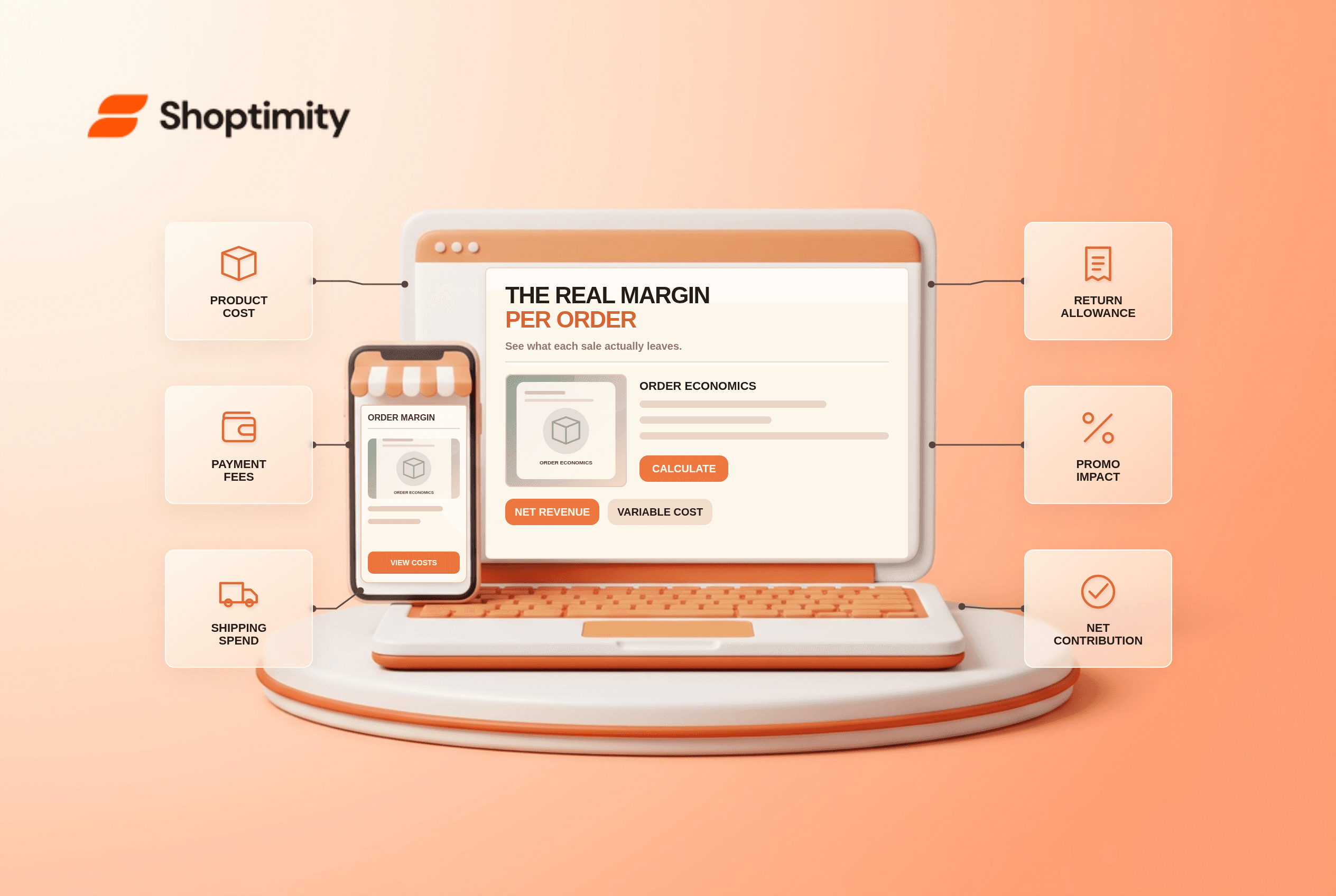
Contribution margin answers a practical ecommerce question: after fulfilling one more order, how much money remains to help pay fixed costs and acquisition? Revenue and gross margin alone can hide shipping subsidies, packaging, payment fees and returns. Before scaling a promotion, calculate the contribution on a real basket using your own records.
What is contribution margin per order?
It is net order revenue minus the costs that change with the sale. Shopify's cost-volume-profit explanation lists product cost, packaging, shipping and payment fees among variable expenses. Gross margin usually subtracts cost of goods sold from sales; contribution margin also considers other variable order costs. Fixed overhead such as rent is handled separately rather than quietly excluded from profitability decisions.
Use the same currency and period for every line. A simple illustrative order might have $100 in net sales, $38 product cost, $8 merchant-paid shipping, $3 packaging, $4 payment fees and $7 expected returns cost. That leaves $40 contribution before acquisition and fixed overhead. These are example figures, not a Shoptimity merchant benchmark. Taxes collected for government and refunded amounts need consistent accounting treatment; ask your finance team how to define net sales.
How do you calculate it without fooling yourself?
Build a small worksheet from real orders. One average across a whole store can hide a loss-making product mix:
- Start with net sales after discounts and refunds. Separate taxes and shipping charges according to your accounting approach.
- Add product cost for the items actually sold, including landed costs where relevant.
- Add variable packaging, fulfillment labor or third-party pick fees, carrier charges you pay and payment processing fees.
- Estimate return costs by category using your own data: return labels, inspection, non-resellable stock and refund-related losses where applicable.
- Subtract those variable costs from net sales. Divide by net sales for the contribution margin ratio if you need a percentage.
- Compare a full-price order, a discounted order and an order just above a free-shipping threshold. Record the difference before changing the offer.
Shopify's gross-margin comparison illustrates why a product with a healthy product-cost margin can have a thinner contribution after other variable expenses. Be explicit about whether paid acquisition is included in your contribution definition or assessed afterward. Both views are useful when labeled; mixing them between reports makes decisions unreliable.
What happens when you offer free shipping?
The carrier is still paid by someone. If the merchant covers an $8 label instead of charging the buyer, an otherwise identical order contributes $8 less unless the offer changes the basket or product price enough to compensate. A free-shipping threshold can work when added items bring sufficient margin, but do the math on actual baskets. Our shipping-bar mismatch guide addresses the separate problem of a displayed threshold disagreeing with checkout.
A discount has a similar effect. A $10 reduction from a $100 order is not “only ten percent of profit”; it can consume a much larger share of the $40 contribution in the example above. For acquisitions, Shopify's customer acquisition guide treats contribution as money available to offset acquisition. Measure repeat buying separately instead of assuming all first-order losses will be recovered later.
Can storefront design improve margin?
It can clarify value and reduce confusion, but cannot change the underlying costs. Shoptimity's themes can present product information, delivery conditions and relevant add-ons. Review our complementary-product guide if pairing products could increase a basket's useful value; validate stock and actual contribution first. We have not audited your books or costs. Use this as a worksheet framework, not financial advice.
Ready to build a faster, higher-converting store?
Every Shoptimity theme ships with conversion widgets built in — so you get speed and features without stacking apps.
7-day free trial · all themes included · cancel anytime
Continue Reading
Top Shopify Theme for Wholesale: A 2026 Buyer's Guide
You've just spent weeks sourcing inventory and building supplier relationships. But when you launch ...
Ecommerce Return Status Updates: Separate Request and Refund
Ecommerce return status updates should separate request, label, receipt, inspection and refund so sh...
Ecommerce Delivery Delay Updates: Show the New Reality
Ecommerce delivery delay updates should replace stale promises with a dated revised estimate, clear ...