
Hoe Duur Is Shopify in 2026? The Real Cost Breakdown for High-Ticket Dropshippers
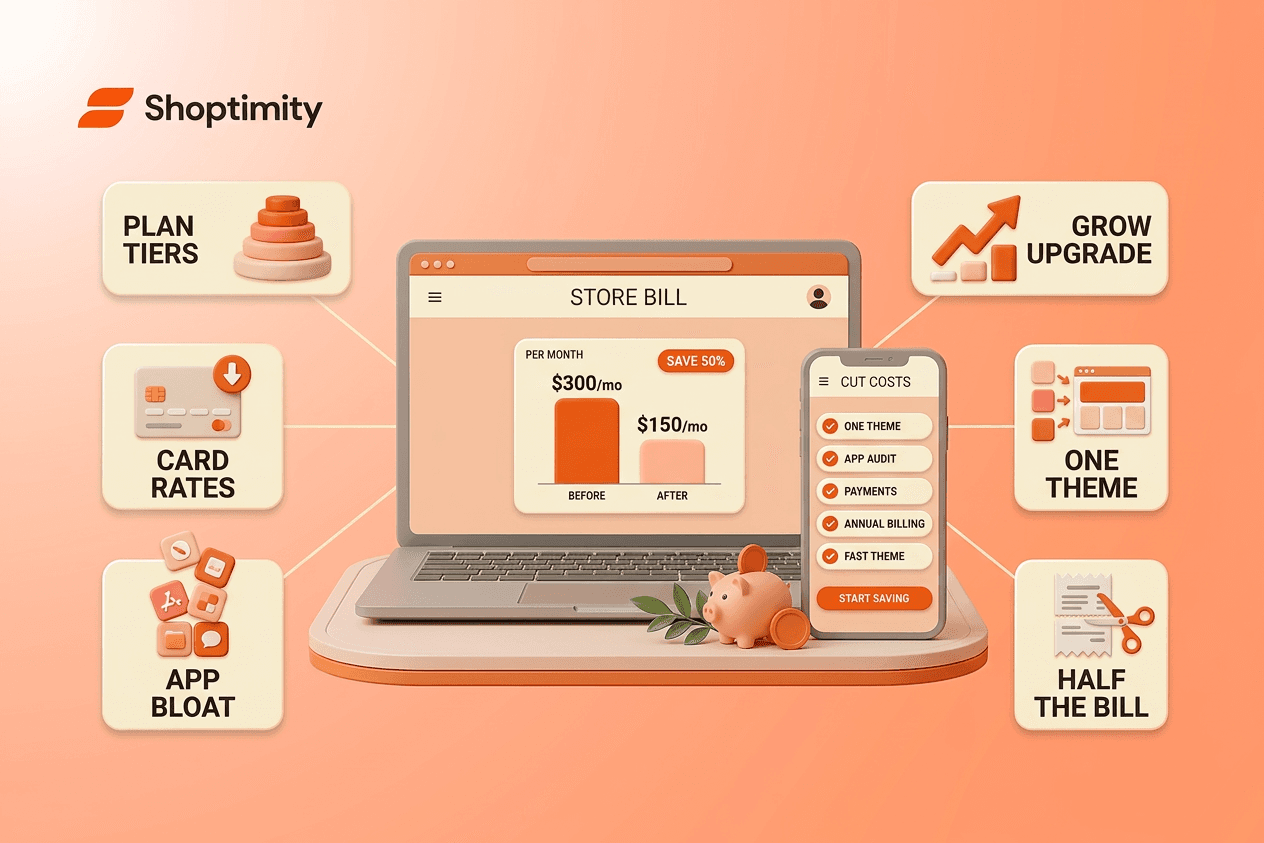
Shopify advertises plans starting at $5 per month, but that's a misleading headline. Most high-ticket dropshippers actually spend $60 to $300+ monthly once you add payment fees, apps, and a professional theme. The question isn't whether Shopify is expensive, it's where your money actually goes and how to control it.
TL;DR: Shopify's base plans run $5–$399/month, but the real cost includes payment processing fees (2.9% + 30¢ per transaction), app subscriptions ($10–$80/month), and a premium theme ($0–$400). A realistic budget for a growing dropshipping store: $50–$150/month on the platform alone, plus ad spend.
What Does Shopify Cost? The Honest Answer
Hoe duur is Shopify? The answer depends on three things: which plan you choose, how many apps you install, and whether you invest in a high-converting theme upfront.
Shopify's base subscription fee is only 30–50% of what you'll actually pay. A typical small-to-mid dropshipping store spends $50–$150/month just on the platform and core tools. Add advertising, and that's a different number entirely. But the subscription itself? That's the part you can control.
The key is understanding that Shopify is built for scaling. Its pricing tiers increase as your revenue grows, but so do your features and per-transaction rates improve. You don't pay for capabilities you don't need yet.
Shopify Pricing Plans in 2026: Breaking Down Each Tier
Shopify offers five core plans, and Shopify's pricing page shows the monthly costs. Here's what each tier actually includes:
Starter: $5/month
Best for selling via social links, popups, or link-in-bio. No full storefront. Most high-ticket brands skip this.
Basic: $39/month ($29/month billed annually)
The standard entry point for new dropshipping stores. Includes hosting, SSL, and a full online storefront, but no staff accounts; only the store owner can log in to the admin. You pay 2.9% + 30¢ per online transaction with Shopify Payments. If you use a third-party payment gateway instead, Shopify adds a 2.0% surcharge on Basic (1.0% on Grow, 0.6% on Advanced, 0.2% on Plus).
Grow: $105/month ($79/month billed annually)
Where most scaling brands move once they need a team or better data. Online card rates drop to 2.7% + 30¢, and you get 5 staff accounts plus more detailed reporting.
Advanced: $399/month ($299/month billed annually)
For established, high-volume brands. Online card rates drop to 2.5% + 30¢, and you get 15 staff accounts and a custom report builder.
Plus: $2,300+/month
Enterprise-only. Starts around $2,300/month on a 3-year term (higher on a 1-year term), with negotiated rates for large operations.
The math: Moving from Basic to Grow costs an extra $50/month on annual billing ($79 vs $29), and your online card rate drops from 2.9% to 2.7%. On $10K in monthly sales, that 0.2% saves about $20/month, so the rate cut alone only pays for the upgrade at around $25K/month in online sales. But most dropshippers underestimate the real burden: it's not the plan fee, it's everything else.
The Hidden Costs Most Dropshippers Miss
Here's where the real expense lives.
Payment Processing Fees
Every sale incurs a payment processing fee. On Basic, you're paying 2.9% + 30¢ per transaction with Shopify Payments. On a $100 sale, Shopify keeps roughly $3.20. Use a third-party gateway instead of Shopify Payments, and Shopify tacks on an extra 0.6%–2.0% surcharge (2.0% on Basic). On a store doing $5,000/month in revenue, that's roughly $150–$250 in processing fees alone, every month. This cost is directly proportional to revenue, it never stops.
App Subscriptions: The Silent Budget Killer
This is where most dropshippers lose control of their budget. The average Shopify store runs 6–8 paid apps. At $10–$30 per app per month, that's $60–$240 in recurring app costs. Many stores exceed this, running 30+ apps and spending $200–$500/month just on third-party subscriptions.
Apps add up fast: one for reviews, one for upsells, one for quantity breaks, one for a sticky cart, one for email capture, one for analytics. Each one sounds essential. Together, they often cost more than your Shopify plan itself.
The performance cost is worse. Every app injects external scripts into your storefront, slowing page load times. A slow store converts worse. You're paying twice, once in subscription fees, and again in lost sales.
Theme Costs
A premium theme in the Shopify Theme Store costs $250–$400 as a one-time purchase. Custom agency themes run $15,000+. But a dated theme forces you to bolt on more paid apps to get conversion features you could have native in a modern theme. A modern theme with built-in quantity breaks, sticky carts, and smart filters eliminates the need for several single-purpose apps, recouping the theme cost within weeks.
Alternatively, subscription themes provide continuous updates and support. Shoptimity, for example, charges $19/month (or $156 for the first year on the current annual launch offer), with a 7-day free trial, for access to every theme plus 30+ built-in conversion tools such as quantity breaks, sticky carts, smart filters, and dynamic product galleries, replacing most of the app stack for most stores.
Everything Else
Domain: $10–$20/year. Email marketing (Klaviyo, Omnisend): $0–$100/month as your list grows. Advertising: Usually the single largest expense after the platform. Forgotten apps: Audit quarterly, you're likely paying for something you disabled six months ago.
The realistic budget: A lean dropshipping store costs $50–$100/month to run properly. A growing store with a full app stack: $150–$300/month. Scale to the Grow plan with paid apps and premium email marketing, and you're easily at $250–$400/month.
Shopify Grow Plan: When It Makes Sense to Upgrade
The Grow plan sits at $105/month ($79 billed annually). Most new dropshippers ask: is it worth it?
Upgrade to Grow when:
- You need staff accounts. Basic has none, so the first hire who needs admin access forces the move.
- You need advanced reporting to identify which products, traffic sources, or customer segments drive profit.
- You're running multiple product lines and need to segment customers by behavior.
- Your online sales are high enough that the 0.2% rate cut covers the $50/month price difference on annual billing (about $25,000/month in online revenue).
The Grow plan isn't a must-have early. But once you've proven your niche, need a team, and are optimizing for scale, the staff accounts, reporting, and lower card rates justify the move.
Don't upgrade because: It looks more professional or because you think you need more features. The Basic plan has everything you need to launch and hit $50K+ monthly revenue.
How High-Ticket Dropshippers Cut Their Shopify Bills in Half
If hoe duur is Shopify bothers you, here are the key control points.
1. Consolidate Apps Into a Single Theme
The biggest win: choose a theme with native built-in conversion tools instead of stacking single-purpose apps. Instead of paying for a reviews app, a quantity-break app, a sticky-cart app, and a filters app ($40–$80/month), migrate to a modern theme with those features included. This alone saves most stores $100–$150/month.
2. Audit Your App Stack Quarterly
Most stores pay for apps they don't use. Go through your Shopify admin, list every paid app, and ask: am I using this? Is it worth the cost? Delete the rest. Average savings: $50–$100/month.
3. Use Shopify Payments
Don't use a third-party gateway unless you have a specific reason. Shopify Payments has no setup fee and no surcharge, while alternatives add 0.6%–2.0% on top of your transaction fees.
4. Bill Annually
Switching to annual billing saves roughly 25% across all plans. Basic drops from $39/month to $29/month, and that compounds over 12 months: $120 savings per year just from the subscription.
5. Skip the Expensive Theme; Choose a High-Performance One
A $350 one-time theme feels cheaper than $19/month until you do the math. A subscription theme at $19/month costs $228/year but includes continuous updates, support, and new features. A $350 one-time purchase feels stale after two years as design trends shift. Subscription themes often provide better long-term value because you're not paying for app replacements.
Stop Overpaying for Apps & Themes
You now know Shopify's real costs and where the budget leaks. See how a conversion-focused theme cuts your monthly app stack by up to 50% and keeps your store fast.
7-day free trial · all themes included · cancel anytime
Continue Reading
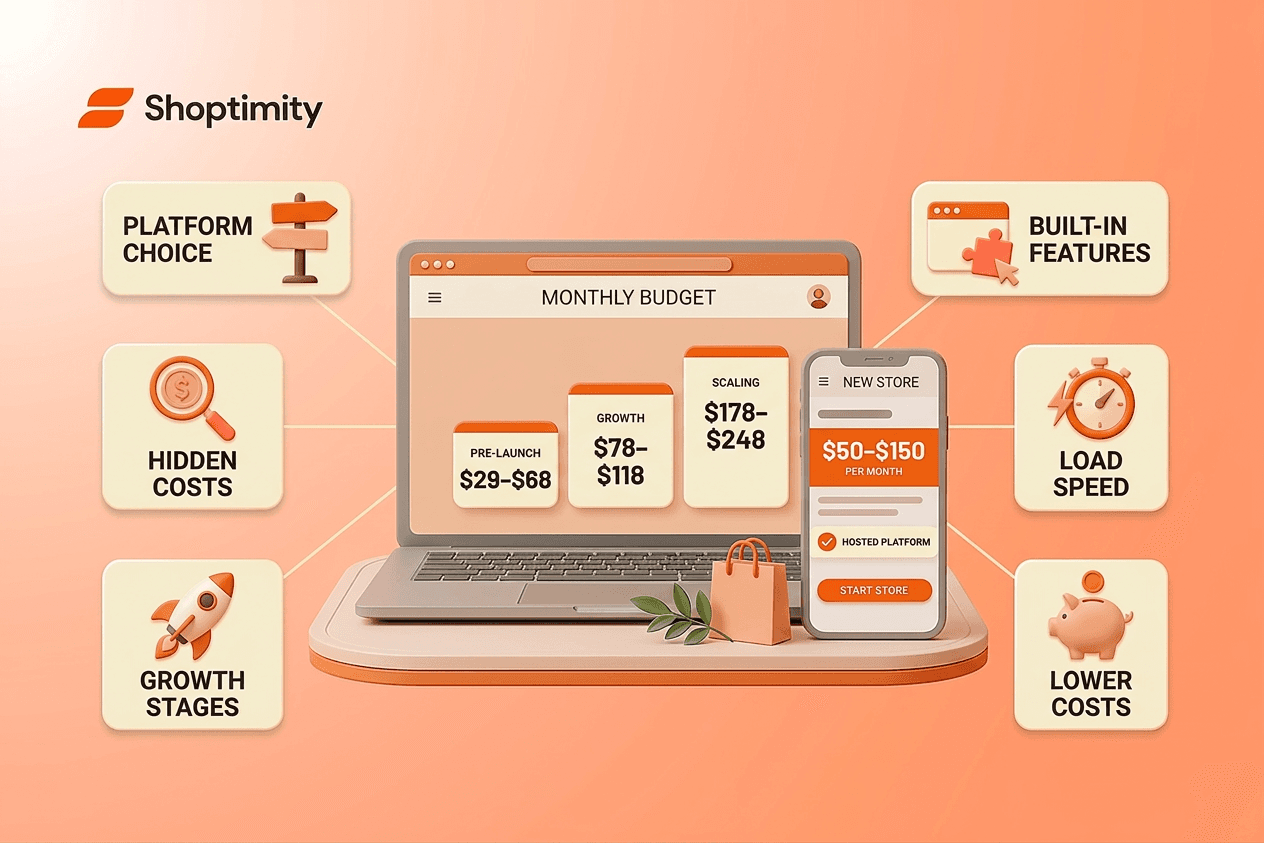
How Much Does It Cost to Create an Online Store in 2026?
The price to start an online store ranges wildly: anywhere from under $100 to $250,000 or more. But ...
Shopify Widgets for High-Ticket Dropshipping: Build Trust and Boost Conversions in 2026
You've found a premium supplier, sourced inventory priced between $500 and $5,000, and launched your...
From Prompt to a Real Shopify Theme: How AI Theme Generation Works in 2026
Every day your storefront stays unfinished costs you sales. A premium furniture brand loses two week...