
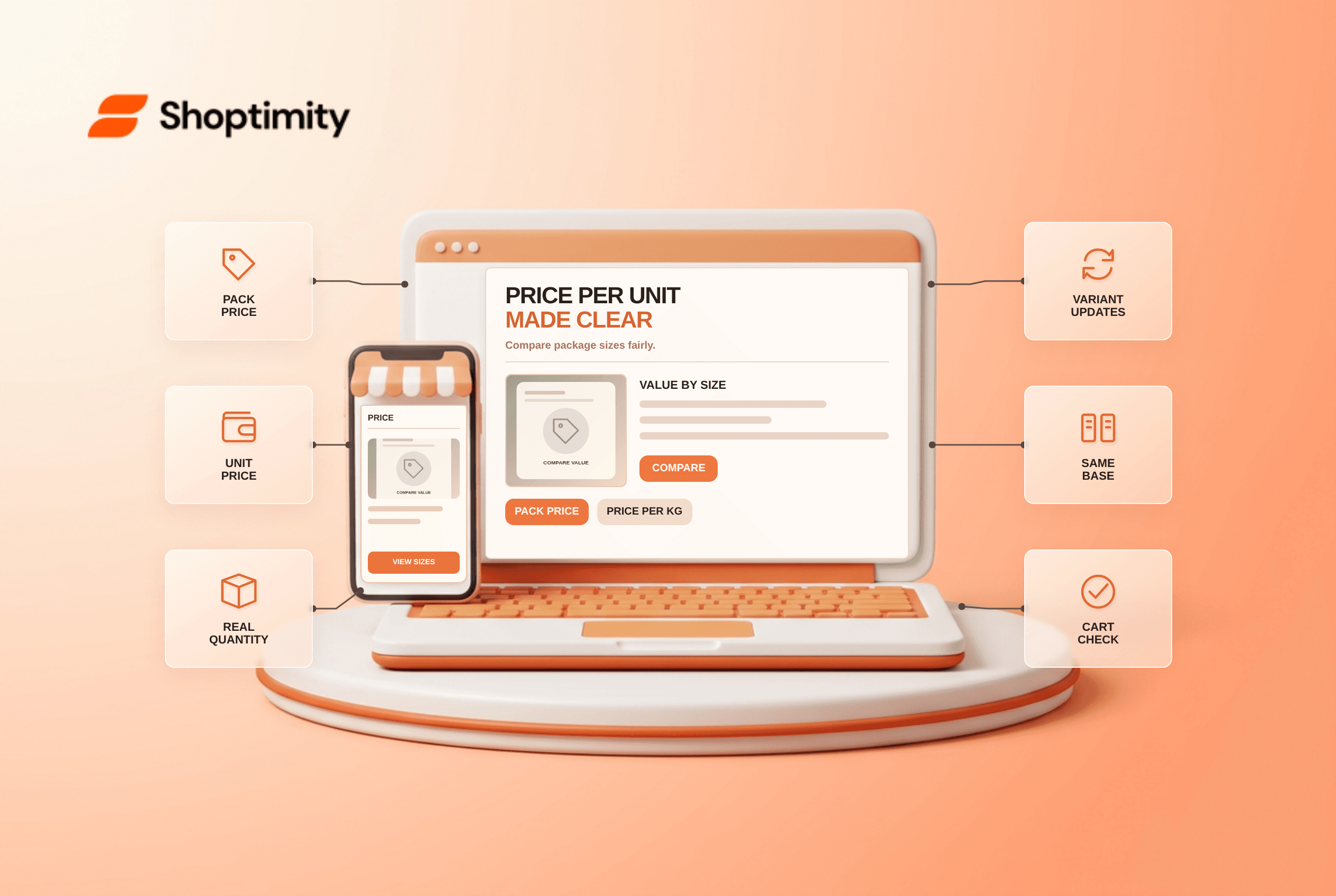
Price per unit shows the cost of a consistent amount, such as a kilogram, litre or individual item, alongside the total price of a package. It helps shoppers compare unlike pack sizes without doing arithmetic in their heads. Calculate it from each sellable variant's current price and verified contents, then display it on product and listing pages. Keep the total checkout price prominent too.
When does a price per unit help?
Use it when quantities differ across comparable items. A 500 g bag and a 1 kg bag can have similar sticker prices but different costs per kilogram. According to Baymard's product-list research, 86% of sites it benchmarked did not show unit prices for items offered in varying quantities or volumes. Its 2026 product-page guidance reports 81% did not provide unit pricing on product pages in the relevant cases. These figures come from different benchmark scopes, not a time-series comparison.
A unit price is not a reason to hide the pack price. A shopper needs to know both whether the larger size offers better value per measure and what they actually owe at checkout. Label the basis plainly: “$12 per kg” is more useful than an unexplained “$12/unit.” For multi-packs, say whether the denominator counts individual pieces or total weight. A price per “pack” is not a fair comparison if pack counts differ.
How do you calculate it accurately?
Normalize to a meaningful base measure and use the sellable contents. The formula is package price divided by package contents, multiplied by the chosen base quantity. Illustrative example: a $9 pack containing 300 g is $30 per kg; a $14 pack containing 500 g is $28 per kg. The larger pack has the lower price per kilogram but the higher cash price. These are arithmetic examples, not merchant observations.
- Record the actual net contents for each variant. Do not use shipping weight, which includes packaging.
- Choose a comparison unit that makes sense for the category, such as per kg, per litre or per item.
- Compute from the current sell price and the correct pack amount. Update when a discount or variant changes.
- Display the same basis across comparable products and label currencies and units clearly.
- Check collection cards, product pages, cart and checkout for mismatched values or stale prices.
- Confirm what happens for bundles with mixed items, subscriptions and products sold by weight; one simplistic denominator may mislead.
Shopify's unit-pricing help explains its total amount and base measure fields and says Online Store 2.0 themes display configured unit prices on product, collection, cart and checkout pages. Its documentation also notes that unit pricing can be legally required in some regions and that available display units depend on store settings. Verify your own markets' rules; this article is not legal advice.
Before launching, inspect a product that has several pack sizes and a sale-price variant. Change the selection and compare the displayed unit basis at every step. If the listing card says per kilogram but the product page shows per gram, normalize the presentation before asking shoppers to compare them.
What mistakes should you avoid?
Do not compare units with different meanings. Price per count makes sense for identical tablets; price per bottle can conceal a difference in bottle size. A concentrated detergent's price per litre may not represent cost per wash unless the dosing instructions and performance are comparable. Unit pricing is a comparison aid, not a claim that the cheapest unit always suits the customer's needs.
We checked Baymard's published research and Shopify's documentation, not your catalog or theme configuration. The limitation is that a clean visual label cannot correct wrong supplier quantities. Audit variants after pack-size changes. Shoptimity themes can present the price, while the catalog owner must maintain its inputs; review our transaction-fee guide for the separate question of merchant costs.
Ready to build a faster, higher-converting store?
Every Shoptimity theme ships with conversion widgets built in — so you get speed and features without stacking apps.
7-day free trial · all themes included · cancel anytime
Continue Reading
Shopify B2B Company Locations: Give Buyers the Right Access
Configure Shopify B2B company locations, verify buyer permissions and test pricing, addresses and pa...
Shopify Checkout Contact Settings: Separate Email From Shipping Phone
Configure Shopify checkout contact settings and test email, phone and shipping address requirements ...
Shopify POS Recent Carts: Share a Sale Without Reserving Stock
Learn how Shopify POS recent carts work across devices, what they do not reserve, and how to hand of...