
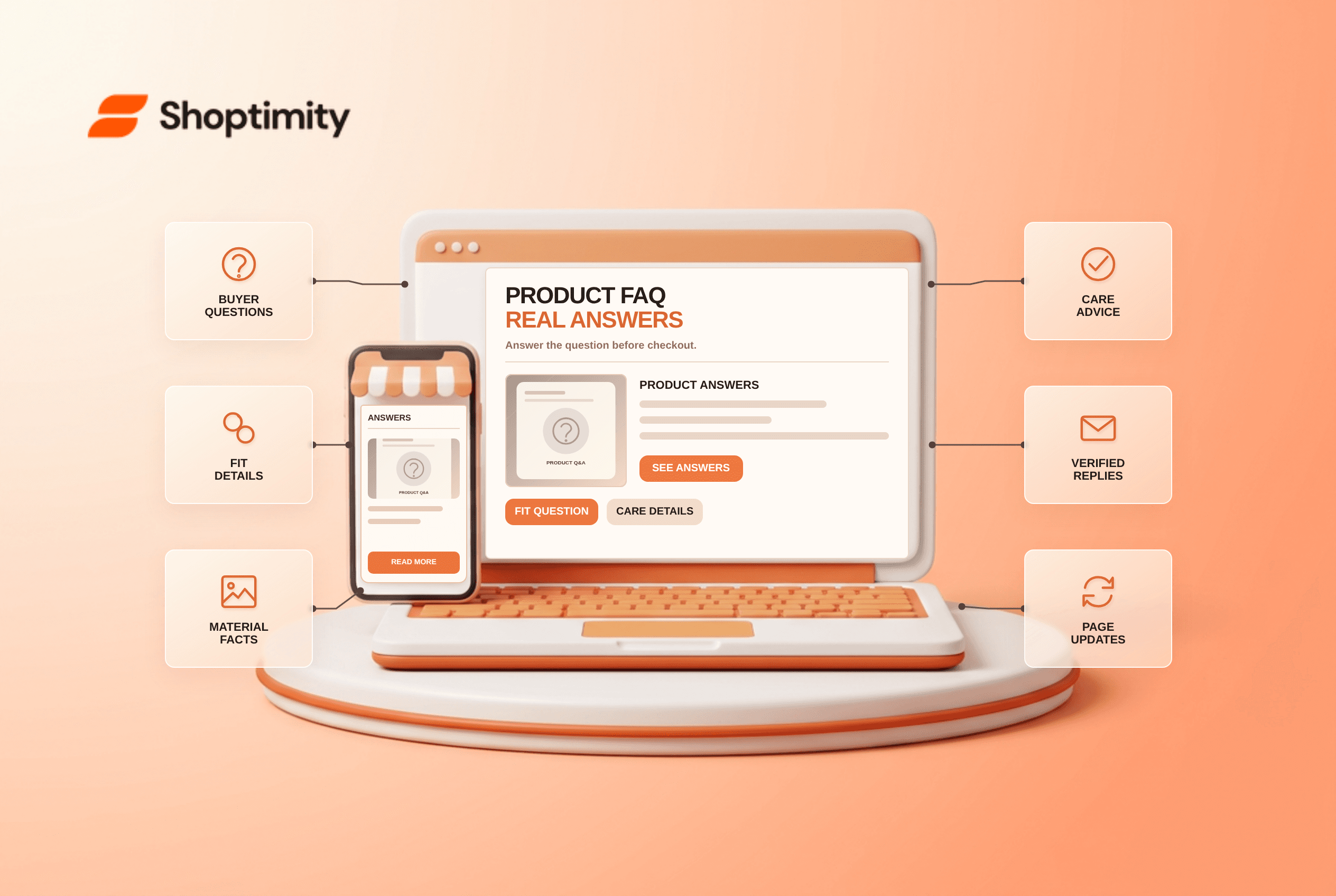
A product page FAQ should resolve the questions that prevent a purchase for that specific item. Put verified answers about fit, compatibility, materials, care and delivery near the relevant product details. Separate merchant-written answers from customer Q&A, keep the information consistent with variants and policies, and update it when the product changes. Its purpose is better buying information, not an automatic search-result feature.
Which questions belong on a product page FAQ?
Use questions that change a decision, not generic filler. According to Baymard's research on product-page FAQ and Q&A, a structured FAQ lets brands answer recurring product questions while customer Q&A can cover unexpected details. A materials question about a particular jacket belongs near that jacket; an account-password reset belongs in support. Do not add “Why are we the best?” because it is easy to write.
We checked Baymard's public research and Google's Search documentation updates while preparing this guide. Google records that FAQ rich results stopped appearing in Search on 7 May 2026 and removed its FAQ rich-result documentation in June 2026. That removes the old incentive to mass-produce FAQ schema for extra SERP space. A useful answer can still serve a shopper, but an accordion is not a ranking guarantee.
How do you build a FAQ from real evidence?
Start with customer language and verify every answer with the team responsible for the product. A simple editorial loop keeps the section useful:
- Export support questions, on-site search terms and product reviews for one SKU family, subject to your consent and privacy rules.
- Group variants of the same question, such as “Will this fit a 15-inch laptop?” and “Does it hold my computer?”
- Confirm dimensions, compatibility and care against current supplier specifications or physical samples. Avoid guessing from a photo.
- Write the answer first, then add conditions: “Fits devices up to 35 cm wide in the main sleeve” is more actionable than “spacious.”
- Link to the exact size guide, shipping policy or compatibility chart where longer detail is necessary. Do not copy a vague policy paragraph into every product.
- Recheck the FAQ when variants, materials, shipping rules or suppliers change. Assign an owner for the update.
This is an editorial method, not a claim that we analyzed Shoptimity customer tickets. If your support team has no repeated questions yet, publish the most important verified specifications first and wait for real queries before adding an elaborate FAQ.
Which format works for specifications and Q&A?
Use each format for a different job. A specification list answers factual attributes such as weight, size and fabric composition. A product page FAQ explains conditional questions: “Is the cover machine washable?” A customer Q&A thread captures a customer's wording and the merchant's response, with moderation for personal data and outdated claims. Keep an authoritative answer when community replies conflict.
A downside of a long accordion is that it hides critical information. If compatibility determines whether the product works at all, show it in the primary description and repeat the answer in a short question only if that helps scanning. A theme can render the section, but it cannot certify the answer. Explore Shoptimity themes for layout, and read our theme-versus-app guide before installing a Q&A widget.
How do you measure usefulness without promising rankings?
Look for fewer repeated clarification requests and better-informed purchase decisions. Review support conversations by SKU after the change; check whether shoppers still ask the same question. Examine whether returns cite wrong fit or compatibility. Search Console impressions and queries can inform edits, but seasonal demand and other page changes make a simple before-and-after ranking claim weak evidence.
The bottom line: write only questions you can answer accurately. Keep policy-level answers in a shared source so they do not drift across hundreds of pages. Do not mark up questions that are absent from the visible page or claim FAQ rich-result eligibility in 2026.
Ready to build a faster, higher-converting store?
Every Shoptimity theme ships with conversion widgets built in — so you get speed and features without stacking apps.
7-day free trial · all themes included · cancel anytime
Continue Reading
Top Shopify Theme for Wholesale: A 2026 Buyer's Guide
You've just spent weeks sourcing inventory and building supplier relationships. But when you launch ...
Ecommerce Return Status Updates: Separate Request and Refund
Ecommerce return status updates should separate request, label, receipt, inspection and refund so sh...
Ecommerce Delivery Delay Updates: Show the New Reality
Ecommerce delivery delay updates should replace stale promises with a dated revised estimate, clear ...