
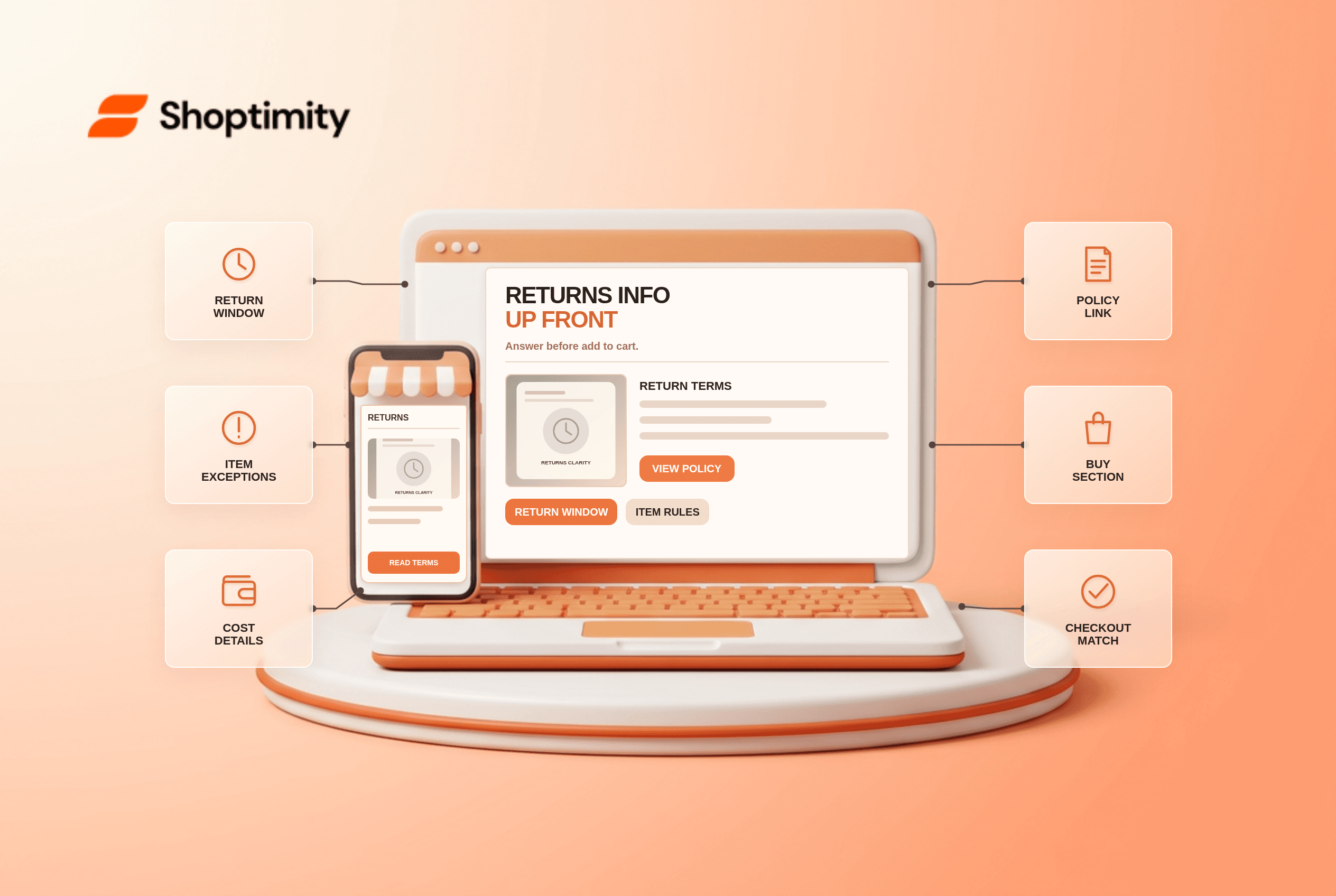
A return policy on a product page should answer whether the item can be returned, how long the customer has, and what conditions or costs apply. Show a short, accurate summary near the buying decision with a direct link to the full policy. Call out item-specific exclusions before checkout. A generic “easy returns” badge does not explain who pays for return shipping or whether this product qualifies.
What should the product page say?
Start with the facts that change a purchase decision. A concise block can state the return window, the item's eligible condition, return method and any known fee. If personalisation, hygiene or final-sale rules apply, show them on the specific product. Do not replace your full policy; provide a link with a descriptive label, such as “Returns and refunds,” so shoppers can read the details.
According to Baymard's 2026 product-page UX research, 60% of surveyed users looked for return-policy information on the product page, and 44% of benchmarked sites did not display or link to it from the main product-page content. These are Baymard's surveyed and benchmarked groups, not outcomes measured for Shoptimity.
How do you make the summary accurate?
Map policy rules to actual product types before writing the design. We checked Baymard's public study and Google's merchant-return-policy documentation, not your store's legal terms or individual SKUs. Use this review sequence:
- Identify the current policy owner and the single canonical full-policy page.
- List product types with exceptions: personalised goods, clearance items, large furniture, digital products or hygiene-sensitive categories, if applicable.
- Confirm when the clock starts, which conditions qualify, and who pays for labels or collection.
- Write a short summary that matches the full terms. Replace vague “hassle-free” language with a real condition where possible.
- Place the summary near the buy controls and repeat a clear policy link in the footer for shoppers who expect it there.
- Test the product page, cart and checkout for contradictions, including mixed baskets with different return rules.
- Assign a review date and update storefront wording whenever the merchant's actual policy changes.
Baymard's footer research notes that some shoppers look in the footer for policy links even when return information is already present on a product page. Offer both routes. A footer link is not an excuse to bury an important product-specific exception below hundreds of items.
What about return-policy structured data?
Markup does not replace visible customer-facing terms. Google's MerchantReturnPolicy documentation recommends defining a broadly applicable return policy under Organization; product-specific nonstandard terms can be specified under the offer. It also supports fields for return window, methods and fees. Only publish details that match the actual policy and market.
The limitation: rules and statutory rights vary by country, so this article is a content and UX checklist, not legal advice. A merchant may need market-specific conditions. Shoptimity themes can position a summary next to a product, but the merchant owns policy accuracy. For a different workflow, see our theme-versus-app guide before adding a returns widget.
How do you evaluate the change?
Look for fewer unanswered policy questions, not a promised conversion gain. Review support contacts asking “Can I return this?” and audit pages where exceptions were missed. If returns or sales shift afterward, account for season, stock and policy changes. Our advice is to correct conflicting terms before optimizing a badge's color.
Ready to build a faster, higher-converting store?
Every Shoptimity theme ships with conversion widgets built in — so you get speed and features without stacking apps.
7-day free trial · all themes included · cancel anytime
Continue Reading
Top Shopify Theme for Wholesale: A 2026 Buyer's Guide
You've just spent weeks sourcing inventory and building supplier relationships. But when you launch ...
Ecommerce Return Status Updates: Separate Request and Refund
Ecommerce return status updates should separate request, label, receipt, inspection and refund so sh...
Ecommerce Delivery Delay Updates: Show the New Reality
Ecommerce delivery delay updates should replace stale promises with a dated revised estimate, clear ...