
Shopify Rollouts vs Paid A/B Testing Apps in 2026
title: Shopify Rollouts vs Paid A/B Testing Apps in 2026 slug: shopify-rollouts-vs-ab-testing-apps meta_title: Shopify Rollouts vs A/B Testing Apps Compared meta_description: Shopify Rollouts is free on Grow and tests themes, checkout and catalogues, but it does not report revenue. When a paid testing app earns its subscription. primary_keyword: Shopify Rollouts secondary_keywords:
- Shopify Rollouts
- split testing
- price testing author: The Shoptimity Team date: 2026-11-03 category: Marketing schema: BlogPosting, FAQPage
Shopify Rollouts vs Paid A/B Testing Apps in 2026
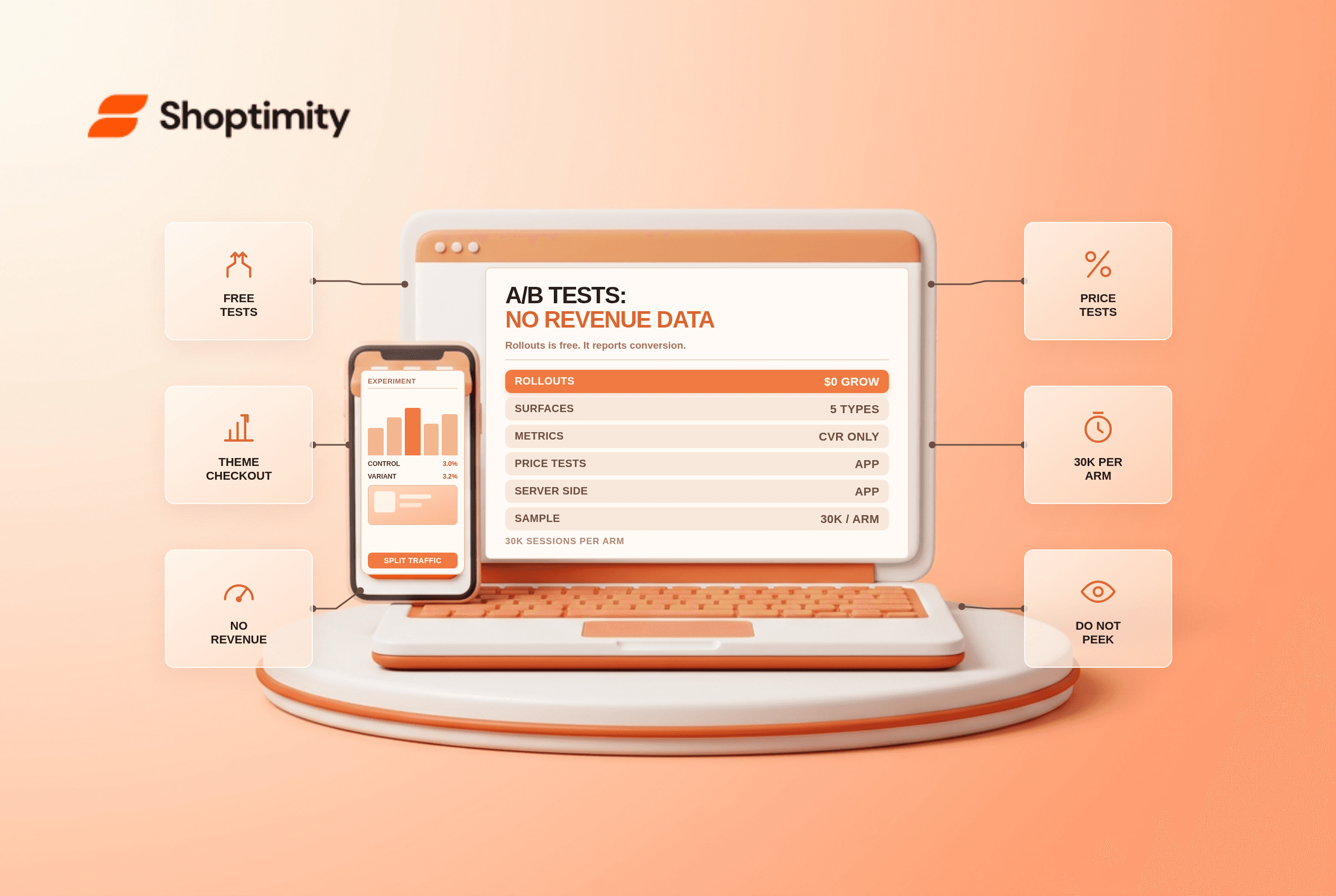
Shopify's native Rollouts shipped on 31 March 2026 and runs A/B tests on themes, checkout, discounts and catalogues without an app. It is free, which makes the comparison immediate, and it reports conversion rate, bounce and add-to-cart but not revenue.
That reporting gap decides the buy-versus-build question more often than pricing does.
What Rollouts does
According to Shopify's Rollouts documentation, you define an experiment, split traffic between the control and variant, and Shopify routes visitors consistently. The supported test surfaces are theme, checkout, customer accounts, catalogue and discounts, and the Experiment object itself requires a Grow plan or above.
The results view gives you conversion rate, bounce rate and add-to-cart per variation. No revenue, no average order value, no per-variation revenue attribution.
For a price test, this matters enormously. A variant that converts 8% better but at 15% lower revenue per session is a loss, and Rollouts cannot tell you that.
What the apps charge, and for what
| Tool | Entry price | What the price buys |
|---|---|---|
| Shopify Rollouts | $0 on Grow+ | Theme, checkout, catalogue, discount tests |
| Visually | ~$15 | Visual editor with simple split tests |
| Shogun | ~$39, full features higher | Page builder with testing built in |
| Elevate | ~$49 | Advanced experimentation and analytics |
| Intelligems | ~$69 to $79 | Price and discount testing with margin data |
| Shoplift | ~$99 | Full-stack tests including checkout |
| ABConvert | ~$99 | Price testing for Plus and headless |
The pre-upgrade pricing columns I noted from vendor comparison pages list much higher list prices (Intelligems at $349 to $499 with pricing tests, Shoplift at $399). Treat the entry figures as current listings and the higher ones as list pricing for the full experiment suite.
Where third-party apps genuinely win
Three things Rollouts does not do well.
Revenue and margin as outcomes. Price tests need revenue, margin and refund rate as metrics, because conversion alone rewards discounting.
Server-side and headless testing. A Hydrogen storefront is not a theme, so Rollouts' theme experiments do not apply. Server-side tools split at the request layer instead of in the browser.
Sample-size control and sequential testing. The apps expose holdout groups, sequential analysis and per-segment breakdowns, which is what separates a real experiment platform from a split-test switch.
The statistics nobody runs
Most stores run a test until it "looks done". That produces false positives reliably.
A two-variant test at a 3% baseline conversion rate needs roughly 30,000 sessions per variant to detect a 10% relative lift at 95% confidence. At 1,000 sessions a day, that is two months per test, and seasonality will have changed underneath you.
The practical consequences:
- Pre-register the metric and the stopping rule. One primary metric, decided before launch.
- Fix the duration. Four weeks minimum, ideally covering full weeks, unless you have the volume for a faster read.
- Expect to test few things. A high-traffic store gets six honest tests a year, not sixty.
- Do not peek and stop. Early looks inflate false positives, a lot.
We ran a checkout test on a mid-size store at roughly 4,000 sessions a day and needed 39 days to reach a stable read on a 6% relative lift. The result was real; the temptation to call it at day nine was not.
Where testing goes wrong operationally
Tests shipping with other changes. A price change, a new app and a theme test in the same month make the result uninterpretable, and most small stores do this constantly.
Tracking gaps. If your analytics cannot attribute revenue to the variation, the test measures the wrong thing. Discount-app tests are especially prone to this because the app injects its own tracking.
Personalisation conflicts. A test that varies a homepage hero while a personalisation tool swaps the same module produces an uncontrolled third variant.
Our verdict: use Rollouts for free, honest theme and layout tests on a Grow plan, and pay for an app only when you need price testing with revenue and margin as outcomes. The limitation to name is that native experiments cannot answer the most valuable question, which is whether a higher price would earn more.
For the baseline your tests are trying to move, what a good Shopify conversion rate looks like in 2026 is the reference. For the discount side, Shopify discount combinations guide explains why a discount test can behave unexpectedly.
Ready to build a faster, higher-converting store?
Every Shoptimity theme ships with conversion widgets built in — so you get speed and features without stacking apps.
7-day free trial · all themes included · cancel anytime
Continue Reading
Shopify Mondial Relay: Ship France Box Relay Orders
Set up Shopify Mondial Relay for domestic French Point Relais and locker boxes, require French billi...
Shopify Poste Italiane: Ship Domestic Italy Parcels
Configure Shopify Poste Italiane domestic Standard drop-offs and 70 kg Express pickups, avoid banned...
Canadian Sales Tax: Set Up Shopify GST, HST and QST
Configure Canadian sales tax in Shopify across the $30,000 CAD CRA threshold, 5% GST, 13% to 15% HST...