
The Hidden Cost of Shopify Apps: Stop Overpaying
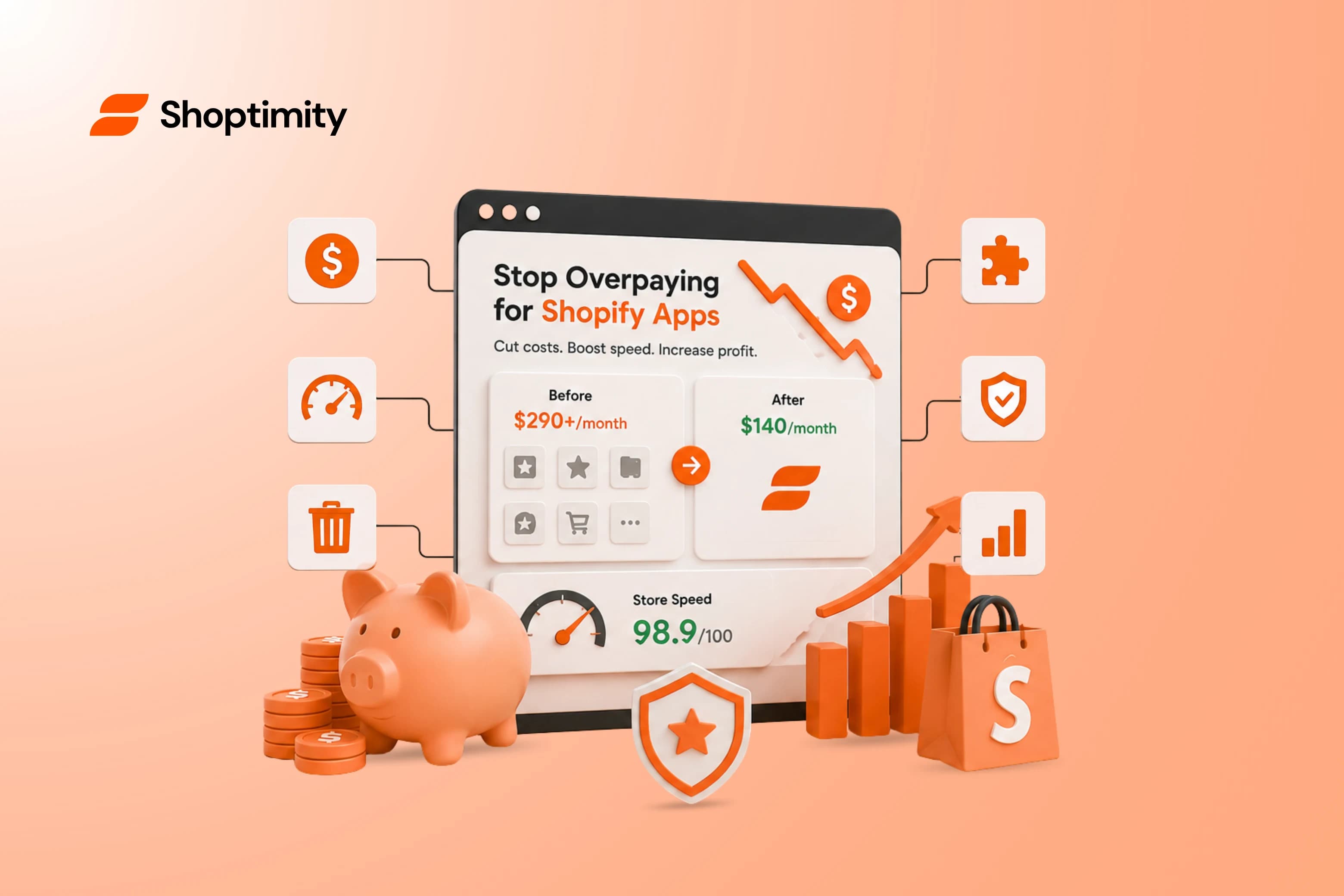
You sign up for Shopify at $39 a month. Fast forward a year, and you are staring at a monthly bill of $290. The core platform fee did not change. The creeping cost of Shopify apps is what blindsides most store owners. These small, incremental monthly charges quickly pile up until they become the single largest operating expense in your tech stack.
- The average store installs 6-8 paid apps, costing $200 to $500 every month.
- Custom app development ranges from $5,000 to $100,000 depending on complexity.
- Auditing your tech stack can cut these monthly expenses by up to 50 percent.
- Consolidating features into a robust theme eliminates the need for expensive third-party subscriptions.
What Is the Real Cost of Shopify Apps?
Before you start tearing down your store setup, you need to know what normal looks like. Standard public apps in the Shopify ecosystem typically range from $5 to $100 per month. Most of these rely on a tiered billing structure. They hook you with a cheap starter tier, then force you into higher brackets as your store generates more orders or traffic.
The real issue is volume. Very few stores run on just one or two add-ons. Recent data shows that the average Shopify store installs 6-8 paid apps. This pushes the actual monthly spend for most merchants to between $200 and $500.
Those numbers only represent the direct financial cost of shopify apps on your monthly statement. There is also a severe performance cost. Every third-party app you install injects external scripts into your storefront. These scripts slow down your page load speed, which directly harms your conversion rate and user experience.
The cost of Shopify apps isn't just a flat platform fee; it is a compounding operational expense that grows as your store scales.
The Hidden Subscriptions Killing Your Margins
The app ecosystem is designed to solve hyper-specific problems. You need one tool for quantity breaks, one for a sticky cart, another for product reviews, and one more for cross-selling. Before you know it, you are managing a dozen different shopify app subscriptions.
This fragmentation quietly drains $50 to $200 a month from basic profit margins, as noted in Rovela's insights on hidden ecommerce bills.
Say you run a Shopify store selling custom apparel. You add an upsell app for $29 a month, a reviews app for $49 a month, and a specialized page builder for $99 a month. That single combination costs you over $2,100 a year. This money comes straight out of your net profit before you even pay for shipping, inventory, or ad spend.
Every app you install chips away at your net profit margin before you ever make a sale.
Build vs. Buy: The True Cost of Custom Apps
Some brands get tired of paying monthly fees and decide to build their own private apps. This gives you complete ownership of the code and removes the monthly subscription tax.
However, the upfront investment is staggering. A basic custom app costs between $5,000 and $10,000 to develop. Medium-level custom builds sit at $10,000 to $30,000. If your store requires complex workflows or deep third-party integrations, those costs can easily surge past $100,000.
Custom builds also require ongoing maintenance. When Shopify updates its API, you have to pay a developer to patch your app. If you decide to update your site architecture during this process, make sure you know How to Change Shopify Themes Without SEO Drop to protect your organic traffic.
Custom app development eliminates recurring subscriptions but replaces them with a massive five-figure upfront investment.
How to Reduce Your Shopify Monthly Bill
You do not have to choose between a slow site loaded with $500 worth of apps or a $30,000 custom build. You just need to stop paying for tools that should be native to your storefront.
The first step is a ruthless audit. Go through your app list and delete anything that does not directly contribute to revenue or fulfillment. Most stores can immediately shed 20 percent of their app costs just by removing abandoned tools.
The next step is consolidation. Instead of paying a separate monthly fee for a sticky cart, quantity breaks, and countdown timers, you can move these functions to the theme level.
This is where Shoptimity completely changes the math. For a single subscription of $19 a month (or $160 a year), you get access to all Shoptimity themes built natively on Online Store 2.0. These themes include over 30 built-in conversion tools. You can literally cancel your expensive upsell, cart timer, and bundle apps today. Because everything is built into the native architecture without legacy liquid files or bulky external scripts, stores using Shoptimity routinely hit a 98.9 Speed Score.
Consolidating your conversion tools into a feature-rich theme is the fastest way to reduce your Shopify monthly bill by 40 to 50 percent.
Ready to build a faster, higher-converting store?
Every Shoptimity theme ships with conversion widgets built in — so you get speed and features without stacking apps.
7-day free trial · all themes included · cancel anytime
Continue Reading
Why Most Shopify Widgets Will Break Your Store In 2026
August 26, 2026 is approaching fast. Many non-Plus stores still rely on custom tracking code or lega...
AI Shopify Theme Builder: How to Build a Store in Minutes
Seventy percent of retail executives plan to implement AI tools this year. Today, that shift is no l...
How to Scale Conversions with an AI Shopify Theme Store Builder
Seventy percent of retail executives plan to implement artificial intelligence tools in 2024 to stay...