
Which Shopify Plan Do You Actually Need? Basic vs Grow vs Advanced
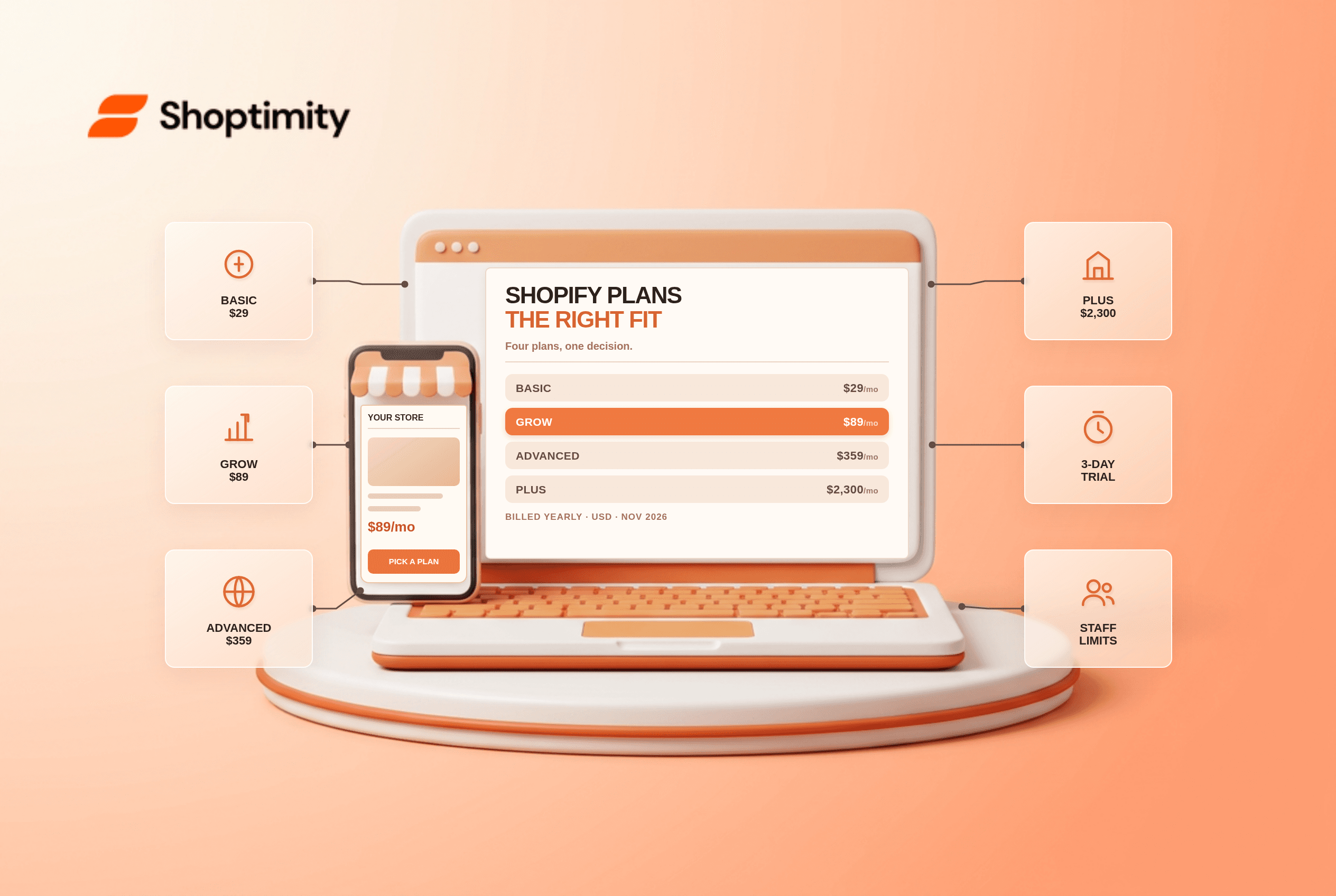
The right Shopify plan is the cheapest one that clears five hard limits: staff accounts, inventory locations, third-party transaction fee, B2B catalogs and checkout customization. In 2026 that is Basic at $29 a month for a solo seller, Grow at $89 once you add staff, and Advanced at $359 only when the fee or the checkout changes your math.
What does each Shopify plan cost in 2026?
Shopify lists four main plans, and the monthly figures are the ones most merchants quote. Paying yearly is cheaper across the first three tiers.
| Plan | Monthly | Yearly | Built for | Card rate (online) |
|---|---|---|---|---|
| Basic | $39 | $29 | Solo entrepreneurs | 2.9% + 30¢ |
| Grow | $105 | $89 | Small teams | 2.7% + 30¢ |
| Advanced | $399 | $359 | Global reach | 2.5% + 30¢ |
| Plus | from $2,300 | quote only | Complex businesses | 2.25% + 30¢ |
According to Shopify's own pricing page, those are the current rates, checked on 2 November 2026. Treat them as a snapshot: Shopify changes plan names and rates more often than its documentation suggests, and regional pricing differs. Plus has no yearly rate at all, which is why the table leaves that cell empty rather than inventing one.
The yearly column is where most of the saving sits. Basic drops 26% when billed yearly, Grow drops 15%, Advanced drops 10%. The discount shrinks as the plan gets more expensive.
What is included on every plan?
Every tier includes the full online store, unlimited products, hosting, SSL, the checkout, email campaigns, customer segments, discounts, gift cards and markets. That is a longer list than most comparison posts admit, and it is the reason a new store rarely needs anything above Basic.
Shopify also includes what it calls Sidekick, its AI assistant, plus website building and a monthly AI token allowance, on all four plans. None of that is a reason to upgrade.
When does Basic stop being enough?
Basic stops working when a second person needs admin access, because it ships without additional staff accounts. Grow adds five, Advanced adds fifteen, and Plus removes the cap.
Basic also caps you at 10 inventory locations, 3 B2B catalogs, limited checkout customization and standard API rate limits. The plan comparison table lists each of those in one place, which is faster than reading four feature pages.
A solo seller with one location and under 50 products will not hit any of these edges. A two-person team hits the staff limit on their first hire.
Which limit actually pushes a store up a tier?
In our experience the staff limit is what triggers an upgrade, while the third-party transaction fee is the limit that actually costs money. Run this audit before you pay for anything.
- Count the people who need their own admin login. Two or more takes you to Grow.
- Count warehouses, pop-ups and stockrooms. Past 10 locations, you need Plus rather than Advanced.
- Check whether you use a payment provider outside Shopify Payments. On Basic that adds a 2% third-party transaction fee on top of the processor's own rate.
- Check whether you sell wholesale. More than 3 B2B catalogs means Plus.
- Check whether checkout needs to change. Anything beyond the limited customization on Basic and Grow means Plus.
The staff limit is cheap to fix: Grow costs $60 more a month than Basic on monthly billing. The third-party fee is proportional to revenue, so it can dwarf the plan difference on a busy store. If you are not sure which side of that line you sit on, the transaction fee breakdown is worth ten minutes before you switch.
Does the upgrade pay for itself?
The plan fee only pays for itself when the limit it removes costs more than the difference. That is arithmetic you can do with your own numbers.
| Move | Extra per month | Break-even test |
|---|---|---|
| Basic to Grow | $66 monthly, $60 yearly | one extra staff login justifies it; the 0.2% card rate cut is a bonus |
| Grow to Advanced | $294 monthly, $270 yearly | $147,000 in monthly card volume just for the rate cut to cover the fee |
| Advanced to Plus | $1,901 and up | B2B catalogs, checkout customization or 200 locations, never the fee |
The Grow to Advanced gap surprises people. A 0.2% card-rate improvement has to ride on roughly $147,000 of monthly card volume before it returns the $294 difference. Most stores that upgrade from Grow do it for the fifteen staff accounts or the third-party shipping rates, not for the rate.
Where the plan fee sits in the real bill
The subscription is usually the smallest line in a Shopify bill, and merchants consistently overestimate how much of their spend it represents.
Apps are the line that grows on its own. A review app, an upsell app, a bundles app and a sticky cart add up quickly, and each one also adds weight to the storefront. Our own breakdown of the true monthly cost of a Shopify store puts a small-to-mid store at $60 to $300 a month all in, with apps driving most of the spread.
That matters for this decision. Moving down a plan and paying for four apps is usually more expensive than staying put, and moving up a plan while still running every app is worse. If you are carrying a stack of paid widgets, the app cost breakdown shows where the money actually goes.
What Shopify's free trial does and does not include
The trial is three days free, then $1 a month for three months on the paid plans. It runs the full platform, so you can test checkout, themes and apps on real products rather than a locked demo.
Two limits are worth knowing before you plan around it. The promotional rate ends, and the plan you picked is the plan you keep paying for, so starting on Advanced to "try everything" quietly sets an expensive default. Shopify also sells a separate POS Pro add-on at $89 a month per location, which is not part of any online plan.
There is no permanent free plan. The cheapest ongoing option is the Basic plan billed yearly, and the $1 promotion is the cheapest three months you will ever get.
Who should not upgrade yet
Most stores that ask this question should not move up a tier. Stay where you are if none of the five limits are biting.
Do not upgrade for the card rate alone. Do not upgrade because a plan comparison page makes Advanced look professional. Do not upgrade to unlock a feature you have not tested on a development store first, where it costs nothing.
The genuine limit on the cheap plans is checkout. If your store needs a customized checkout, no amount of app spending will get you there, and Plus is the only route. That is a real reason to upgrade and it is the one case where the price is not the deciding factor.
Ready to build a faster, higher-converting store?
Every Shoptimity theme ships with conversion widgets built in — so you get speed and features without stacking apps.
7-day free trial · all themes included · cancel anytime
Continue Reading
Shopify B2B Company Locations: Give Buyers the Right Access
Configure Shopify B2B company locations, verify buyer permissions and test pricing, addresses and pa...
Shopify Checkout Contact Settings: Separate Email From Shipping Phone
Configure Shopify checkout contact settings and test email, phone and shipping address requirements ...
Shopify POS Recent Carts: Share a Sale Without Reserving Stock
Learn how Shopify POS recent carts work across devices, what they do not reserve, and how to hand of...