
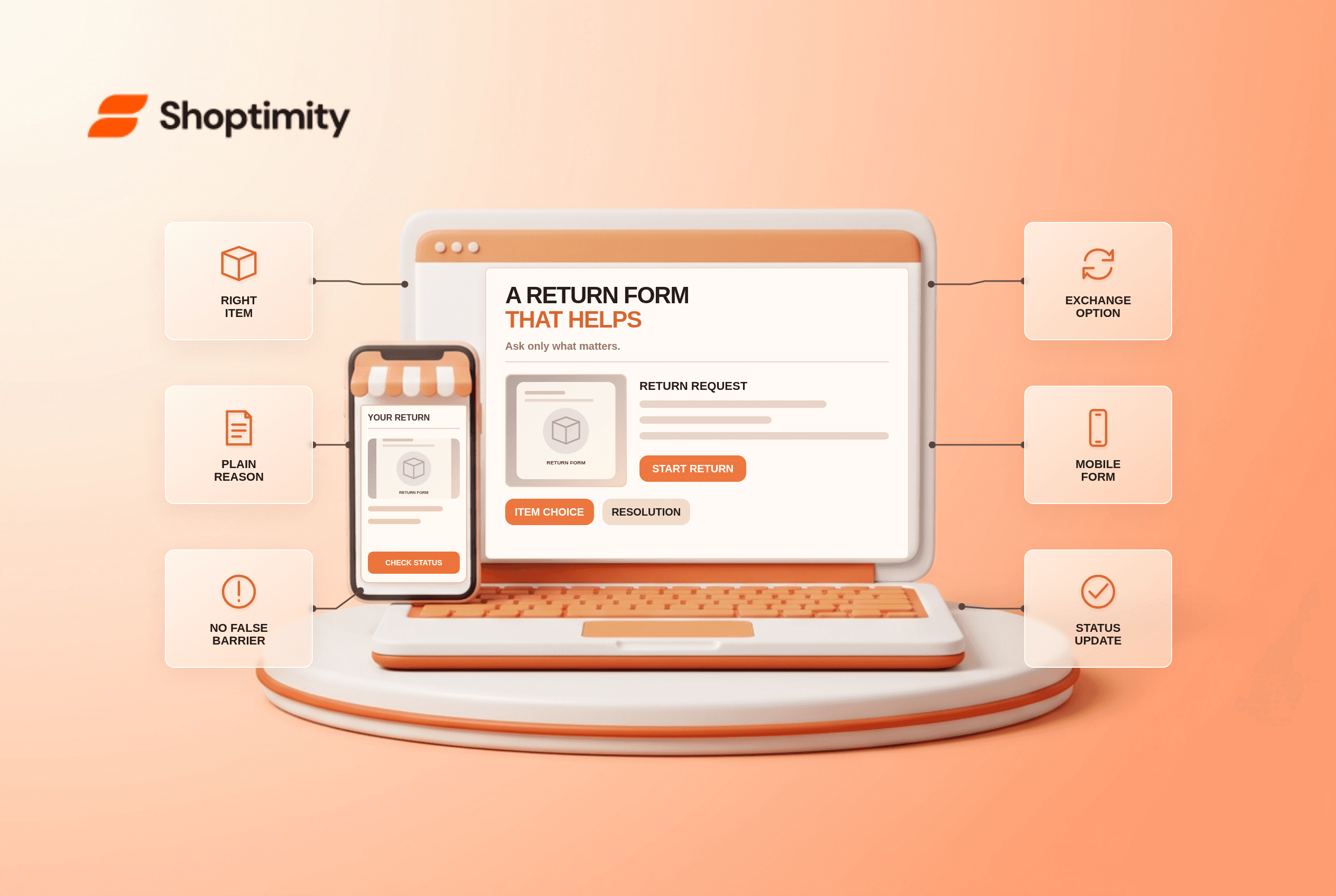
Ecommerce return reason form should answer the buyer's actual decision, not just decorate a page. Ask for the item, quantity, reason and desired resolution only when those answers drive actual next steps. The right presentation depends on the merchant's product data and operating rules. Treat the checks below as a test plan, not a promise that Shoptimity or a theme can implement every backend behavior by itself.
What does the evidence say about ecommerce return reason form?
The useful takeaway is a clear, testable customer answer. According to Baymard’s order-returns research, 54% of the large sites it benchmarked had substantial usability issues in their returns flows. This is not a measured failure rate for a particular reason dropdown.
Baymard’s in-store returns study reported 20% of tested users preferred returning an item directly to a store. When that option is available, a reason form should not bury it behind an unrelated mail-return path.
What should the interface say first?
Show the essential fact before a shopper reaches an irreversible step. Ask for the item, quantity, reason and desired resolution only when those answers drive actual next steps. Use plain choices such as “wrong size,” “damaged” and “not as described,” plus “other” and an optional explanation. Do not require a photo for every reason if the policy does not require one. Show the eligibility and shipping cost before final submission.
A customer wants to exchange one shirt in a two-item order. The form should preserve the other item, allow a size selection if stock exists and say what happens if the exchange is unavailable. A generic mandatory “upload photos” gate makes little sense for a shirt that simply does not fit.
How should a merchant test the flow?
Test a real edge case, not only the happy path. Run these checks on a product, cart and mobile device that reflect the catalog and workflow:
- Start a return for one item in a multi-item order.
- Test damage, wrong size, gift return and unknown reason paths.
- Verify required evidence matches the written policy.
- Display refund, store credit or exchange choices only when eligible.
- Show label cost, drop-off method and next update before submission.
- Keep the request and status visible in the customer account or guest link.
What breaks when information is missing?
A confident-looking interface can still make a false promise. If an item is outside the return window, give the relevant policy reason and a support path instead of silently disabling the button. For faulty products, jurisdiction-specific remedies may differ from a voluntary returns policy; send policy claims for legal review. Do not treat a submitted request as an approved refund.
A team should record who owns the source data and which event updates the customer-facing message. Test a changed selection or an unavailable option after the first screen has loaded. If a requirement cannot be met by a theme alone, route the change through the commerce platform, inventory service, fulfillment system or payment provider as appropriate.
How does this fit into a Shoptimity storefront?
Start with reliable information and then improve presentation. Shoptimity themes can help present storefront content, but operational rules may live elsewhere. See our return policy on product pages and order tracking checklist for adjacent checks. We checked the cited public research, not this merchant's analytics or implementation. We have not tested this merchant's live setup. Avoid claiming that a benchmark proves an expected conversion gain for this store.
What should be measured after launch?
Verify the actual outcome against the visible promise. Track incomplete forms, reasons requiring manual correction and customers asking whether a return was received. Audit outcome accuracy rather than only form completion. Keep a dated sample of real customer journeys, including a mobile case and one exception, for an editorial and operational review after any configuration change.
Ready to build a faster, higher-converting store?
Every Shoptimity theme ships with conversion widgets built in — so you get speed and features without stacking apps.
7-day free trial · all themes included · cancel anytime
Continue Reading
Top Shopify Theme for Wholesale: A 2026 Buyer's Guide
You've just spent weeks sourcing inventory and building supplier relationships. But when you launch ...
Ecommerce Return Status Updates: Separate Request and Refund
Ecommerce return status updates should separate request, label, receipt, inspection and refund so sh...
Ecommerce Delivery Delay Updates: Show the New Reality
Ecommerce delivery delay updates should replace stale promises with a dated revised estimate, clear ...