
How Shoptimity Increased Revenue by 50% for Activewear Brands
Activewear ecommerce demands precise execution and fast adaptation. Trends shift quickly, margins are lean, and shoppers expect a store that loads instantly, tells a clear story, and inspires trust from the moment they land.
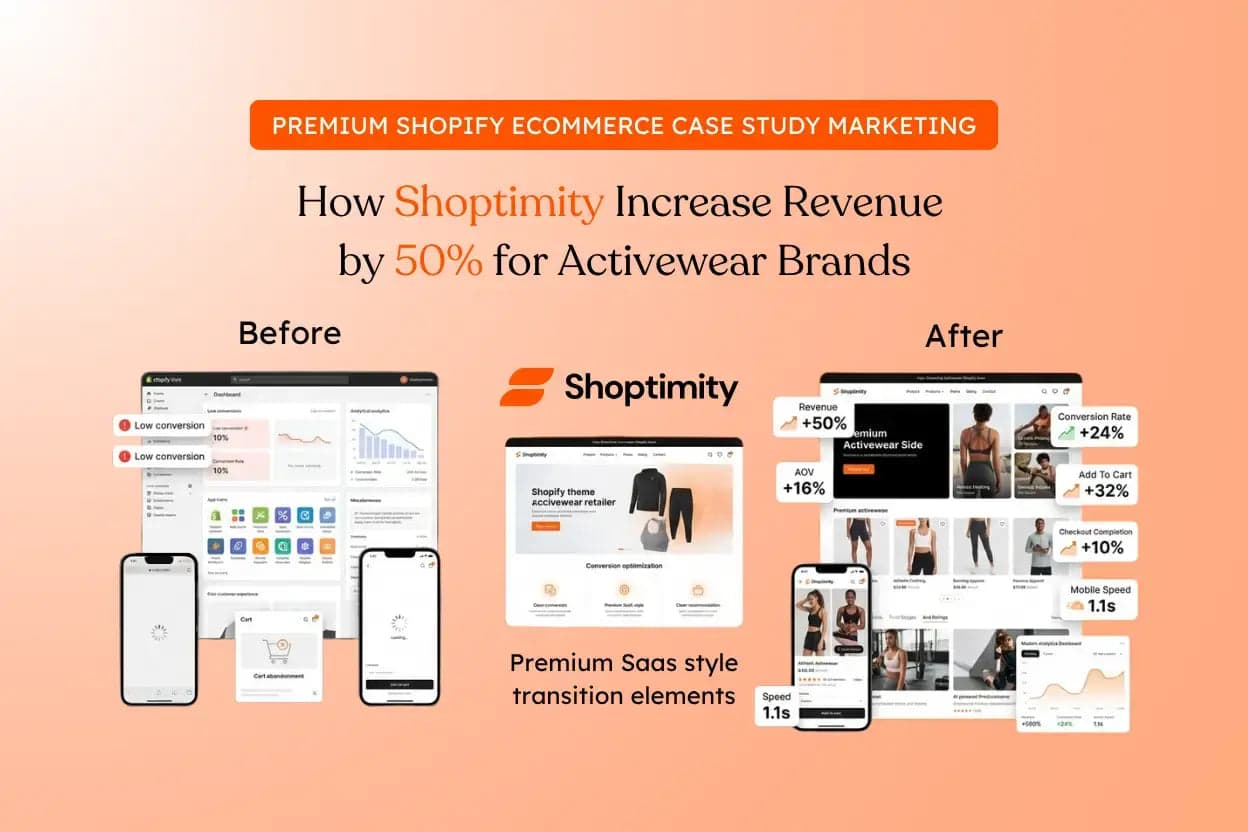
This case study details the growth of an activewear retailer that switched to Shoptimity — a premium Shopify theme designed to boost conversions — resulting in a 50% increase in store revenue in just two months, with no monthly apps, no custom code, and no recurring software fees.
While every business is unique and outcomes will vary, this example offers actionable insights for Shopify owners aiming to break through growth ceilings. The strategy focused on measurable goals: increasing conversion rate, average order value (AOV), and buyer retention — all while maintaining fast performance on every device. Shoptimity's success is built on a mobile-first approach, flexible subscription plans, 100+ built-in conversion features, and dedicated support.
Executive Summary
Activewear brands succeed when their stores convert efficiently — especially on mobile. Here, one retailer swapped a sluggish, app-heavy setup for a streamlined Shoptimity storefront, gaining higher trust and real financial returns.
What changed in the store setup and theme:
- Upgraded to Shoptimity for mobile-first layouts and built-in CRO tools.
- Removed six recurring monthly apps by activating 100+ built-in theme blocks — product bundles, reviews, countdowns, and sticky add-to-cart.
- Simplified navigation, restructured collections for easy browsing, and improved search/filter logic.
- Enhanced product pages with detail-rich sizing, fabric, and fit guides.
- Integrated live reviews, shipment transparency, and secure-checkout cues for buyer trust.
- Streamlined the cart, enabled in-cart upsells, and accelerated checkout.
Who benefits most from these insights:
🏃 Apparel & activewear stores
Shopify stores in fast-moving apparel and activewear segments where mobile shopping dominates.
🐌 App-heavy, slow stores
Merchants stifled by slow stores, unmanageable code stacks, or mounting monthly app bills.
🎯 CRO-minded owners
Owners who value strong UX, transparent upfront pricing, and effective CRO — without developer dependencies.
Why Activewear Brands Need CRO-Focused Storefronts
Activewear customers make rapid decisions — usually on their phones. Poor site experience or a lack of trust cues translates instantly to abandoned carts and lost sales.
📱 Mobile-first behaviour dominates
More than three-quarters of visitors shop via mobile, and even slight friction causes drop-off. Quick navigation and immediate product previews aren't optional — they're buying triggers.
⚡ Seasonal, fast-moving inventory
Limited releases and flash restocks are common. Simple filters and prominent new-arrival blocks increase sell-through before items are gone.
💸 Competition and ad-cost pressure
Rising ad spend squeezes profits, so every lost sale stings. High-performing stores gain more from every paid click — boosting margins and funding further growth.
The Challenge Before Optimisation
Before switching to a purpose-built theme, this store struggled with performance drains and lost revenue:
- ✕Low conversion rate. Conversion stalled below 2% despite steady traffic, and mobile users bounced before product engagement.
- ✕Weak product discovery. Navigation was cluttered and confusing, and collection pages failed to surface trending or new-release items.
- ✕Poor mobile experience. Heavy images slowed critical pages to a crawl, and add-to-cart options fell below the fold, out of sight.
- ✕Inefficient cart and checkout. A pileup of third-party cart, upsell, and checkout apps caused code conflicts, errors, and extra steps — with no easy way to present bundles or reinforce trust.
Leadership wanted a future-proof store with powerful built-in features, no hidden monthly charges, and active theme support.
What Was Changed to Drive the Revenue Lift
A strategic overhaul leveraging Shoptimity targeted every hesitation point in the funnel — from navigation to checkout. Each step was deliberate, guided by data and user feedback.
Streamlined Collection Structure
- Main menu reworked into major categories with concise dropdowns.
- Dynamic product filters delivered instant updates by size, colour, or activity type.
- "New In" and "Bestsellers" sections featured above the scroll to capture demand.
Detailed Fit and Fabric Info
- Always-visible sizing guides and contextual fit notes on desktop and mobile.
- A dedicated section for fabric composition and care to reduce pre-purchase uncertainty.
- Galleries optimised to keep colour and variant selectors always above the fold.
Reviews and Secure-Checkout Cues
- Recent verified reviews presented in a fluid, credibility-building slider.
- Secure-checkout icons and privacy badges placed adjacent to call-to-action buttons.
- Clear return and shipping language stated near purchase prompts.
Reduced Cart and Checkout Friction
- Consolidated cart to a single, fast-loading page with editable quantities and instant shipping estimate.
- Persistent add-to-cart button kept visible through scrolling.
- Accelerated checkout with autofill and fewer compulsory fields.
Built-In Upsells and Cross-Sells
- "Complete Your Kit" recommendations promoted accessories at key moments.
- Bundle offers built in, so customers saw value-driving add-ons before checkout.
- Free-shipping threshold displayed with a progress bar, nudging shoppers to qualify.
Optimised Site Performance
- Disabled all unnecessary app scripts and replaced them with theme-native blocks.
- Lossless image compression and asynchronous script loads ensured snappy transitions.
- Achieved mobile page loads under 1.2 seconds.
Mobile Optimisation and Responsiveness
- Placed all essential actions — search, filter, add-to-cart — within thumb's reach.
- Used built-in preview tools to QA every change on common device sizes.
- Kept support accessible from all pages, giving buyers post-purchase confidence.
To enact these improvements, the team relied on Shoptimity's easy-to-follow setup guide — eliminating the need for expensive external developers or agencies.
Feature, Benefit, and Impact
| Feature | Shopper benefit | Business impact |
|---|---|---|
| Mobile-first navigation and search | Immediate access to wanted products | Higher add-to-cart rates |
| Built-in, real-time reviews & trust badges | Increased confidence to purchase | Raises conversion rate |
| Prominent sizing and fit guidance | Builds comfort, decreases returns | Higher checkout rate, fewer returns |
| Contextual cart upsells and shipping progress | Greater perceived value | Lifts average order value |
| Theme-native blocks instead of paid apps | Consistent, speedy browsing | Better SEO and lower costs |
Results
Over 60 days following the Shoptimity relaunch, the retailer recorded the following outcomes — with no material change to traffic sources or marketing spend. These results reflect sitewide performance.
More checkouts combined with a larger average order value.
Reduced abandonment at the product page and checkout.
Cart bundling and better product suggestions.
Above-the-fold buttons and improved navigation.
Streamlined checkout and visible trust cues.
A massive drop in mobile drop-off.
Performance disclaimer: these numbers reflect a real use case, but results vary by business — no guarantee of future outcome is implied. Data was pulled from Shopify analytics and matched to identical traffic periods for control; advertised offers and email campaigns remained unchanged to isolate theme performance.
Mobile commerce contributed the majority of new revenue, outpacing desktop — a reflection of better responsive layouts and mobile-first site flow.
Why These Changes Worked
User intent matched with merchandising
Curated collections and dynamic "new in" sections mirror how shoppers search and discover, shrinking the lag between interest and purchase.
Friction points systematically eliminated
Tighter menus, concise navigation, and always-there cart buttons turn casual browsers into buyers.
Trust signals built fast and focused
Recent reviews, return transparency, and visible security icons build confidence, especially for first-time customers.
Mobile-first as the default
Thumb-targeted controls and zero-wait page loads keep users engaged, supporting conversion on every device.
Best Practices for Activewear Brands
Apply these steps to prime your store for scalable conversion and repeat shoppers.
Homepage
- Feature clear categories up top; avoid dropdown overload.
- Showcase trending and new-product rows front and centre.
- Highlight real reviews and easy-care trust signals before the scroll.
- Surface free shipping and returns prominently.
Collections
- Minimal, prominent filters — prioritise size, fit, colour, activity.
- Responsive grid: 2–3 products per row on mobile.
- Automated "low stock" and "back soon" badges for limited inventory.
Products
- Size charts and fit notes beside add-to-cart for quick answers.
- Mix lifestyle and detail shots for rich context.
- Concise callouts for fabric, functionality, and benefits.
- Built-in "complete the look" to increase basket sizes.
Cart
- Sticky add-to-cart on mobile; a single clear checkout path.
- Free-shipping progress bar for AOV lift.
- Targeted, product-specific upsell suggestions.
- Distraction-free checkout flow without pop-ups.
Retention & Email Capture
- Use time- or action-based pop-ups for a single, clear incentive.
- Place subscribe prompts in the footer or exit-intent overlays only.
- Collect explicit consent for email and SMS.
- Set up automations for new-product notifications and back-in-stock alerts.
Common Mistakes to Avoid
- ✕App overload. Multiple third-party apps for reviews, upsells, or sticky carts slow sites and cause conflicts — use built-in theme features instead.
- ✕Insufficient sizing advice. Hiding size charts or unclear fit guidance spikes return rates and lost checkouts.
- ✕Uninspired product communication. Opaque copy and a lack of detail fail to distinguish your brand in a crowded market.
- ✕Neglecting site speed. Large images, excess scripts, and unnecessary effects slow loads — driving ad-spend waste through bounces.
Frequently Asked Questions
Conclusion and Next Steps
When to consider a CRO-first theme or redesign: if you face flatlining sales despite strong traffic, experience checkout drop-off, or juggle multiple expensive apps with little return, it's time to upgrade your theme.
How to evaluate readiness: review your speeds, app fees, conversion-rate trends, and customer satisfaction. List pain points — anything from confusion around sizing to missing trust cues.
Shoptimity unites conversion-optimised layouts, mobile-first speed, and built-in premium features — backed by flexible subscription plans and continuous updates.
Build your store for profitable scaling
Conversion-optimised layouts, mobile-first speed, and 100+ premium features built in — so you can tell your brand story and grow on a fast, modern foundation.
$19/month or $160/year (save 30%) — 7-day free trial, no hidden charges.
Informational note: the results in this case study are illustrative examples. Please refer to the official documentation and policies for details on data privacy and refunds. All payments are secured and processed via Stripe; no card information is stored on Shoptimity's servers.
Continue Reading
How to Scale Conversions with an AI Shopify Theme Store Builder
Seventy percent of retail executives plan to implement artificial intelligence tools in 2024 to stay...
What Is a Shopify Theme?
Most beginners pick a Shopify theme the way they'd pick a phone wallpaper — by the homepage that loo...
How to Fix Core Web Vitals on Shopify for Faster Speeds
You spend months perfecting product photos, collection layouts, and checkout flows. Yet, many ecomme...