
Managed Markets vs Running Shopify Markets Yourself
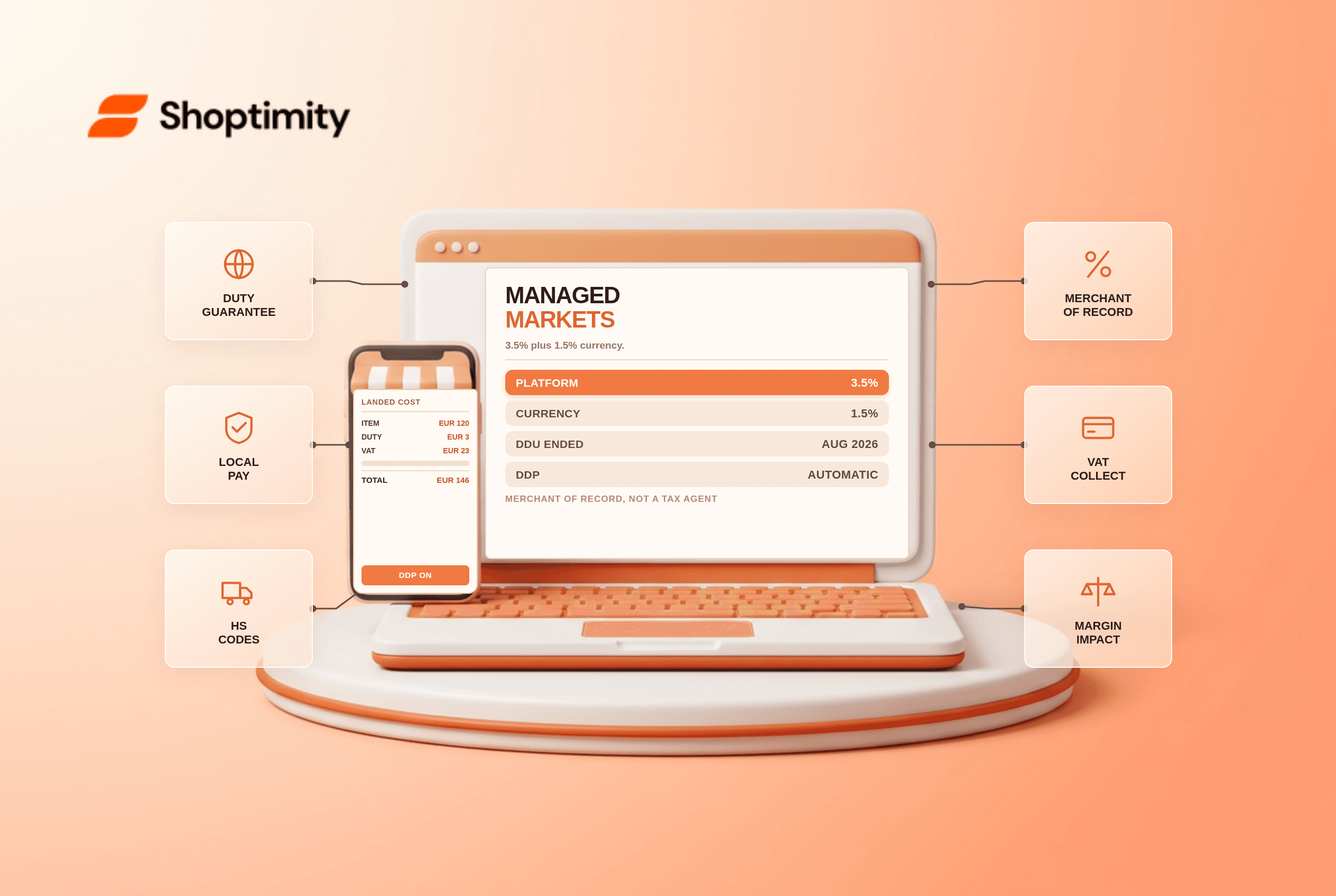
Managed Markets makes Shopify the merchant of record for cross-border orders. You hand over duties, taxes, currency and payment methods in exchange for 3.5 percent plus 1.5 percent currency conversion, down from 6.5 plus 2.5 for merchants added since October 2025. Running Markets yourself costs nothing in platform fees and takes real setup work on HS codes, carriers and thresholds.
What each option actually takes off your desk
Managed Markets handles duty and tax calculation, guarantees the amount it collects, localises prices and payment methods, and acts as the importer of record for the transaction. You ship, they deal with customs paperwork and remittance.
Doing it yourself means enabling duties at checkout, adding an HS code and country of origin to every product, using DDP-capable carrier services, registering for VAT where required, and maintaining all of it as the catalogue changes.
That difference in maintenance is the whole argument. Fees are the easy part to compare and the least interesting.
The fee math on a real store
| Monthly cross-border revenue | Managed fee at 3.5% | Currency at 1.5% | Annual cost |
|---|---|---|---|
| $10,000 | $350 | $150 | About $6,000 |
| $50,000 | $1,750 | $750 | About $30,000 |
| $100,000 | $3,500 | $1,500 | About $60,000 |
Self-managed, those same orders carry no platform percentage. They carry your time, your carrier rates and the risk that a duty estimate falls short and you absorb the difference.
On $10,000 a month of cross-border revenue, the annual fee is roughly what a part-time bookkeeper costs for a quarter. On $100,000 a month it is a salary, and the build-versus-buy question changes shape entirely.
According to Shopify's pricing page, the reduced rate applies to merchants added after October 2025, so older contracts may still carry the previous schedule.
Where self-managed Markets is genuinely better
Margin. Every percentage point you keep is yours, and cross-border margin is usually thinner than domestic before the fee lands.
Control. You choose the carrier, the incoterm, the price rounding and the markets you open. With Managed Markets, a market that does not meet their supported criteria is simply not available.
Data. Orders, customers and duty spend sit in your own reporting rather than in a partner's system, which matters when you are modelling contribution margin by country.
In our experience, the stores that leave Managed Markets do it for margin and reporting, not for features. The ones that stay do it because nobody on the team wants to own HS codes.
The 2026 change that simplified one thing
Managed Markets stopped supporting DDU on 24 August 2026. Markets that used to leave duty to the customer on delivery converted to DDP automatically.
That removed the worst customer experience in cross-border ecommerce, the doorstep customs bill, from every managed market. It also means the customer now sees the full landed cost at checkout, which raises displayed prices in markets where duty is material.
Self-managed stores can do the same thing, but they have to set it up. Our duties at checkout guide walks through the HS codes, the carrier requirement and the per-market toggle.
The deciding question
Ask how much cross-border revenue you actually have, and how many markets you actively support. Under roughly $20,000 a month across two or three markets, self-managed Markets with DDP enabled is usually the cheaper and simpler answer.
Above that, with four or more markets and a team that does not want to maintain classification data, the fee starts buying something real: guaranteed duty amounts, local payment methods and no registration work in markets where you cannot justify an entity.
Our advice: start self-managed, and treat Managed Markets as the upgrade you take when compliance hours exceed the fee. Read the localisation checklist before you open a market either way, and the translation limits before you promise local language.
What the guarantee does and does not cover
The guarantee covers the duty and tax amount collected on managed orders. If customs charges more than was collected, that gap is the managed service's problem rather than yours.
It does not cover a wrong HS code you supplied, a product that customs refuses, or a customer who rejects the parcel. Those costs stay with you in both models, which is why product data quality matters more than the fee schedule.
Ready to build a faster, higher-converting store?
Every Shoptimity theme ships with conversion widgets built in — so you get speed and features without stacking apps.
7-day free trial · all themes included · cancel anytime
Continue Reading
Shopify Translate & Adapt: The Limits, and When You Need an App
Eight automatic languages since October 2026, free. What it still cannot do, and when a paid transla...
Duties at Checkout in 2026: DDP vs DDU on Shopify Markets
The EU ended its 150 euro duty-free threshold in July 2026. How DDP at checkout works, what setup ne...