
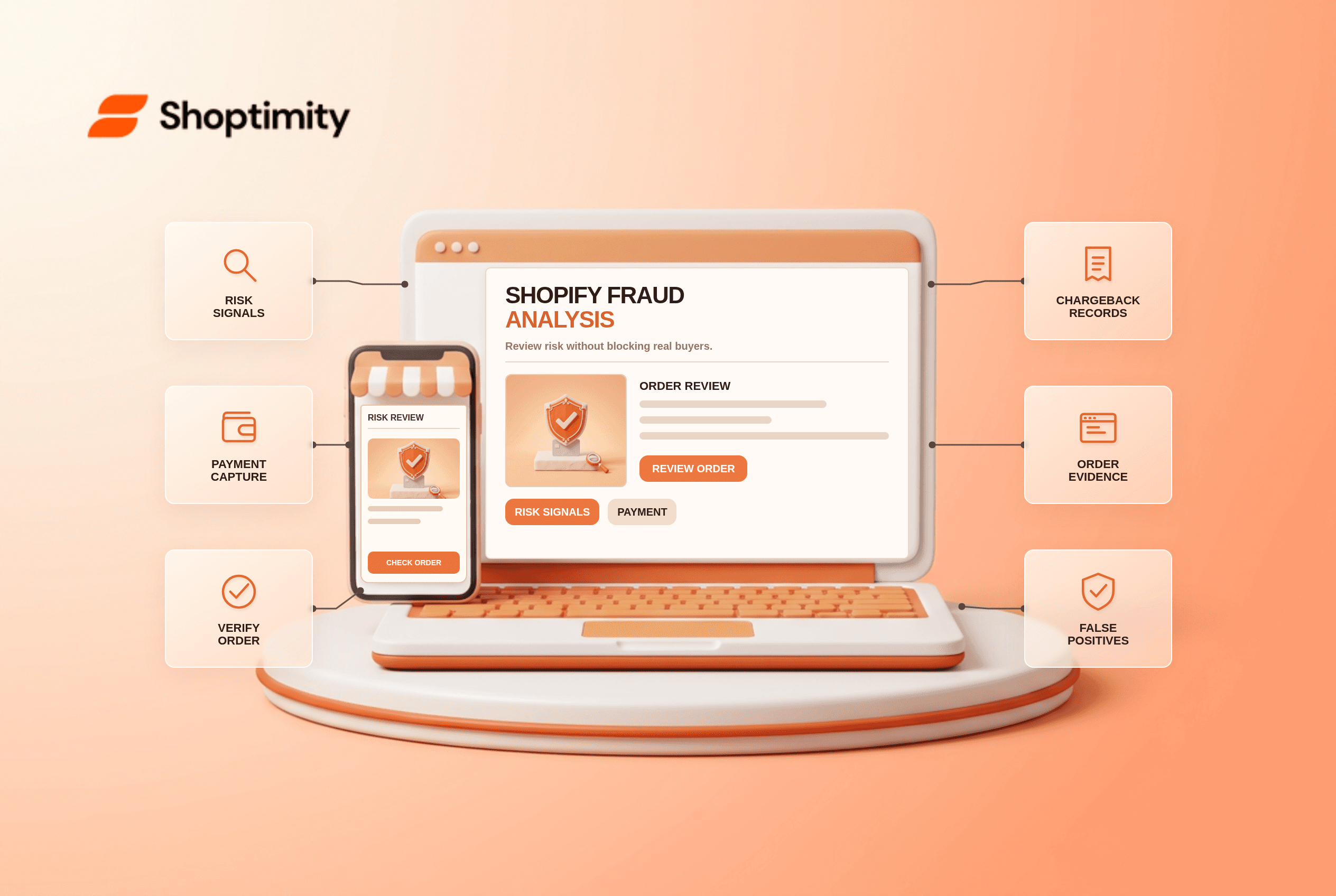
Shopify fraud analysis can help flag an order that deserves a closer look, but it cannot prove that a buyer is dishonest or guarantee that a chargeback will be prevented. A sensible process separates risk indicators, payment capture, fulfillment and customer communication. It also avoids a rule so aggressive that legitimate customers cannot check out.
What does Shopify fraud analysis tell you?
It provides risk signals for an order, not a final verdict. Shopify's fraud-prevention guidance says its analysis uses machine learning to bring suspicious orders to attention. Availability depends on your payment processor and plan: Shopify Payments stores have access, while stores using most third-party processors need an eligible plan such as Grow, Advanced or Plus. Check your admin instead of assuming a dashboard exists on every store.
The analysis can be one part of a review alongside order history, customer details and shipping consistency. An international billing address or a fast delivery request is not, on its own, proof of fraud. The goal is to decide whether to fulfill, verify, or cancel an order with a documented rationale: not to label customers publicly.
How should you review a high-risk order?
Pause fulfillment while you gather facts, then make a consistent decision. A six-step workflow works better than reacting to a single red badge:
- Open the order's risk analysis. Note the risk level and individual indicators. Confirm payment status and whether funds have been captured.
- Check the order for anomalies. Look at quantity, address changes, shipping speed, purchase history and repeated failed attempts, without treating any one factor as conclusive.
- Verify with safe channels. Contact the customer through the order's recorded details when needed. Do not request full card numbers, passwords or one-time banking codes.
- Consider manual payment capture. If your payment setup supports it, reviewing before capture can give staff time to make a decision. Authorization windows and fees vary, so test the actual configuration.
- Decide and document. Record the evidence and whether you will fulfill, hold or cancel/refund. Avoid vague internal notes like “looks suspicious” with no reasons.
- Recheck before shipment. Confirm no new address or item changes and ensure the packing team sees the same status that the risk reviewer approved.
Shopify explicitly says canceling a high-risk order may reduce exposure but does not prevent the bank from filing a chargeback. Even an authorization hold that was never captured can be disputed. Do not promise “zero chargebacks” to a merchant because they added one fraud rule.
Which tools are protection, and which are only insight?
A dashboard is not an insurance policy. Shopify's fraud-prevention tool list distinguishes fraud analysis, Shopify Protect, Flow, card-testing protection and dispute management. Shopify Protect applies to eligible orders in qualifying US stores using Shop Pay; it is not a blanket benefit for every payment method or country. Fraud Control can summarize risk and trends but does not itself guarantee chargeback coverage.
| Tool or practice | Main job | Important limit |
|---|---|---|
| Fraud analysis | Surface order-level risk signals | Not proof or automatic reimbursement |
| Manual review | Apply merchant context | Depends on staff judgment and timing |
| Fraud Control dashboard | Report risk and chargeback trends | Insight, not blanket chargeback protection |
| Shopify Protect | Protect eligible qualifying orders | Availability and eligibility restrictions apply |
| Theme trust badges | Reassure shoppers visually | Cannot authorize or protect a payment |
According to Shopify's Fraud Control documentation, its checkout rules need care so they do not block good orders. Its dashboard classifies a chargeback rate below 0.4% as good standing, 0.4% to 0.6% as at risk, and above 0.6% as elevated risk. These dashboard bands are not a guarantee of processor outcomes. Review false positives after implementing any rule, especially if customers use different addresses for gifts or business purchasing.
What about a chargeback that has already arrived?
Treat a filed dispute as a separate workflow. Preserve order confirmation, fulfillment tracking, customer communication and the terms shown at purchase. Review the reason code and the deadline inside the payments or dispute interface; respond with relevant evidence rather than a generic packet. The issuing bank decides the outcome. A favorable risk label at checkout is not a substitute for shipping proof or policy records.
Separate friendly-fraud concerns from genuinely unauthorized payments and routine service disputes. A customer saying “not received” needs different evidence from a customer disputing product quality. Never change a published policy retroactively and present it as the terms accepted on an earlier order.
Shoptimity's theme catalog can help make checkout-adjacent policy links and contact options clearer, but no theme can evaluate a cardholder's bank authorization or guarantee dispute outcomes. We checked Shopify's published guidance, not a merchant's payment settings. For storefront versus service boundaries, read our theme-versus-app guide; for checkout-friction context, read the cart-abandonment guide. Reduce fraud thoughtfully without needlessly rejecting real buyers.
Ready to build a faster, higher-converting store?
Every Shoptimity theme ships with conversion widgets built in — so you get speed and features without stacking apps.
7-day free trial · all themes included · cancel anytime
Continue Reading
Top Shopify Theme for Wholesale: A 2026 Buyer's Guide
You've just spent weeks sourcing inventory and building supplier relationships. But when you launch ...
Ecommerce Return Status Updates: Separate Request and Refund
Ecommerce return status updates should separate request, label, receipt, inspection and refund so sh...
Ecommerce Delivery Delay Updates: Show the New Reality
Ecommerce delivery delay updates should replace stale promises with a dated revised estimate, clear ...