
Shopify Loyalty Apps in 2026: What Each Tier Actually Costs
title: Shopify Loyalty Apps in 2026: What Each Tier Actually Costs slug: shopify-loyalty-app-cost-comparison meta_title: Shopify Loyalty App Cost Comparison 2026 meta_description: A Shopify loyalty app runs $0 to $199 a month at real tiers. The reward liability arithmetic and the order volume where a points programme does not pay. primary_keyword: Shopify loyalty app secondary_keywords:
- Smile.io pricing
- loyalty programme cost
- VIP tiers author: The Shoptimity Team date: 2026-11-03 category: Cost & Pricing schema: BlogPosting, FAQPage
Shopify Loyalty Apps in 2026: What Each Tier Actually Costs
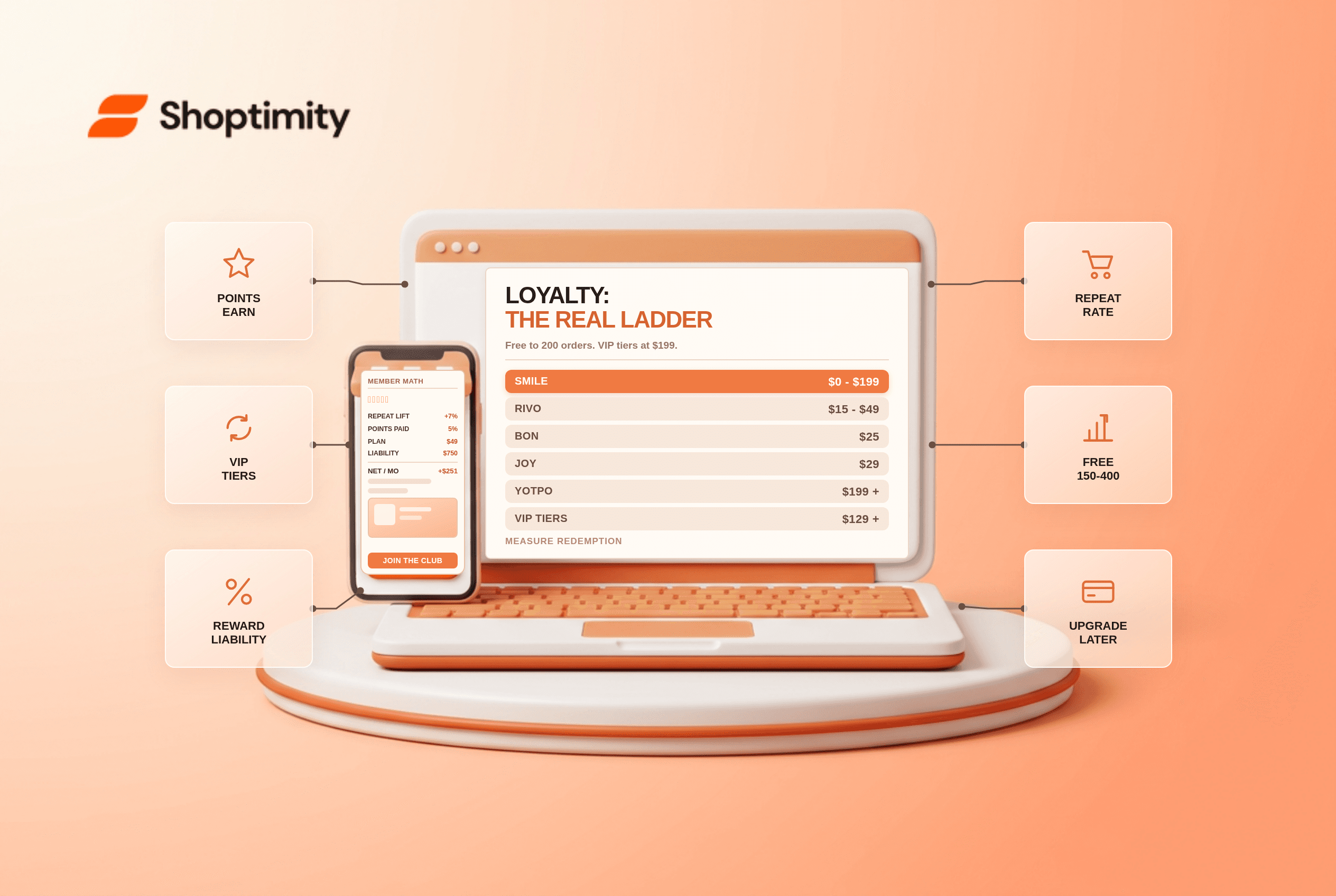
A Shopify loyalty app costs between $0 and about $199 a month at the tiers most stores use, and the free tiers are real: Smile.io covers 200 orders a month at no charge. The decision is not price. It is whether a points program changes repeat purchase behaviour enough to cover both the subscription and the discount you hand back.
For a store doing 200 orders a month, that is genuinely unproven. For one doing 2,000, it usually is.
What the apps actually sell
Three mechanics, priced differently:
- Points on purchases, redeemed for discounts or products. This is the core product and the source of most of the cost, because you are funding the reward.
- Referral programs, where the reward is paid for growth rather than retention.
- VIP tiers, where status unlocks better earning rates or perks. This is almost always gated to a higher plan.
The gating is the part that surprises merchants. VIP tiers commonly start on plans around $199 a month, which is the jump most small stores never make.
The 2026 price ladder
Published pricing moves often, and sources disagree on the entry tier, so check the listing before you commit.
| App | Free tier | Entry paid | VIP tiers from | Metering |
|---|---|---|---|---|
| Smile.io | 200 orders/mo | ~$15 to $49 | ~$199/mo | Order volume and features |
| Rivo | 200 orders/mo | ~$15 to $49 | ~$49/mo | Order volume |
| BON Loyalty | 150 orders/mo | ~$15 to $25 | ~$129/mo | Order volume |
| Joy Loyalty | 250 orders/mo | ~$29 | ~$129/mo | Order volume |
| Yotpo Loyalty | Under 100 orders/mo | ~$199/mo | Above Pro | Plan plus per-order above 500 |
| LoyaltyLion | 400 orders/mo on some tiers | ~$199 to $399/mo | ~$699/mo | Order volume |
According to the published pricing pages for Smile.io and LoyaltyLion, the free tiers are 200 and 400 orders a month respectively. The pattern worth noticing: the free tiers are generous enough to test, and the feature you actually want is one or two tiers above where you start. Budget for the tier you will need in month four, not the one you install in week one.
The arithmetic, honestly
Take a store at $50,000 a month, 1,000 orders, $50 average order value.
Assume 30% of customers join, points redeem at 5% of order value, and 20% of members buy more often than they would have otherwise. If membership lifts repeat frequency by even 7%, the incremental revenue on the enrolled base is $1,050 a month, against a $49 to $199 subscription and $750 of reward liability. It works, but thinly, and every assumption is doing heavy lifting.
We ran the same model on a 220-order-a-month store and the incremental revenue came to $231, which does not cover a $49 plan plus $180 of reward liability. That is why vendors push the free tier at that size. That is why vendors push the free tier at that size.
The one number to measure rather than assume is redemption. Smile's own published figures claim redeeming members spend around 31% more per order, which is plausible and self-reported; your own lift will be smaller than a vendor's headline.
Three costs nobody puts in the spreadsheet
The reward liability is the biggest line. A points program that earns fast and redeems slowly accumulates a balance sheet obligation, and one that earns slowly gets ignored. Set expiry rules on day one.
Discount stacking interacts with everything. Points redeemed as a discount code compete with your promotions, and Shopify will not stack two product discounts on one item. Our guide to Shopify discount combinations covers the mechanics.
The app adds storefront weight. Launchers, widgets and popups all load on every page, and a heavy loyalty widget on mobile is a conversion cost against a retention benefit.
Our verdict: launch free, measure repeat rate for 90 days against a matched cohort, then upgrade only when the lift clears the reward liability plus the subscription. The limitation to accept is that attribution is genuinely hard here, because a member who buys again may have bought again anyway; without a holdout group you are guessing.
If your retention problem starts earlier than loyalty, what a good Shopify conversion rate looks like in 2026 sets the baseline, and Shopify Flow vs Zapier is where simple win-back automations belong before a loyalty subscription.
Ready to build a faster, higher-converting store?
Every Shoptimity theme ships with conversion widgets built in — so you get speed and features without stacking apps.
7-day free trial · all themes included · cancel anytime
Continue Reading
Shopify Flow Variant Added vs Deleted: Safe Alerts
Compare Shopify Flow variant added and deleted triggers, understand the default-variant exception, a...
Shopify Flow Workflow Error Trigger: Alert Limits
Use the Shopify Flow workflow error trigger to route internal alerts, understand the 30-day suppress...
Shopify Flow Fulfillment Rescheduled: 3PL Alerts
Build Shopify Flow fulfillment rescheduled alerts for third-party services, review affected assignme...