
Shopify Payments Availability in 2026: What to Use Instead
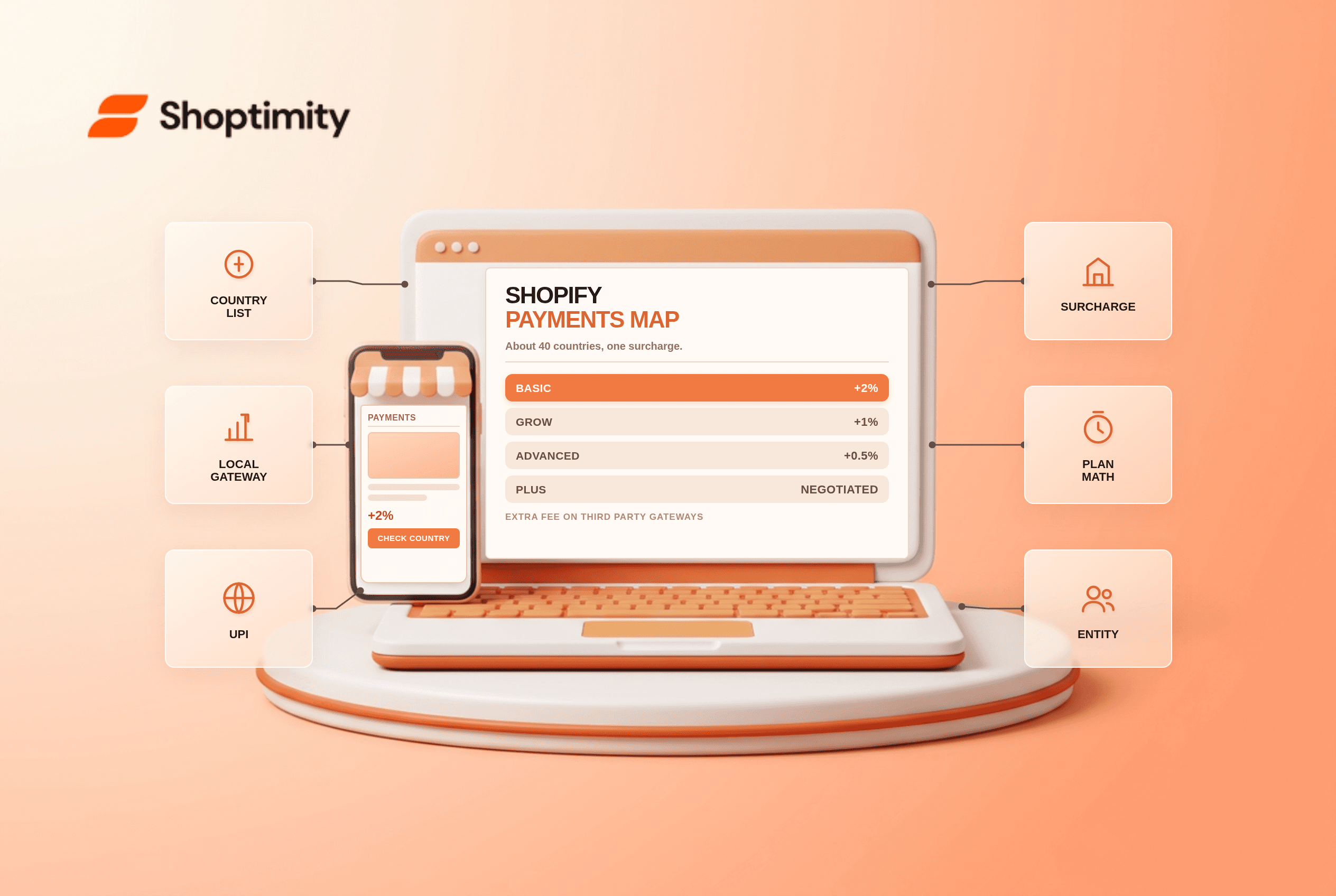
Shopify Payments availability depends on where your business is registered, not where your customers are. It works in roughly 40 countries and regions. If yours is not on the list, you need a third-party gateway, and you pay Shopify an extra transaction fee on every order you process through it.
Check the country list first, not the plan
According to Shopify's supported countries page, eligibility is decided per country and updated as new markets launch. Coverage expanded from around 23 countries in 2024 to roughly 40 by 2026, with most additions in Eastern Europe. The count itself is a moving target, and secondhand lists go stale within a quarter.
India is not on the list. Neither are Brazil, Nigeria, Pakistan or the Philippines, among other large ecommerce markets. Merchants there process cards through local gateways instead, and that choice carries a surcharge.
Before you change anything, open Shopify's own supported countries page and search for the country your business entity is registered in. Registration is what counts. A US LLC can use Shopify Payments even if the founder lives elsewhere, as long as the entity and bank account meet the country's verification requirements.
The fee nobody quotes at signup
When you use a third-party gateway, Shopify charges an additional transaction fee on those orders. In 2026 that is 2 percent on Basic, 1 percent on Grow, and 0.5 percent on Advanced, per Shopify's pricing page. Plus merchants negotiate it.
| Plan | Shopify Payments rate | Third-party gateway surcharge |
|---|---|---|
| Basic | From 2.9% + 30 cents | 2% |
| Grow | From 2.7% + 30 cents | 1% |
| Advanced | From 2.5% + 30 cents | 0.5% |
| Plus | From 2.25% + 30 cents | Negotiated |
On a store taking $50,000 a month on Basic, that surcharge is $1,000 a month, or $12,000 a year. It is the single largest cost difference between a merchant in a supported country and one outside it, and it is not optional unless your gateway can route through a supported entity.
Our transaction fee breakdown covers how the surcharge interacts with gateway fees, so you can see the true cost per order rather than two separate percentages.
What a local gateway actually costs
The surcharge is not the whole story. Local gateways charge their own processing rate, and in several markets that rate is lower than card processing in the US or EU.
Razorpay in India typically quotes somewhere between 1.9 and 2 percent for domestic cards, with UPI often cheaper. A merchant on Basic pays that plus Shopify's 2 percent, landing near 4 percent all in. That is high, and it is still cheaper than a payment aggregator that adds currency conversion on top.
We checked five stores in unsupported markets and found the same pattern: the gateway rate was competitive, and the surcharge was what made the stack expensive. The real advantage of a local gateway is coverage of local payment methods. UPI, net banking, wallets and cash on delivery decide conversion in India. In Brazil, boleto and instalments do the same job. A gateway that handles only international cards will lose carts a local one would convert.
Gateway options by situation
If you sell domestically in an unsupported country, use the dominant local gateway and accept the surcharge. It is the cost of operating in that market.
If you sell internationally from an unsupported country, consider a gateway that supports multi-currency settlement, and price your products with the conversion spread in mind. Currency conversion is where international stores quietly lose margin.
If you have entities in two countries, route processing through the supported one. This is legal and common, and it needs an accountant's sign-off rather than a blog post's blessing, because the tax treatment decides whether it works.
If you are on Plus, negotiate. The surcharge is not published in the same way at that tier, and processing volume is a lever. Our advice, after auditing stores on both sides of this: separate the gateway fee from Shopify's surcharge on every quote you receive, because vendors quote one number and the truth is two. The catch is that local gateways can be slow to approve high-risk categories, and a cheaper rate is worth nothing if your account cannot process on launch week.
The plan decision this feeds into
The surcharge changes the plan arithmetic for merchants outside supported countries. Grow's extra $60 a month over Basic buys a 1 percent surcharge instead of 2 percent, plus 5 staff accounts and better reporting.
At $30,000 a month in processed revenue, the 1 percent difference is $300 a month. The upgrade pays for itself five times over, and that is before you count the other plan features. Stores that stay on Basic for years while paying the 2 percent surcharge are usually losing money without noticing.
Read which Shopify plan you actually need for the full break-even math, and the real cost of running a store for where processing sits against apps, themes and shipping.
Ready to build a faster, higher-converting store?
Every Shoptimity theme ships with conversion widgets built in — so you get speed and features without stacking apps.
7-day free trial · all themes included · cancel anytime
Continue Reading
Shopify Payments Payouts: Timing, Holds and Reserves
Payouts land in 2 to 5 business days, until a review or a reserve changes the schedule. What trigger...
Shoptimized Alternatives 2026: Four Themes That Cost Less to Own
Shoptimized still costs $199 a year while its app bundle went native. Four alternatives compared on ...
Glozin Shopify Theme Review 2026: What $79 Buys
A $79 ThemeForest theme with a large demo library, no Shopify code review, and speed that needs work...