
Shopify Tax: What It Collects, What It Never Does, and What It Costs
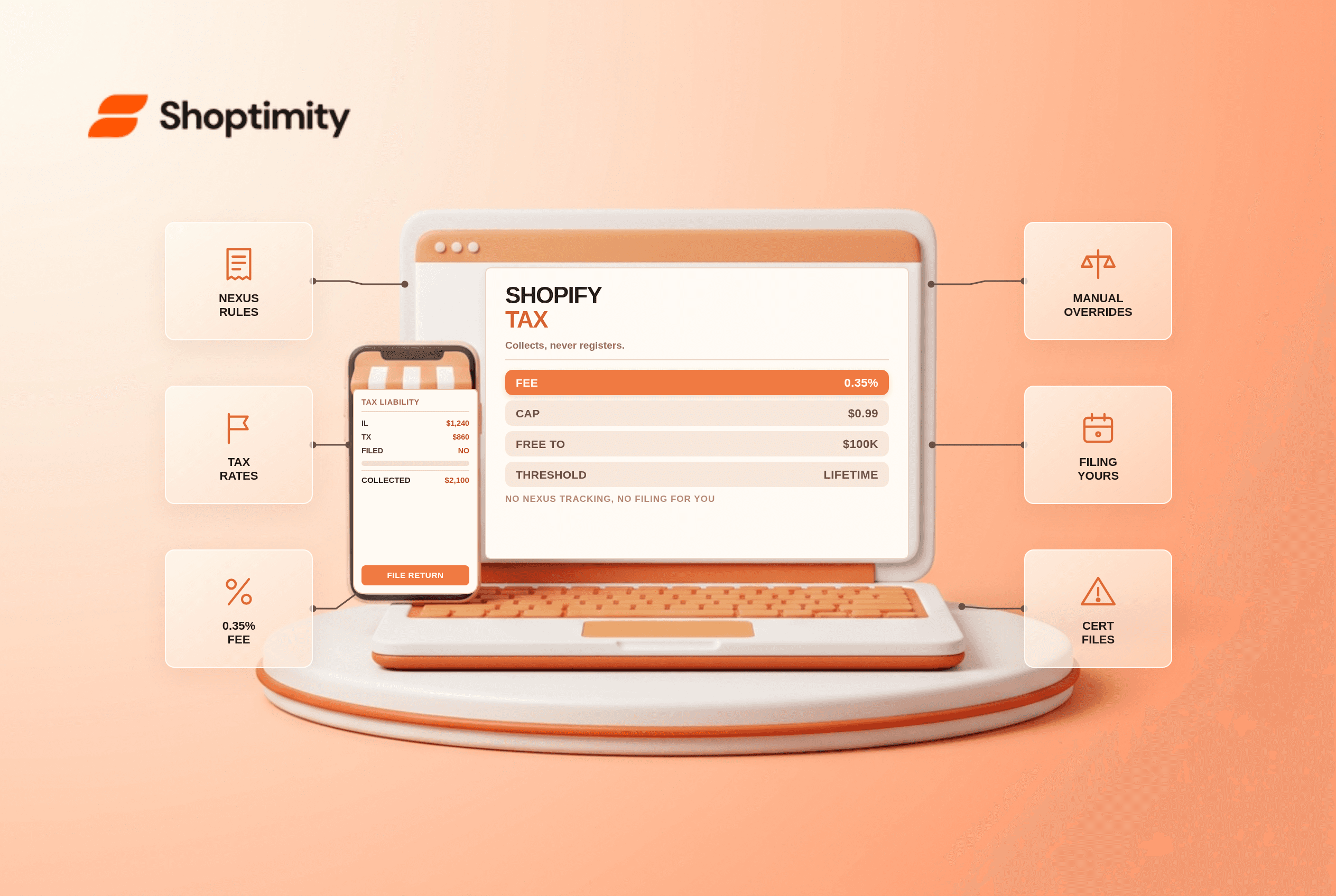
Shopify Tax calculates the right rate at checkout and collects it from the buyer. It does not register you in any state, does not decide where you have nexus, and does not file returns on your behalf. Those three duties stay with you, and the fee for the calculation is 0.35 percent per order once you pass a $100,000 threshold.
The part merchants get wrong
Turning on collection is not registering. If you enable a state in Shopify without holding a permit there, the tax your customers pay sits in your account and goes nowhere. The liability remains yours, and it grows quietly until a notice arrives.
Nexus comes from two directions. Physical presence covers an office, a warehouse, an employee or inventory held by a 3PL. Economic nexus is triggered by sales volume, most commonly $100,000 in gross sales or 200 transactions in a state per year, with California and Texas setting $500,000 and New York requiring $500,000 plus 100 transactions.
What Shopify Tax costs in 2026
| Store type | Free threshold | Fee after threshold | Cap |
|---|---|---|---|
| Created before 13 May 2026 | $100,000 per calendar year, per region | 0.35% per US order (0.25% on Plus) | $0.99 per order |
| Created on or after 13 May 2026 | $100,000 lifetime sales, per region | 0.35% per US order (0.25% on Plus) | $0.99 per order |
That threshold change is the detail worth reading twice. A store created after 13 May 2026 gets a lifetime $100,000 allowance rather than an annual reset, so the fee starts permanently higher. According to Shopify's tax documentation, rates also apply to EU, UK and Canadian stores at similar thresholds.
The 0.35 percent is not the same thing as the duty handling in our duties at checkout guide. Duties are import charges collected for customs. Sales tax is a domestic obligation collected for states and countries. They share a settings page and nothing else.
The overrides that decide your accuracy
Three settings do most of the work. Product tax categories assign the right treatment to categories that are exempt or partially taxed, such as clothing in some states or food in others.
Tax overrides handle the exceptions: a specific product, a customer group, a wholesale account with a certificate on file. Collect the certificate before you apply the exemption, not after.
Shipping tax is state-specific. Most stores should leave "charge tax on shipping" on and let Shopify apply each state's rule, rather than switching it off to look cheaper at checkout.
In our experience, the stores that get audited badly are the ones with exemptions applied by hand and no certificates stored. The tax was calculated correctly and the exemption was undocumented, which is the worst of both.
Setting it up in the right order
Pull twelve months of orders and total them by state. Compare against each state's threshold. Register with the states where you cross it, then enable those states in Shopify with the registration number.
Then configure categories, overrides and shipping rules, and run a test order in two states with different rules to confirm the totals. Check the liability insights dashboard monthly rather than annually, because a threshold crossed mid-year is a threshold you should have been collecting for.
If you sell through marketplaces or 3PLs, repeat the exercise with warehouse locations included. Inventory sitting in a state creates physical nexus whether or not you ever shipped from your own address.
Where the platform stops
Filing is yours. Automated filing through Shopify's partner service exists in a limited set of states and has been closed to new enrolment at times, so do not plan around it without checking.
Remittance is yours. Collected tax is not forwarded to agencies. Registration is yours. The plan comparison is worth a look if you are near a tier change, because the tax fee drops only at Plus.
Our advice: register before you collect, keep certificates, and treat Shopify Tax as a calculator with a compliance assistant rather than a tax department. For anything cross-border, get an accountant who has seen your states.
Ready to build a faster, higher-converting store?
Every Shoptimity theme ships with conversion widgets built in — so you get speed and features without stacking apps.
7-day free trial · all themes included · cancel anytime
Continue Reading
Shopify B2B Company Locations: Give Buyers the Right Access
Configure Shopify B2B company locations, verify buyer permissions and test pricing, addresses and pa...
Shopify Checkout Contact Settings: Separate Email From Shipping Phone
Configure Shopify checkout contact settings and test email, phone and shipping address requirements ...
Shopify POS Recent Carts: Share a Sale Without Reserving Stock
Learn how Shopify POS recent carts work across devices, what they do not reserve, and how to hand of...