How Shoptimity Helps Increase Sales on Your Shopify Store (2026 Complete Guide)

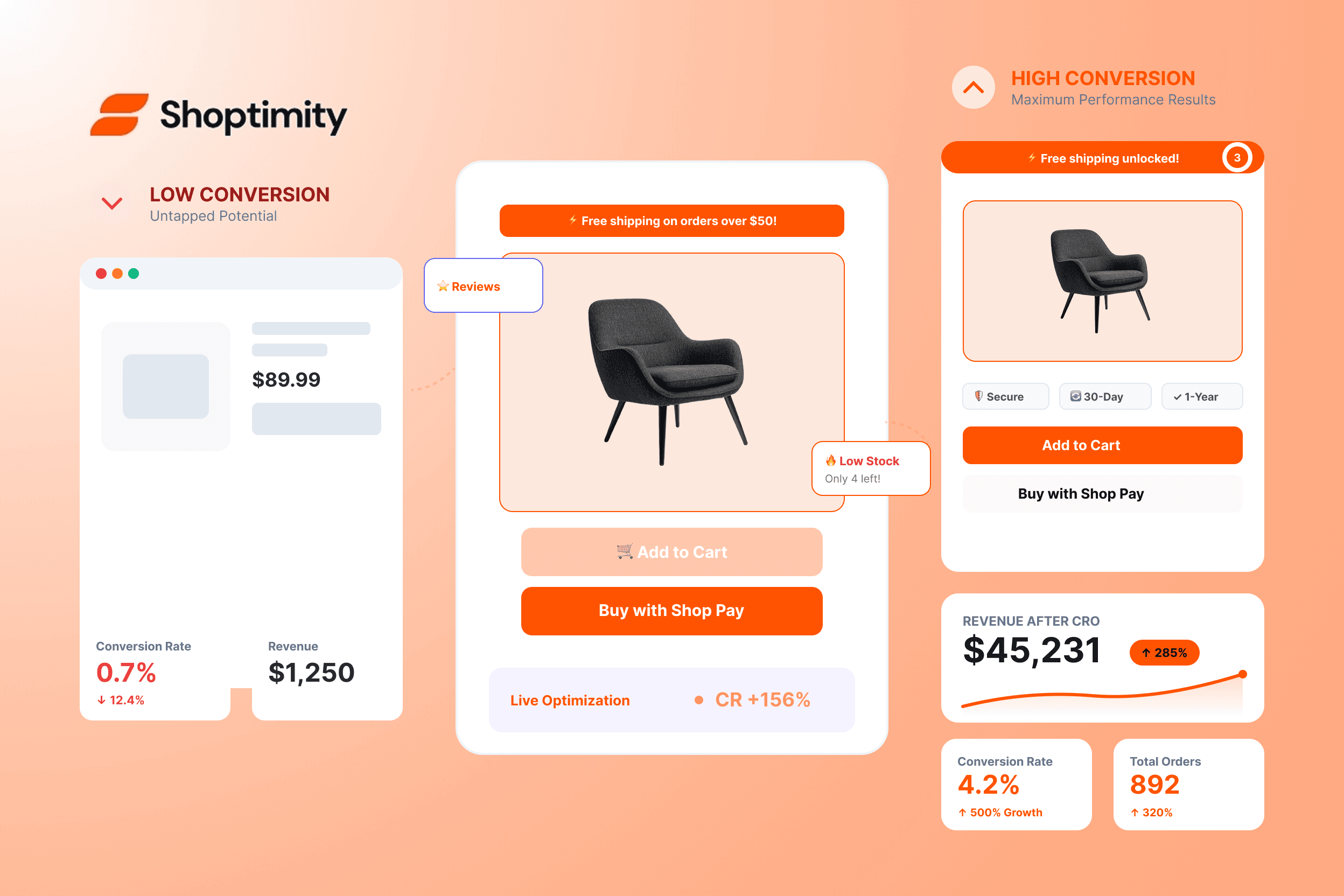
You're getting traffic. You're running ads. You're posting on social media. But your sales numbers aren't moving the way you want them to.
Sound familiar?
Here's the truth most Shopify store owners discover too late: traffic is not the problem. Conversion is.
And conversion lives or dies with your store experience — the speed, the layout, the trust signals, the upsells, the mobile flow. Everything a visitor sees, feels, and clicks from the moment they land on your store to the moment they hit "Place Order."
This is exactly where Shoptimity comes in.
In this guide, we break down precisely how Shoptimity helps you increase sales on your Shopify store — backed by data, real conversion psychology, and a clear picture of what changes when you switch from a generic theme to a purpose-built conversion machine.
What Is Shoptimity?
Shoptimity is a premium Shopify theme engineered from the ground up around one goal: converting more of your existing traffic into paying customers.
It is not just a "pretty theme." It is a conversion infrastructure — a storefront built the way high-performing ecommerce brands actually operate, with every layout decision, feature, and line of code serving one master: your sales.
Why Most Shopify Stores Struggle to Increase Sales
Before we get into what Shoptimity does, let's be clear about why most stores plateau. The typical Shopify store owner follows the same pattern:
- Launches with a free theme
- Installs 8–12 apps to add missing features (upsells, speed, trust badges, countdown timers)
- Watches the store slow down as every app adds JavaScript to every page
- Pays $150–$300/month in subscriptions for features that conflict with each other
- Wonders why conversion rate is stuck at 1–2%
The problem is structural. The free theme was never designed to convert. It was designed to display products. The apps were never designed to work together. They were designed to be sold individually.
Shoptimity solves this at the root.
9 Proven Ways Shoptimity Increases Your Shopify Sales
Blazing Fast Page Load Speed
Let's start with the single most impactful conversion factor most store owners ignore: speed.
The average Shopify store loaded with 10+ apps loads in 4–7 seconds on mobile. That is a conversion catastrophe. Shoptimity is built on clean, modern code — no legacy bloat, no redundant jQuery libraries, no competing app scripts loading simultaneously. The result is a store that consistently scores 90+ on Google PageSpeed, loads under 2.5 seconds on mobile, and passes all Core Web Vitals.
What this means for sales:
- Lower bounce rates — visitors actually see your store before leaving
- Higher Google rankings — Core Web Vitals is a confirmed SEO ranking factor
- Better ad performance — Google rewards fast landing pages with lower CPCs and higher Quality Scores
- More mobile checkouts — a fast mobile experience means more completed purchases
Mobile-First Design That Actually Converts
Yet most Shopify themes are designed on desktop first, then squeezed into a mobile view as an afterthought. The result is a desktop experience made smaller — not a mobile experience made right. Shoptimity flips this entirely. Every layout, every button size, every tap target, every swipe interaction is designed for mobile first. Desktop scales up from that foundation.
The practical difference for customers:
- Buttons that are actually tappable with a thumb
- Images that load fast and swipe smoothly
- A checkout flow that doesn't require zooming or pinching
- Product information presented in the right hierarchy for a small screen
For store owners running Facebook, TikTok, or Instagram ads — where virtually all traffic is mobile — this is not optional. This is survival.
Conversion-Optimized Product Page Layouts
Your product page is the single most important page on your store. Everything else — your homepage, your blog, your ads — exists purely to bring visitors to this one page. What happens here decides whether you make the sale. Shoptimity's product page layouts are engineered around conversion psychology — the science of how people make buying decisions online.
- High-contrast add-to-cart buttons — the purchase action is visually dominant, never buried, never competing with other elements for attention.
- Trust signals at the decision point — star ratings, review counts, security badges, and guarantee text sit right next to the price and the add-to-cart button, exactly where purchase anxiety peaks.
- Sticky add-to-cart on mobile — as customers scroll, the buy button stays visible at the bottom of the screen. One tap, always. This single feature measurably reduces drop-off.
- Optimized image galleries — pinch-to-zoom, smooth swipe, fast load. Customers buy what they can clearly see.
- Scarcity and urgency signals — stock level indicators and urgency messaging that feel authentic rather than fake, accelerating decisions when used correctly.
Built-In Upsells and Cross-Sells
The math is compelling: if your average order value is $40 and an upsell moves it to $50, every single order becomes 25% more profitable. The problem is how most stores implement upsells. A third-party app fires a pop-up that doesn't match the brand, loads slowly from an external server, and fires at the wrong moment. Customers dismiss it.
Shoptimity ships with native upsell and cross-sell functionality built directly into the theme:
- Product page upsells — "Frequently bought together" and "You might also like" displayed naturally within the product layout
- Cart drawer upsells — relevant add-ons surfaced at the highest-intent moment, right before checkout
- Zero loading delay — everything renders with the page because it is the page, not a bolted-on script
- Perfectly on-brand — upsells look like part of your store, not an interruption from a third-party app
Quantity Breaks to Boost Average Order Value
Quantity breaks — "Buy 2, save 10%" — are one of the simplest, highest-ROI tactics in ecommerce. They work because the psychology is universal: people respond to visible savings, and buying more to save more feels like a win for the customer even as it delivers a win for you.
Shoptimity includes native quantity break functionality that renders cleanly on product pages, directly in the buying flow, right where the decision is being made. No app. No extra charge. No style mismatch. Just a clean, effective incentive that systematically moves customers from buying one unit to buying two or three.
Cart Drawer That Keeps Customers in the Flow
The journey from "add to cart" to "order confirmed" is full of opportunities to lose a sale. Every extra page load, every navigation away from the buying flow, every moment of friction is a chance for a customer to get distracted, reconsider, or simply close the tab.
Shoptimity's slide-out cart drawer directly attacks this problem. Instead of redirecting customers to a separate cart page — breaking their momentum entirely — the cart appears inline, overlaid on the current page. Products are visible. The total is clear. Checkout is one tap away. Upsells appear naturally in the drawer. The friction is gone. The flow continues. More carts convert.
Trust Signals That Convert Cold Traffic
For an established brand, trust is built over time through reputation, reviews, and word of mouth. But most Shopify stores — especially new ones and dropshipping stores — need to build trust instantly, with a complete stranger, in under 10 seconds. This is one of the hardest problems in ecommerce, and it's solved through design.
Shoptimity's layouts are built with trust architecture — the deliberate placement of elements that build purchase confidence:
- Review displays — star ratings and review counts visible at a glance, positioned near the price and the add-to-cart button.
- Trust badges — secure checkout, money-back guarantee, and free returns badging positioned below the add-to-cart button, exactly where purchase hesitation peaks.
- Social proof — "X people are viewing this" and "Recently purchased" notifications that create authentic social validation without feeling gimmicky.
- Professional presentation — a storefront that looks like an established brand, not a template. The subconscious judgement a visitor makes in the first 3 seconds is a massive conversion factor.
SEO-Friendly Architecture
More sales doesn't just mean better conversion on existing traffic — it means more traffic in the first place. Shoptimity is built with clean semantic HTML, proper heading structure, fast load times, and schema markup compatibility. All of these are factors that help your store rank higher in Google.
- Clean semantic HTML — search engines can correctly read and index your product pages, collections, and blog content
- Fast load times — Google's Core Web Vitals directly influence search rankings. A faster store ranks higher.
- Mobile optimisation — Google uses mobile-first indexing, so a mobile-optimised theme gets better rankings
- Blog-ready — Shoptimity's blog layouts are designed for long-form content that ranks, not as an afterthought
More organic traffic means more sales without additional ad spend. Every blog post that ranks, every collection page in search results, every product in Google Shopping — that's revenue that costs you nothing beyond the time it took to publish.
No-Code Customisation That Lets You Move Fast
Speed to market is a competitive advantage. The faster you can test a new hero banner, update a seasonal promotion, launch a new product layout, or A/B test your add-to-cart button copy, the faster you learn what works and the faster you grow.
Shoptimity's entire customisation layer works through Shopify's native theme editor. No code. No developer. No waiting. Every section, every colour, every font, every layout is adjustable with a visual editor. What used to take a developer two days takes a store owner two hours.
For growing stores, this compounds significantly over time. More tests, more learning, faster optimisation, more sales.
The Real Numbers: What Shoptimity Is Worth to Your Business
Let's put conservative numbers on what each of these improvements means for a store doing $12,000 per month in revenue.
| Improvement | Conservative lift | Monthly gain |
|---|---|---|
| 20% faster page load | +3% conversion rate | +$360 |
| Mobile-first design | +2% mobile conversion | +$240 |
| Product page optimisation | +3% overall conversion | +$360 |
| Built-in upsells | +8% AOV | +$960 |
| Quantity breaks | +5% AOV | +$600 |
| Reduced cart abandonment | +2% checkout rate | +$240 |
| Total estimated gain | +$2,760/mo |
Intentionally conservative. Stores that implement CRO systematically — especially on a purpose-built theme — frequently report larger lifts.
The key insight is that these effects compound: a higher conversion rate applied to higher AOV applied to more traffic creates exponential revenue growth.
Shoptimity vs. Running an App Stack
This is the comparison most Shopify store owners need to make honestly.
The financial case alone is overwhelming. But the conversion case is more important: a cohesive, fast, purpose-built theme simply outperforms a patchwork of apps — consistently, measurably, at scale.
Who Gets the Most from Shoptimity?
📈 Store owners spending on ads
Your cost per acquisition is directly tied to your conversion rate. A better-converting store makes every ad dollar go further — Shoptimity pays for itself many times over on your first month's ad spend.
🛒 Dropshipping stores
Every competitor has access to the same products. The only differentiator is the store experience. A professional, fast, conversion-optimised store wins against a generic template every time.
📊 High traffic, low sales
If your analytics show healthy traffic but disappointing conversion (anything under 2% is a red flag), the store experience is the bottleneck. Shoptimity is designed to fix it.
✨ Brands that care about presentation
If you want customers to see a brand — not a template — Shoptimity's premium layouts deliver that instantly, building the trust that converts.
📱 Mobile-first audiences
If more than 60% of your traffic is mobile (it probably is), a mobile-first theme is not optional. It's the difference between a store that converts and one that doesn't.
Getting Started with Shoptimity
Setting up Shoptimity does not require a developer or weeks of work. Here's what the process looks like:
Day 1
Install the theme and choose your base layout. Shoptimity's pre-built layouts are designed for specific industries and ready to customise with your brand.
Day 2
Customise colours, fonts, and images using the visual editor. Set up your upsell offers and quantity breaks. Configure your cart drawer.
Day 3 & Beyond
Go live, monitor your conversion data, and start testing. The no-code editor makes it easy to iterate quickly based on what you see in your analytics.
Most store owners see measurable improvements in conversion rate within the first 30 days.
Frequently Asked Questions
Will switching themes affect my SEO rankings?
Temporarily, theme switches can cause minor fluctuations as Google recrawls your pages. Because Shoptimity uses clean semantic code and fast load times, most stores see neutral to positive SEO impact within 60 days.
Do I still need any apps with Shoptimity?
Shoptimity eliminates the need for the most common app categories — upsells, quantity breaks, cart optimisation, speed tools. You may still want apps for email marketing, reviews, and shipping, but most stores cut their app count from 12+ down to 3–4.
Can I keep my existing products and content?
Yes. Your products, collections, blog posts, and customer data all live in Shopify — not in your theme. Switching themes never affects your store data.
Is $19/month really all I pay?
Yes. The Starter plan at $19/month includes the full conversion feature set. No hidden fees, no feature tiers locked behind higher plans, no per-transaction charges.
The Bottom Line
Your Shopify store can have excellent products, a solid ad strategy, and strong social media presence — and still underperform if the store itself is not built to convert.
Shoptimity fixes that. It is the fastest, most cost-effective way to close the gap between the traffic you're already generating and the sales you should be making. For $19/month, you get a store built to sell — with every layout decision, every feature, and every line of code pointing toward one outcome: more sales.
Built to convert. Designed to scale.
Start turning traffic into sales
Replace your bloated app stack with one fast, conversion-focused theme — and keep more of the revenue you're already earning.
Try the $19/month Starter plan — no hidden fees, cancel anytime.
Continue Reading

Best Shopify Themes for 2026: The Complete Buyer's Guide
Picking the right Shopify theme is the single highest-leverage decision you'll make as a new store o...

How to Increase Your Shopify Conversion Rate (Step-by-Step Guide for 2026)
You're spending money on ads. You're getting traffic. But your revenue isn't growing the way it shou...

How Shoptimity Helps You Increase Sales on Your Shopify Store
You've done the hard part. You built your Shopify store, sourced your products, and started driving ...