
Shopify Customer Cohorts: Retention and CAC Payback
title: Shopify Customer Cohorts: Retention and CAC Payback slug: shopify-customer-cohorts-retention-cac-payback meta_title: Shopify Customer Cohorts and CAC Payback meta_description: Analyze Shopify customer cohorts, retention and CAC payback with a contribution-based example and clear measurement caveats for store teams. primary_keyword: Shopify customer cohorts secondary_keywords:
- Shopify merchant guide
- ecommerce operations author: The Shoptimity Team date: 2026-11-03 category: Marketing schema: BlogPosting, FAQPage
Shopify Customer Cohorts: Retention and CAC Payback
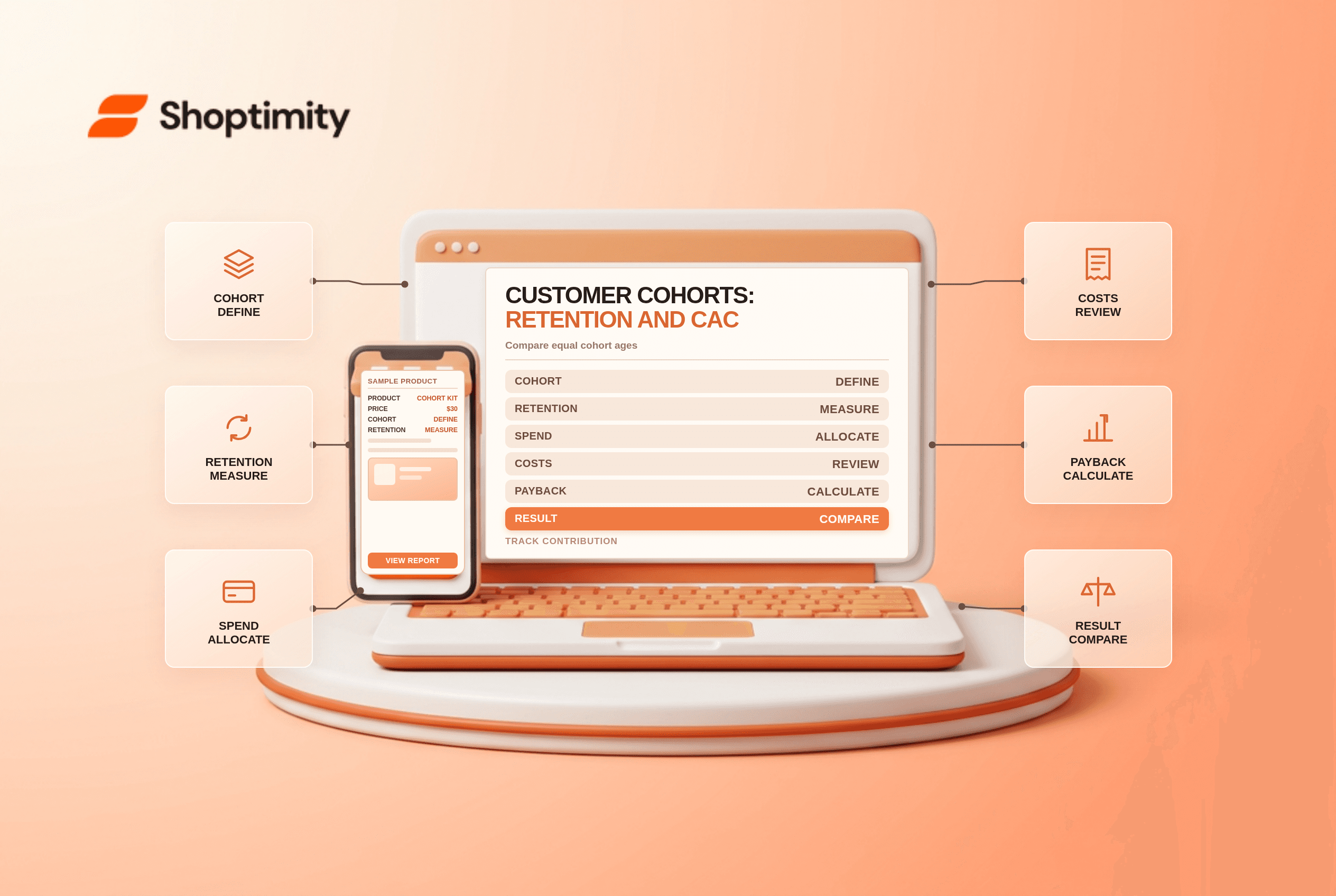
Shopify customer cohorts group customers by a shared starting event, commonly the period of their first purchase. Comparing cohorts at the same age can show when repeat purchases occur and help estimate customer acquisition cost, or CAC, payback. Revenue is not profit, and a young cohort cannot tell you its full lifetime value.
Read a cohort table
Shopify's customer-report guide describes the Customer cohort analysis report. By default, customers are grouped by the date of their first order. Metrics, interval and cohort definitions can be customized where available.
| Concept | Meaning | Common mistake |
|---|---|---|
| Cohort | Customers sharing a defined first-order period or other criterion | Comparing groups with different definitions |
| Cohort age | Time since the first order | Comparing a two-month cohort with a twelve-month cohort |
| Retention | Customers returning under the report's definition | Assuming every report uses the same definition |
| Sales per customer | Revenue metric divided by customers | Calling sales profit or lifetime value |
| CAC payback | When accumulated contribution recovers acquisition cost | Ignoring returns or repeat-order costs |
Check the report's metric definition and time zone before exporting. A Month 1 value is a period relative to the first order, not necessarily the same calendar month for every row.
Calculate a simple payback example
Suppose a cohort has 100 new customers and $3,000 in attributable acquisition spend, producing a blended cohort CAC of $30 per customer. Assume the first orders yield $2,000 total contribution after product, fulfilment, payment and other included variable costs, or $20 per customer. After additional orders, cumulative contribution reaches $3,400 by month three, or $34 per customer. On those assumptions, the cohort recovers its $30 CAC by month three.
This example excludes overhead, financing cost and any later refunds not yet reflected. It also assumes the $3,000 acquisition spend is correctly matched to the same customers and period. If a channel drives orders from existing buyers, dividing the full channel spend by new customers alone can misstate CAC unless you define and allocate that spend consistently.
Choose a defensible cost model
Define acquisition spend: advertising, agency fees, creative production and any other included costs. State whether the measure is paid-channel or blended CAC. Define contribution consistently for first and repeat orders, including discounts, shipping subsidy, payment costs and expected or actual returns. Taxes collected on behalf of authorities are not automatically revenue.
Compare cohorts at equal ages and keep a fixed observation window. A January cohort observed for twelve months cannot fairly be compared with a November cohort observed for one month. Seasonality, product mix, promotions and channel mix can all change the result.
Use the report without overclaiming
A cohort table shows observed behavior; it does not prove that a particular campaign caused retention. Identity gaps, consent, attribution rules and customer merges can affect reporting. Predicted spend is a model output, not guaranteed future cash. Treat projections separately from realized contribution.
For a practical review, select a cohort definition, reconcile first-order counts, export the relevant sales data, apply your cost model and document assumptions. Review acquisition and finance together before increasing spend. Related reading: contribution margin per order and Shopify analytics versus GA4.
Ready to build a faster, higher-converting store?
Every Shoptimity theme ships with conversion widgets built in — so you get speed and features without stacking apps.
7-day free trial · all themes included · cancel anytime
Continue Reading
Shopify B2B Company Locations: Give Buyers the Right Access
Configure Shopify B2B company locations, verify buyer permissions and test pricing, addresses and pa...
Shopify Checkout Contact Settings: Separate Email From Shipping Phone
Configure Shopify checkout contact settings and test email, phone and shipping address requirements ...
Shopify POS Recent Carts: Share a Sale Without Reserving Stock
Learn how Shopify POS recent carts work across devices, what they do not reserve, and how to hand of...