
Shopify Gross Sales vs Net Sales vs Total Sales
title: Shopify Gross Sales vs Net Sales vs Total Sales slug: shopify-gross-sales-vs-net-sales-vs-total-sales meta_title: Shopify Gross Sales vs Net Sales vs Total Sales meta_description: Compare Shopify gross sales vs net sales vs total sales with an example, reporting-date caveats and practical reconciliation guidance for store teams. primary_keyword: Shopify gross sales vs net sales vs total sales secondary_keywords:
- Shopify merchant guide
- ecommerce operations author: The Shoptimity Team date: 2026-11-04 category: Operations schema: BlogPosting, FAQPage
Shopify Gross Sales vs Net Sales vs Total Sales
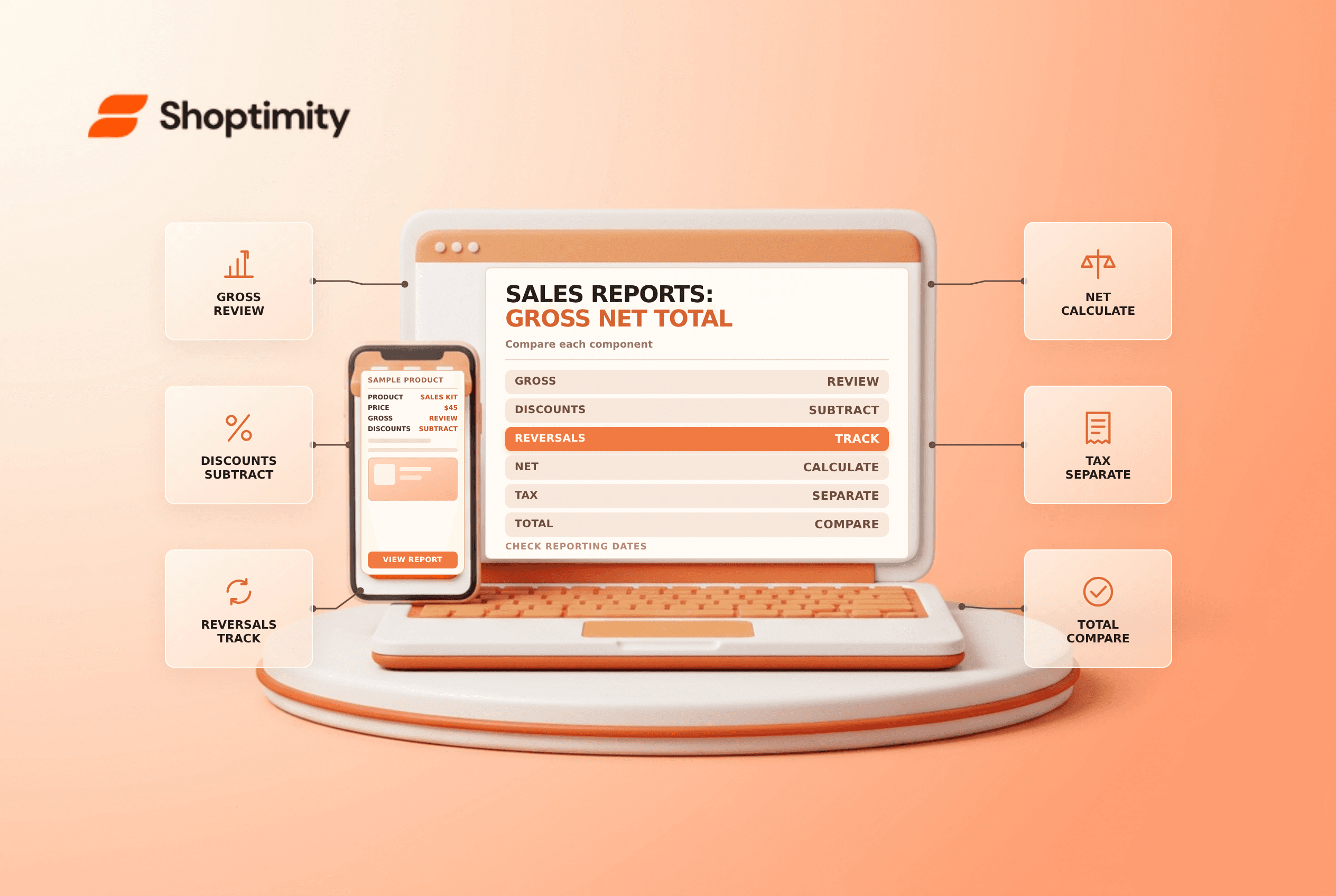
Shopify gross sales vs net sales vs total sales measures different stages of a sales calculation. Gross sales start with product sales before discounts and reversals; net sales subtract those reductions; total sales then incorporate other components. None of these figures alone is profit or cash deposited in the bank.
Read the sales equation
Shopify's sales report documentation defines the metrics and their components. Simplified:
Gross sales − discounts − sales reversals = net sales
Net sales + shipping charges + return fees + taxes + duties + additional fees = total sales
Shopify may display reversals and other components as signed values in reports. Read the report's current definitions and presentation rather than subtracting a negative number twice. Some breakdowns, including discounts and reversals of shipping charges, are included in the shipping component.
| Metric | What it helps answer | What it does not answer alone |
|---|---|---|
| Gross sales | What was sold before discounts and reversals? | Whether the business made a profit |
| Net sales | What remains after discounts and sales reversals? | How much cash reached the bank |
| Total sales | What is the reported total including additional components? | Whether tax or shipping is profit |
Work through an example
Suppose a report period shows 1,000 in gross product sales, 100 in discounts and 50 in sales reversals. Net sales are 850. If shipping is 40, tax is 70, duties are 10 and return and additional fees are zero, total sales are 970. The amounts are illustrative and assume those components are already represented in the relevant reporting period. Actual report definitions, returns and timing can make a reconciliation more complex.
Do not add tax and shipping to net sales and call the result gross sales. Equally, do not treat the reported total as contribution margin: cost of goods, advertising, payment fees and other expenses need separate analysis.
Watch the reporting date
Shopify states that sales reversals can include returns, cancellations, edits and adjustments, and that they are reported on the date processed. A return in February for an order placed in January can reduce February's reported sales even though the original order belongs to January's customer cohort.
This makes a period-based sales report different from a cohort analysis. When investigating a decline, compare the report's date range and definitions with the original orders as well as the reversals processed during the period. Document whether your management report is based on order date, transaction date or another convention.
Reconcile without mixing concepts
- Choose a date range, currency, sales channel and consistent report definition.
- Review gross sales, discounts and reversals separately.
- Inspect shipping, fees, tax and duties before comparing total sales.
- Trace unusual changes to underlying orders and adjustment dates.
- Compare payment and payout reports separately, allowing for timing and fees.
- Reconcile with accounting records under your accounting policy.
A sales report is not a tax return or accounting ledger. Consult a qualified professional for revenue recognition and tax treatment. For adjacent analysis see payout reconciliation and cohort retention.
Compare like with like when presenting results to a team. A promotion can raise gross sales while larger discounts reduce the share retained as net sales; investigate both volume and price effects.
Ready to build a faster, higher-converting store?
Every Shoptimity theme ships with conversion widgets built in — so you get speed and features without stacking apps.
7-day free trial · all themes included · cancel anytime
Continue Reading
Shopify B2B Company Locations: Give Buyers the Right Access
Configure Shopify B2B company locations, verify buyer permissions and test pricing, addresses and pa...
Shopify Checkout Contact Settings: Separate Email From Shipping Phone
Configure Shopify checkout contact settings and test email, phone and shipping address requirements ...
Shopify POS Recent Carts: Share a Sale Without Reserving Stock
Learn how Shopify POS recent carts work across devices, what they do not reserve, and how to hand of...