
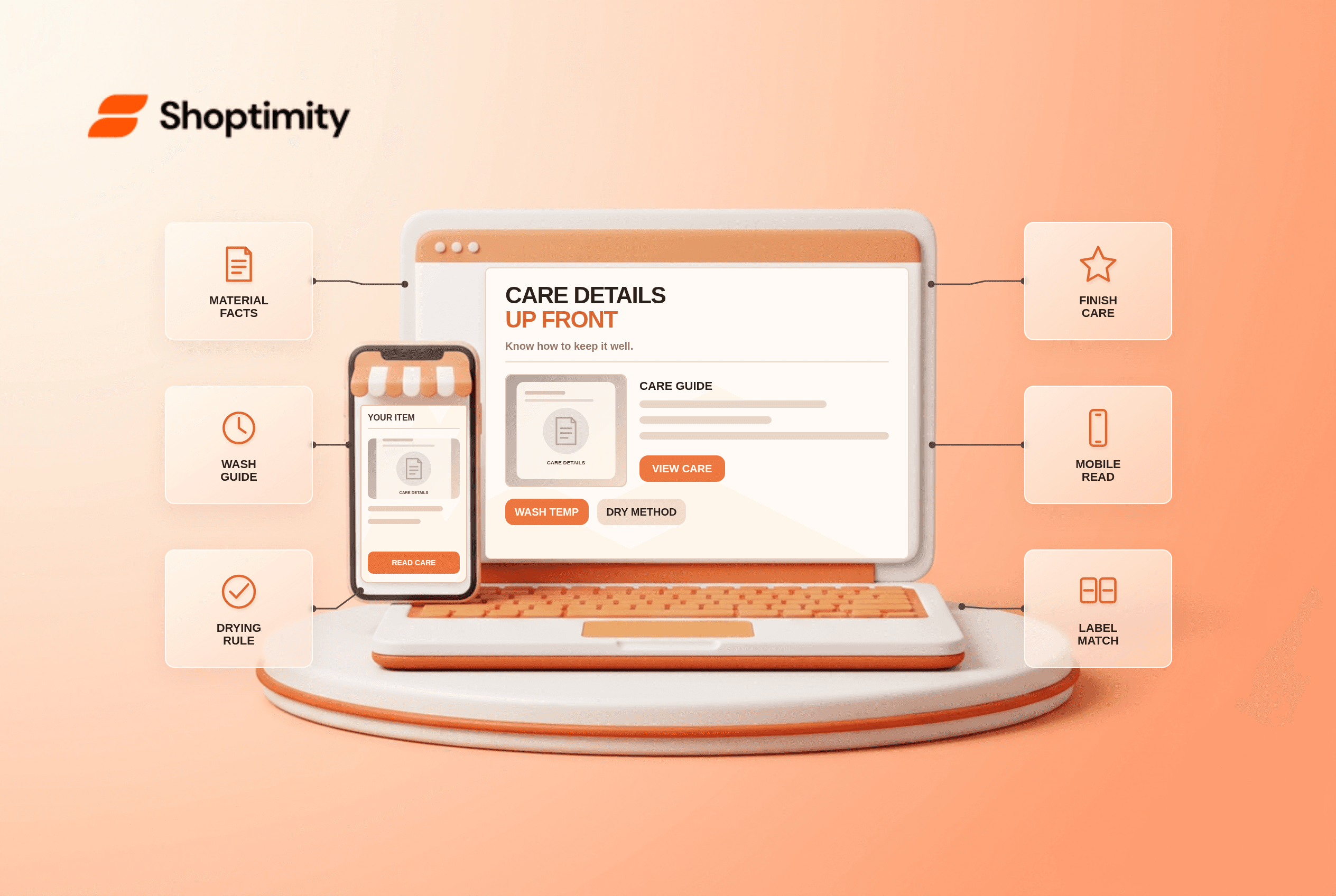
Ecommerce product care instructions should answer the buyer's actual decision, not just decorate a page. Say what the buyer must do, in a usable order: wash temperature, compatible detergent, drying method and what to avoid. The right presentation depends on the merchant's product data and operating rules. Treat the checks below as a test plan, not a promise that Shoptimity or a theme can implement every backend behavior by itself.
What does the evidence say about ecommerce product care instructions?
The useful takeaway is a clear, testable customer answer. According to Baymard’s product-description research, 10% of large ecommerce sites in its benchmark lacked consistently detailed descriptions. Its research specifically notes that materials and ingredients are attributes shoppers seek. Care information should be tied to those actual materials, not pasted across unlike products.
Baymard’s 2026 product-page benchmark reported 52% of desktop product pages had mediocre-or-worse overall UX. That broad figure is not a measurement of care instructions; it reinforces why a merchant should test whether critical product information is actually findable.
What should the interface say first?
Show the essential fact before a shopper reaches an irreversible step. Say what the buyer must do, in a usable order: wash temperature, compatible detergent, drying method and what to avoid. For non-apparel goods, specify cleaning products, exposure limits and any upkeep schedule. Cross-check the supplier label and local labeling rules before publishing. Distinguish care guidance from warranty terms.
A linen-cotton shirt listed as “machine washable” could still shrink if tumble-dried. A helpful page names the fabric blend, temperature and drying restriction beside the size and material details. On a phone, the buyer should not have to download a tiny photo of a label to learn how to clean the garment.
How should a merchant test the flow?
Test a real edge case, not only the happy path. Run these checks on a product, cart and mobile device that reflect the catalog and workflow:
- Collect approved care statements for each material and finish.
- Compare copy against the sewn label, pack insert or manufacturer manual.
- Check whether different colors or finishes require different cleaning methods.
- Expose the instructions in readable text, not only an image or PDF.
- Test search within the page for common words like wash, dry and store.
- Review mobile accordions and keep the essential warning accessible.
What breaks when information is missing?
A confident-looking interface can still make a false promise. A product may contain multiple components with different care requirements: a removable cover, an insert and a frame cannot share a single instruction. Where a finish is sensitive or advice is conditional, say which component and condition the rule applies to. Do not claim a product is dishwasher-safe without evidence for the sold variant.
A team should record who owns the source data and which event updates the customer-facing message. Test a changed selection or an unavailable option after the first screen has loaded. If a requirement cannot be met by a theme alone, route the change through the commerce platform, inventory service, fulfillment system or payment provider as appropriate.
How does this fit into a Shoptimity storefront?
Start with reliable information and then improve presentation. Shoptimity themes can help present storefront content, but operational rules may live elsewhere. See our product descriptions checklist and size guide for adjacent checks. We checked the cited public research, not this merchant's analytics or implementation. We have not tested this merchant's live setup. Avoid claiming that a benchmark proves an expected conversion gain for this store.
What should be measured after launch?
Verify the actual outcome against the visible promise. Compare pre-purchase care questions, post-purchase care contacts and returns attributed to unclear handling. These are diagnostic signals, not proof that a longer description causes more sales. Keep a dated sample of real customer journeys, including a mobile case and one exception, for an editorial and operational review after any configuration change.
Ready to build a faster, higher-converting store?
Every Shoptimity theme ships with conversion widgets built in — so you get speed and features without stacking apps.
7-day free trial · all themes included · cancel anytime
Continue Reading
Shopify Checkout and Accounts Editor: Set Page Blocks
Use the Shopify checkout and accounts editor to place Thank you and Order status app blocks, check B...
Shopify Marketplace Connect: Sync Amazon and eBay Stock
Sync listings and orders with Shopify Marketplace Connect across Amazon, eBay, Walmart and Target Pl...
Shopify Audiences: Export Plus Ad Lists and Benchmarks
Export Shopify Audiences lists on Shopify Plus to Meta, Google, TikTok and Pinterest, match refresh ...