
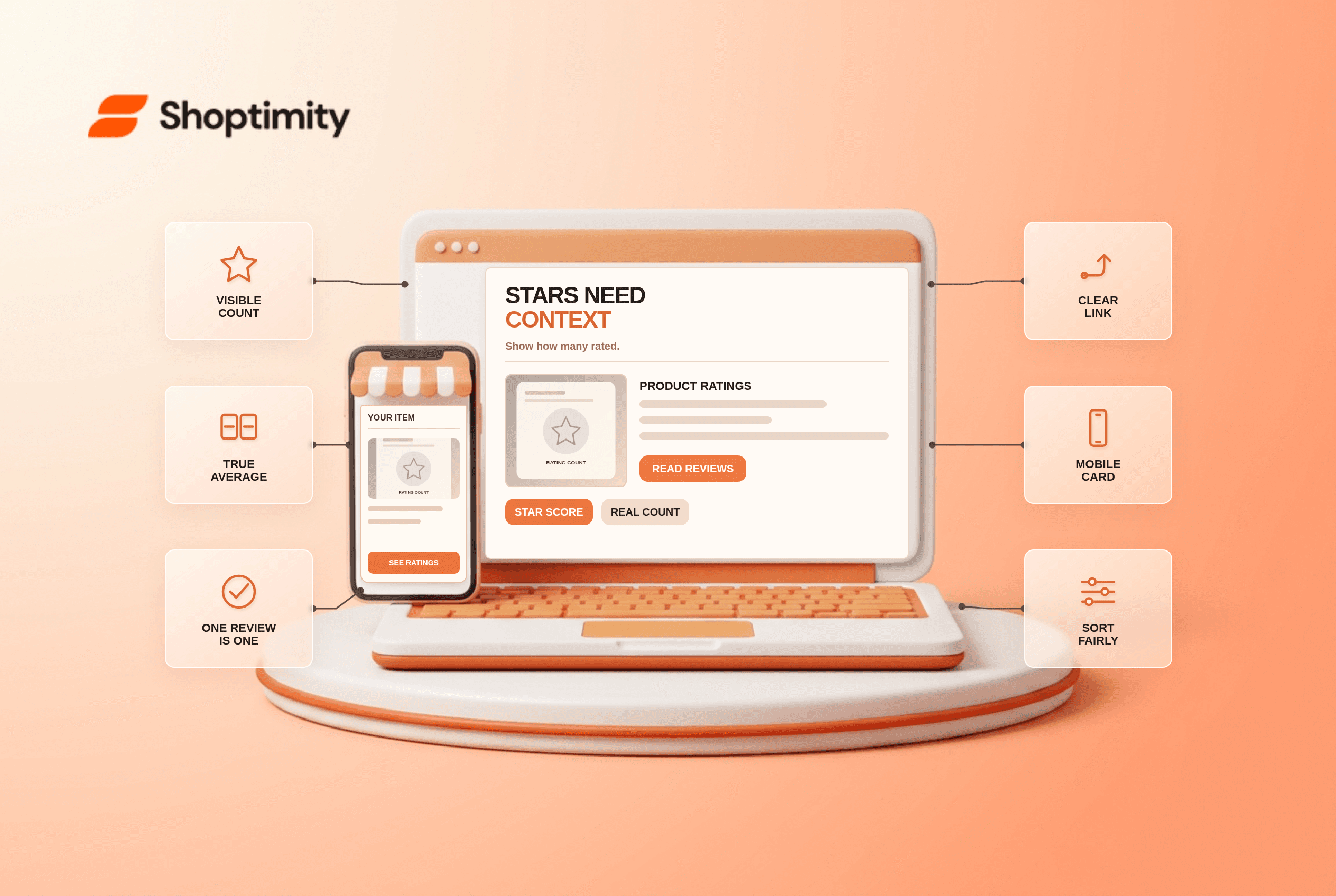
Ecommerce product list rating counts should appear beside review averages so shoppers can distinguish strong evidence from a single perfect rating. Start by testing one real customer journey and one exception before changing a template. The store needs accurate underlying data; a theme can present it, but cannot make an incorrect warehouse, catalog or payment record true.
What does the research say about ecommerce product list rating count?
Use the finding as a diagnostic, not a conversion forecast. According to Baymard’s rating-count research, a five-star average from 4 people was less persuasive in its survey than a 4.5-star average from 57 people; its 2022 benchmark found 5% of sites still omitted the count.
Baymard’s rating-sort research reports that 64% of studied sites failed to account for review volume in their rating-sort logic. The visible count and the ordering rule must tell a consistent story.
What belongs beside a product star score?
Lead with the fact that changes the decision. Display an average such as 4.5/5 with the number of ratings beside it. Make the count a link to the relevant reviews when the page supports that destination. Avoid a lone five-star graphic that hides the fact it comes from one response. Keep review totals and calculations consistent between search results, collection cards and product pages.
A product card displays 5.0 stars with no count; a competing card shows 4.7 from 240 ratings. The shopper cannot assess the reliability of the first score. If the product has one review, show 5.0 (1) honestly and let the buyer read it before trusting the summary.
How should unrated products appear?
Keep the message consistent after selection. A card, form or account screen is only one view of a wider system. Update the customer-facing display when the selection changes; preserve the relevant detail in cart, checkout and confirmation where applicable. If a feature depends on backend rules, give the owner of those rules a concrete test case before promising behavior in editorial copy.
How can a team test this before launch?
Test the edge case that makes the promise fail. Use a representative product, location or account alongside the happy path:
- Compare rating average and count against the current review database.
- Test products with zero, one and hundreds of ratings.
- Check rounding produces the same visible score everywhere.
- Link the count to actual product reviews, not a generic page.
- Test mobile legibility alongside price and title.
- Audit sorting behavior for low-volume perfect ratings.
What exception needs special handling?
Do not turn uncertain data into a confident claim. Do not display “0 stars” for a product with no ratings; distinguish an unrated item from a poorly rated one. If reviews are imported, disclose their origin where required and avoid merging reviews for materially different items. A deleted or moderated rating should update the count promptly.
What should Shoptimity merchants check?
Verify operations before polishing the storefront. Our recommendation is to confirm the customer-visible promise against the source record before launch. Shoptimity themes can display information; the merchant’s platform and connected systems own most transaction rules. See the ethical review collection guide and product sorting guide for adjacent checks. We checked the cited public studies, not this merchant’s analytics or live setup. The study figures are neither Shoptimity results nor a promised sales improvement.
What signals matter after launch?
Compare what customers saw with what actually happened. Review review-detail opens and customer confusion about seemingly perfect products. The count is a trust cue, not evidence that an item is intrinsically better. Save dated examples so the team can diagnose a data error separately from confusing copy.
Ready to build a faster, higher-converting store?
Every Shoptimity theme ships with conversion widgets built in — so you get speed and features without stacking apps.
7-day free trial · all themes included · cancel anytime
Continue Reading
Shopify Apple Pay: Check Wallets, Subscriptions and B2B
Activate Shopify Apple Pay with network tokenization, verify Visa or Mastercard subscription rules, ...
Shopify Order Notes: Capture Cart Instructions Cleanly
Enable Shopify order notes on Online Store 2.0 carts, separate notes from cart attributes and checko...
Shopify Planet: Add Carbon-Neutral Shipping Badges
Set up Shopify Planet carbon-neutral shipping, match Marketing vs $0.50 Engagement badge modes to yo...