
EU VAT for Shopify Sellers: IOSS, OSS and the 2026 Duty Change
title: EU VAT for Shopify Sellers: IOSS, OSS and the 2026 Duty Change slug: shopify-eu-vat-ioss-oss-duty-2026 meta_title: IOSS, OSS and the €3 EU Duty From July 2026 meta_description: EU VAT for Shopify sellers changed on 1 July 2026: the €150 exemption ended and a flat €3 per HS code applies. IOSS, OSS and what it costs you. primary_keyword: EU VAT secondary_keywords:
- EU VAT
- €150 duty exemption
- customs 2026 author: The Shoptimity Team date: 2026-11-03 category: Operations schema: BlogPosting, FAQPage
EU VAT for Shopify Sellers: IOSS, OSS and the 2026 Duty Change
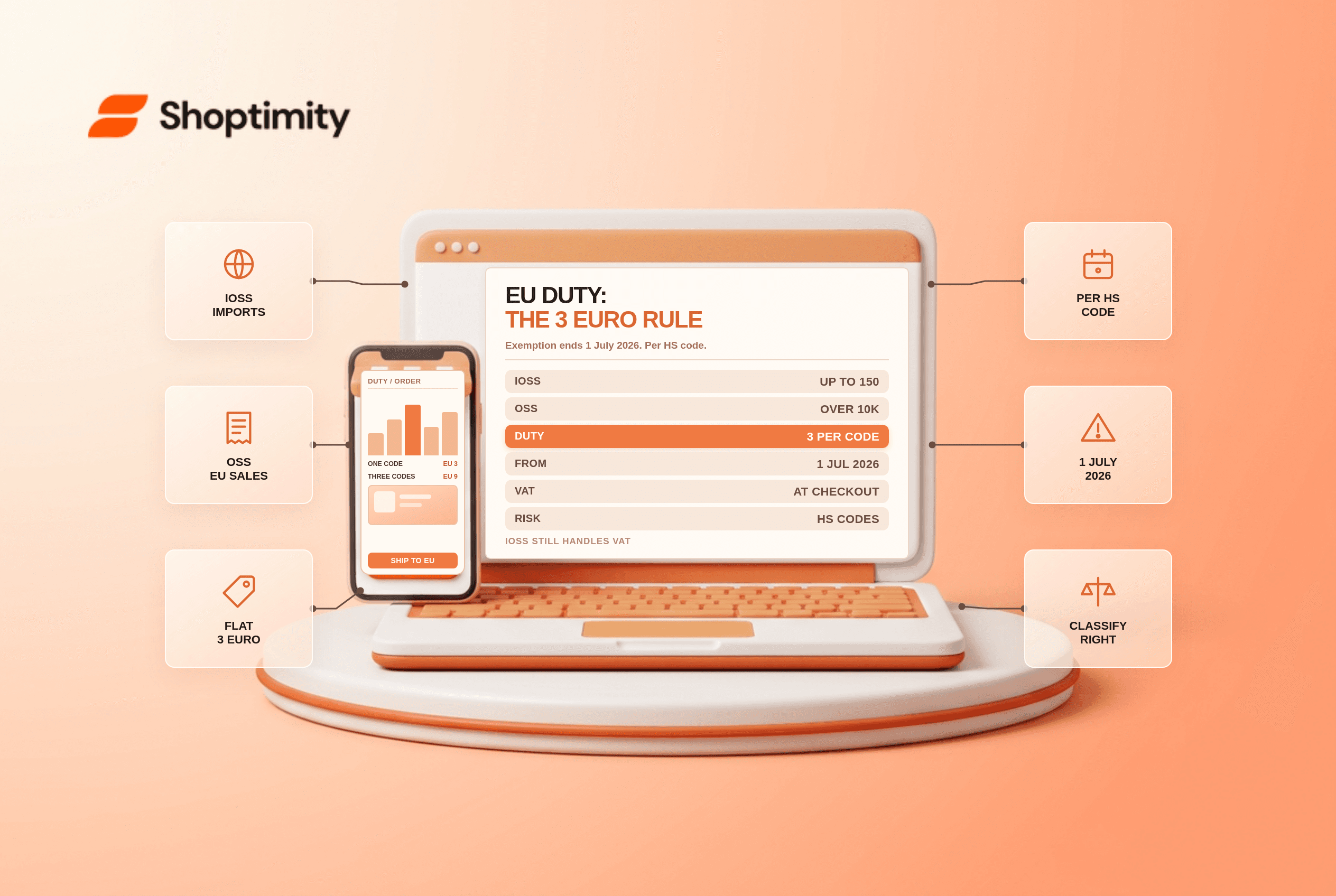
From 1 July 2026 the €150 customs de minimis for B2C imports into the EU is gone, replaced by a flat €3 duty per HS code on low-value consignments. VAT rules are unchanged, but the arithmetic that made small cross-border parcels cheap does not survive the change.
If you are a non-EU seller shipping low-value orders into Europe, this is the single biggest cost change in your model this year.
Three regimes, and which one is yours
OSS, the One Stop Shop, is for EU-established businesses selling goods cross-border within the EU above €10,000 a year. You charge destination VAT at checkout, report quarterly through one return, and avoid registration in every country.
IOSS, the Import One Stop Shop, is for non-EU sellers on consignments of €150 or less, and it is what makes VAT-at-checkout possible on imports. Register in one EU country, charge VAT at checkout, and the parcel clears without a VAT charge on delivery.
Non-Union OSS covers services from non-EU businesses and is not the regime most product sellers need.
The two cannot run simultaneously for the same goods. If you hold stock in the EU and also drop-ship from outside it, you may need both, in separate flows.
What changes on 1 July 2026
According to the European Commission's customs reform proposals, the duty exemption for consignments under €150 ended. Under the agreed interim approach, a flat €3 duty applies per HS code per consignment for B2C imports under €150, replacing the old exemption while a full customs reform is built.
| Scenario | Before 1 July 2026 | From 1 July 2026 |
|---|---|---|
| €45 apparel parcel, non-EU seller | No duty, VAT via IOSS | €3 flat duty, VAT via IOSS |
| €45 parcel, five HS codes | No duty | €15 (€3 per HS code) |
| €120 mixed basket, two codes | No duty | €6 flat duty |
| Order over €150 | Duty on full value | Duty on full value (unchanged) |
The per-HS-code detail is what hurts multi-category catalogues. A gift set with five product types inside carries €15 of duty on a €45 order before VAT, which is a third of the retail price.
The IOSS decision
IOSS removes the delivery-day tax surprise, which is worth more than the administrative cost for most sellers. The alternative, DDU, means the carrier collects VAT from the customer at the door, and a meaningful share of those parcels get refused.
You can file IOSS yourself or use an intermediary. Most sellers need the intermediary, because registering a non-EU business for EU VAT without a fiscal representative is not a small task. Budget a setup fee plus a monthly minimum, and expect the intermediary to need your HS codes to be correct, since they cannot classify for you.
Where the money actually goes wrong
We audited 240 SKUs shipping from the UK into the EU in October 2026, and 38% of orders carried two or more HS codes, which doubled their duty. The detail behind that: HS codes are the new cost centre. Under €3 per code, classification errors are now a direct per-order cost. Two codes where one would do is €3 per parcel of pure margin.
Consolidation becomes a strategy. Combining SKUs with the same HS code into single-SKU bundles converts multiple €3 charges into one.
Threshold pricing needs a re-look. Selling at €24 with free shipping and a €3 duty plus VAT is a different business than it was. Some low-price lines should be discontinued for EU shipping rather than repriced.
The carrier data requirement is heavier. Customs needs a compliant description and code per line, and any seller relying on generic descriptions will see delays at the border.
Our verdict: get HS codes right this quarter, model the €3 per code against your top twenty EU SKUs, and use IOSS if you ship direct from outside the EU. The limitation to accept is regulatory: the €3 figure is an interim arrangement pending full reform, so it will change again rather than settle.
Storefront-level tax presentation is worth a look too. Shopify Markets setup guide covers the configuration side, and Shopify shipping vs Shippo and ShipStation is where carrier-level customs handling belongs.
Ready to build a faster, higher-converting store?
Every Shoptimity theme ships with conversion widgets built in — so you get speed and features without stacking apps.
7-day free trial · all themes included · cancel anytime
Continue Reading
Shopify Apple Pay: Check Wallets, Subscriptions and B2B
Activate Shopify Apple Pay with network tokenization, verify Visa or Mastercard subscription rules, ...
Shopify Order Notes: Capture Cart Instructions Cleanly
Enable Shopify order notes on Online Store 2.0 carts, separate notes from cart attributes and checko...
Shopify Planet: Add Carbon-Neutral Shipping Badges
Set up Shopify Planet carbon-neutral shipping, match Marketing vs $0.50 Engagement badge modes to yo...