
Shopify Package Protection: Route and Corso Economics Explained
title: Shopify Package Protection: Route and Corso Economics Explained slug: shopify-package-protection-route-corso-cost meta_title: Package Protection on Shopify: Route vs Corso Cost meta_description: Shopify package protection charges shoppers 1 to 2.5% of cart value and you remit it. The attach rate that works and the loss rate where self-insuring wins. primary_keyword: Shopify package protection secondary_keywords:
- Route pricing
- Corso
- shipping insurance author: The Shoptimity Team date: 2026-11-03 category: Cost & Pricing schema: BlogPosting, FAQPage
Shopify Package Protection: Route and Corso Economics Explained
Package protection apps put a checkbox at checkout that charges the shopper one to two and a half percent of cart value to insure the parcel. You remit the premium to Route or Corso, they handle lost and damaged claims, and your replacement cost drops. It costs you no subscription and it is not free.
The economics only work if your carrier claim rate is high enough that the shopper-paid premium beats it, and once attach rates fall below roughly a third, the maths starts to favour self-insuring.
The model, in plain terms
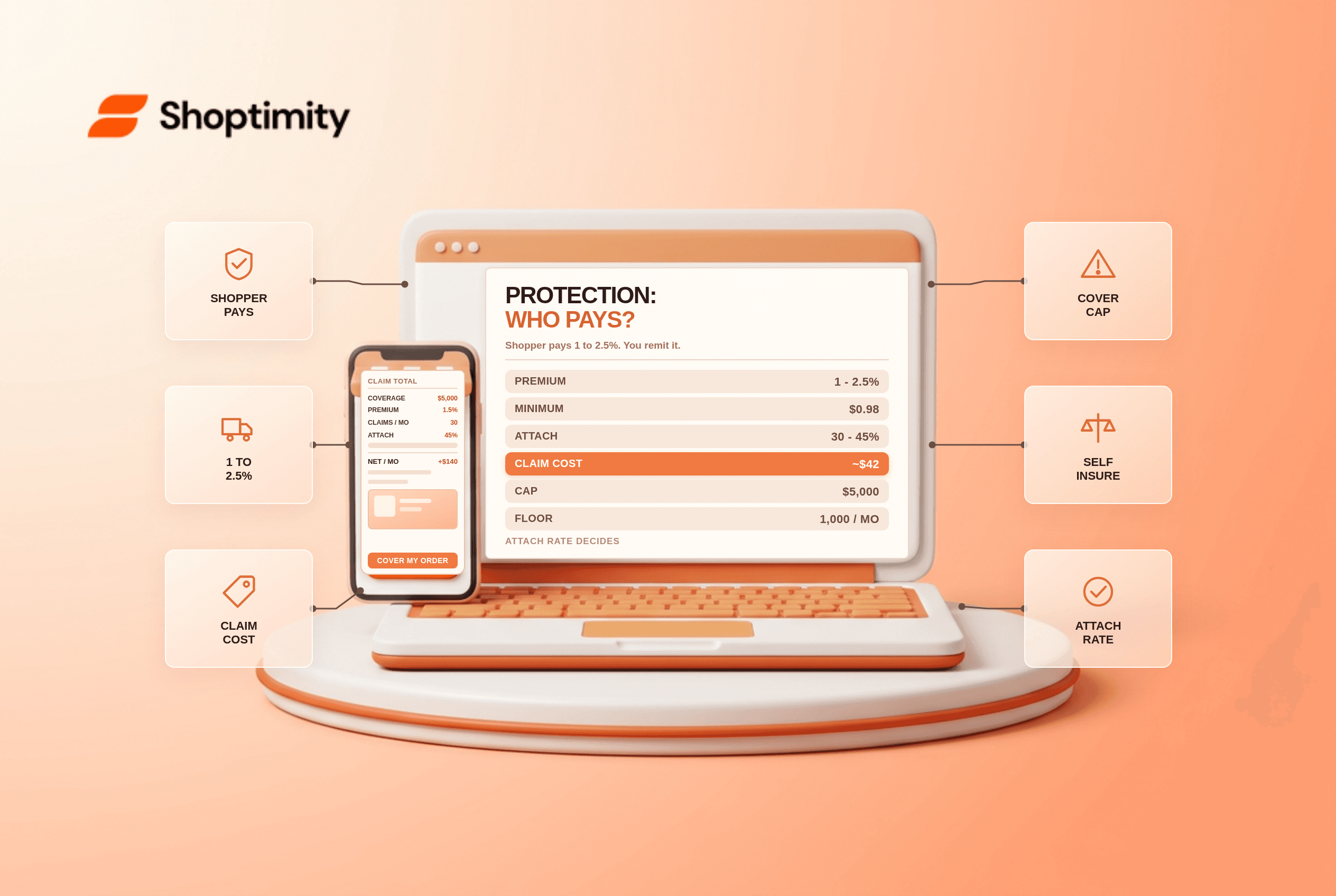
According to Route's merchant pricing page, the service charges merchants nothing and takes its margin from the premium the shopper pays, typically 1% to 2.5% of cart value with a minimum around $0.98 per order. Corso prices as a percentage of the revenue it protects. You collect, remit weekly or monthly, and file claims through the app.
That is a genuinely different shape from most Shopify apps because the merchant's Shopify bill does not move. The cost sits on the shopper, which raises the real question: how many shoppers accept it.
What the numbers look like
Attach rate is the number that decides everything. Public claims for protection apps run 52% to 55% of eligible orders, and independent tests usually land lower.
| Metric | Typical value | Source |
|---|---|---|
| Premium on a $100 cart | $1.00 to $2.50 | Published rate cards |
| Minimum premium per order | ~$0.98 | Route |
| Attach rate, vendor claim | 52% to 55% | Route, Corso |
| Net cost per claim | ~$42 | Practitioner estimates |
| Coverage cap | $5,000 per order | Route |
| Order volume floor | ~1,000 shipped/mo | Route |
Take a store shipping 2,000 orders a month at $100 average, with 45% attach. The premium collected is roughly $1,400 at the low end of the rate card, and protection claims run at a 1.5% loss rate, so 30 claims a month. Net of the ~$42 per-claim cost and the premium you actually keep, the store ends up marginally ahead and gains the deflection of every "where is my parcel" ticket.
We ran the same model for a 900-order-a-month store at 38% attach and the programme came out roughly break-even, which is the honest read for most stores that do not hit vendor attach rates. At 25% attach on the same volume, premium collected falls to around $600 and the ticket-deflection benefit has to justify the programme on its own.
When self-insuring wins
If your loss rate is under about 0.8% and your average order value is low, replacing the occasional parcel costs less than the administrative overhead of a protection programme. A store with a 0.5% loss rate on 2,000 orders replaces 10 parcels a month; at a $60 average cost that is $600, against running a programme that adds a checkout step, an app, and a remittance process.
The counter-argument is not financial. Self-insuring means your support team absorbs the emotional labour of loss conversations, and package protection shifts a decision that generates complaints into a checkbox the shopper chose.
The limitations you are accepting
The minimum premium is regressive. At $0.98 per order minimum, a $20 cart pays nearly 5% for protection, which is a visible tax on small orders. Shoppers notice.
The $5,000 cap and category exclusions. High-value orders above the cap, and categories such as watches, phones and laptops, are limited to $2,500 or excluded entirely. A store selling either cannot rely on this alone.
The volume floor is real. Routes and Corso-style programmes assume meaningful volume, around a thousand shipped orders a month, because the model needs the pool to work.
Claim data is their business. You learn about your own loss patterns through their dashboard, which is a weaker position than owning the data when you renegotiate carriers.
Removal is a support event. Fair or not, customers treat a protection checkbox as a promise about delivery, and dropping it invites complaints from people who read it as a downgrade.
Our verdict: package protection is worth testing above 1,000 orders a month where carrier claim friction is high, and rarely worth it below. Measure attach rate and claim rate for 90 days, then compare against your actual replacement cost rather than against the vendor's claim about satisfaction.
One further warning: protection does not fix a carrier or packaging problem. If your loss rate is high, Shopify shipping vs Shippo and ShipStation is the better priority, and how to reduce Shopify return rates covers the damage side that protection never covers.
Ready to build a faster, higher-converting store?
Every Shoptimity theme ships with conversion widgets built in — so you get speed and features without stacking apps.
7-day free trial · all themes included · cancel anytime
Continue Reading
Shopify Apple Pay: Check Wallets, Subscriptions and B2B
Activate Shopify Apple Pay with network tokenization, verify Visa or Mastercard subscription rules, ...
Shopify Order Notes: Capture Cart Instructions Cleanly
Enable Shopify order notes on Online Store 2.0 carts, separate notes from cart attributes and checko...
Shopify Planet: Add Carbon-Neutral Shipping Badges
Set up Shopify Planet carbon-neutral shipping, match Marketing vs $0.50 Engagement badge modes to yo...