
Shopify Returns Apps: What Each Costs and When the Fee Pays
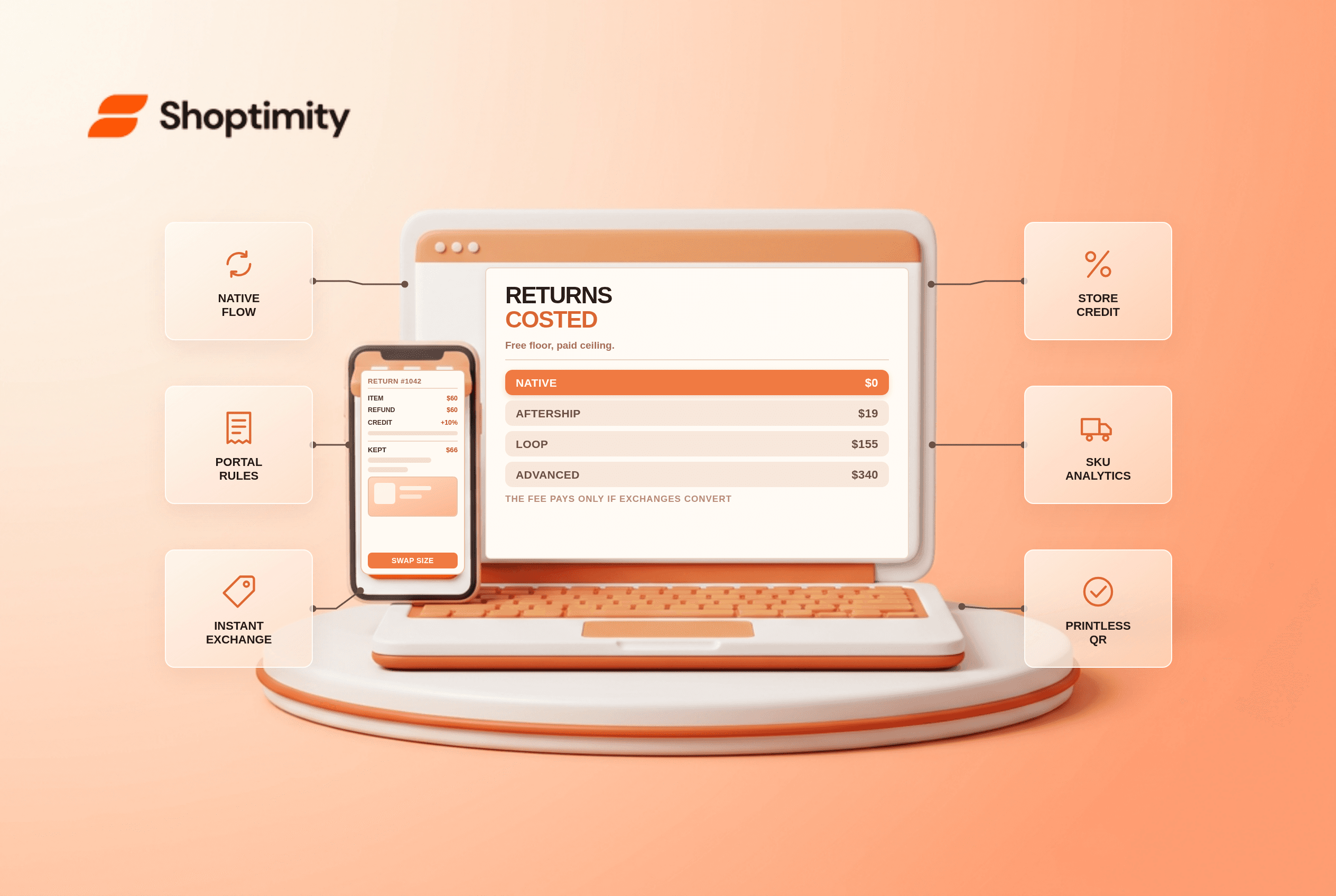
Shopify's native returns workflow is free and handles requests, labels, refunds and simple exchanges. A returns app costs between $19 and $340 a month and earns that fee on one metric: how many refunds it converts into exchanges or store credit.
Everything else an app offers is supporting detail. This is the fee maths, not the setup walkthrough.
What the free workflow already covers
Customers request a return from their account or an order status link. You set an eligibility window, decide who pays return shipping, and choose whether requests need approval. Shopify issues the label, tracks the parcel, and records the refund or exchange.
That is enough for a store doing 20 returns a month with one warehouse and one policy. The limits are that you get one rule set for the whole store, limited portal styling, basic exchange handling, and no SKU-level return analytics.
The 2026 price ladder
| Option | Monthly | Included | Exchange depth |
|---|---|---|---|
| Shopify native | $0 | Full basic workflow | Basic only |
| AfterShip Returns | Free | 3 returns/mo | Variant exchanges |
| AfterShip Essentials | $19 | 20 returns, then $0.50 each | Variant exchanges |
| AfterShip Premium | $119 | 100 returns, then $1 each | Instant and Shop Now exchanges |
| Loop Essential | $155 | Exchange-first portal, annual contract | Instant exchanges, bonus credit |
| Loop Advanced | $340 | Higher volume and controls, annual contract | Full exchange suite |
Watch the billing basis. AfterShip's website quotes annual-billed equivalents of $16 and $99 a month, which differ from its Shopify listing's monthly figures of $19 and $119. Loop's paid plans carry an annual contract, and its free tier is the Checkout+ product rather than a returns plan.
The only break-even that matters
We ran the same exchange arithmetic at 20 and at 200 returns a month, and the two answers point in opposite directions.
Take a store at 200 returns a month and a $60 average order value. It refunds roughly $12,000 a month.
According to the app listings, that fee range is what you are weighing against this.
Move 15% of those requests to exchanges and you keep $1,800 of revenue that would otherwise leave. Against $155 to $340 a month, that pays back within the first month, before counting the higher repeat-purchase rate of a customer who exchanged rather than refunded.
Now run the same store at 20 returns a month. Fifteen percent of a $1,200 refund pool is $180, against a $155 fee. That is a subscription with extra steps rather than a business case.
Where apps earn more than the exchange math
Rules that differ by segment. Apparel returning at 25% and electronics at 3% need different windows and different shipping liability. One rule set cannot express that, and manual review costs staff time.
Drop-off networks and printerless returns. QR-code returns through carrier drop-off points raise completion rates for customers who do not own a printer, which is most of them.
Return analytics. Reason codes as a dataset, return rate by SKU, label cost per return. This is what tells you which product page needs a size guide.
Store credit incentives. Bonus credit for choosing credit over refund converts a refund into future revenue at a known discount rate.
Choosing between the two price points
Our verdict: native until exchanges are a lever you can measure, then the cheapest app that does instant exchanges, not the most complete suite. For most stores under 100 returns a month that is AfterShip's entry tier; above 300 returns the exchange maths supports Loop's pricing.
The limitation to hold in mind is that switching creates a second source of truth. The refund completes in Shopify either way, but reason codes and exchange history live in the app, so a mid-season change means reconciling two datasets for a month.
If you are setting the workflow up rather than pricing it, Shopify's self-serve returns setup covers the configuration side. For the stock consequences of exchanges, the bundles inventory checklist is the companion read, and what a good conversion rate looks like in 2026 gives you the revenue baseline to judge return-adjusted results against. Current listings and pricing are on the App Store for Loop and AfterShip Returns.
Ready to build a faster, higher-converting store?
Every Shoptimity theme ships with conversion widgets built in — so you get speed and features without stacking apps.
7-day free trial · all themes included · cancel anytime
Continue Reading
Built for Shopify: What the Badge Guarantees, and What It Does Not
The badge caps how far an app can drag your storefront speed and bans theme-file edits. What it cert...
Shopify Subscriptions vs Recharge: The Cost Math for 2026
Native is free with no revenue share. Recharge costs $99 a month plus a percentage. The break-even, ...
Shopify App Blocks vs App Embeds: Where Each One Belongs
Blocks load where you place them, embeds load everywhere. Why that is usually your biggest speed win...