
Shopify Review App Costs in 2026: Judge.me vs Loox vs Yotpo
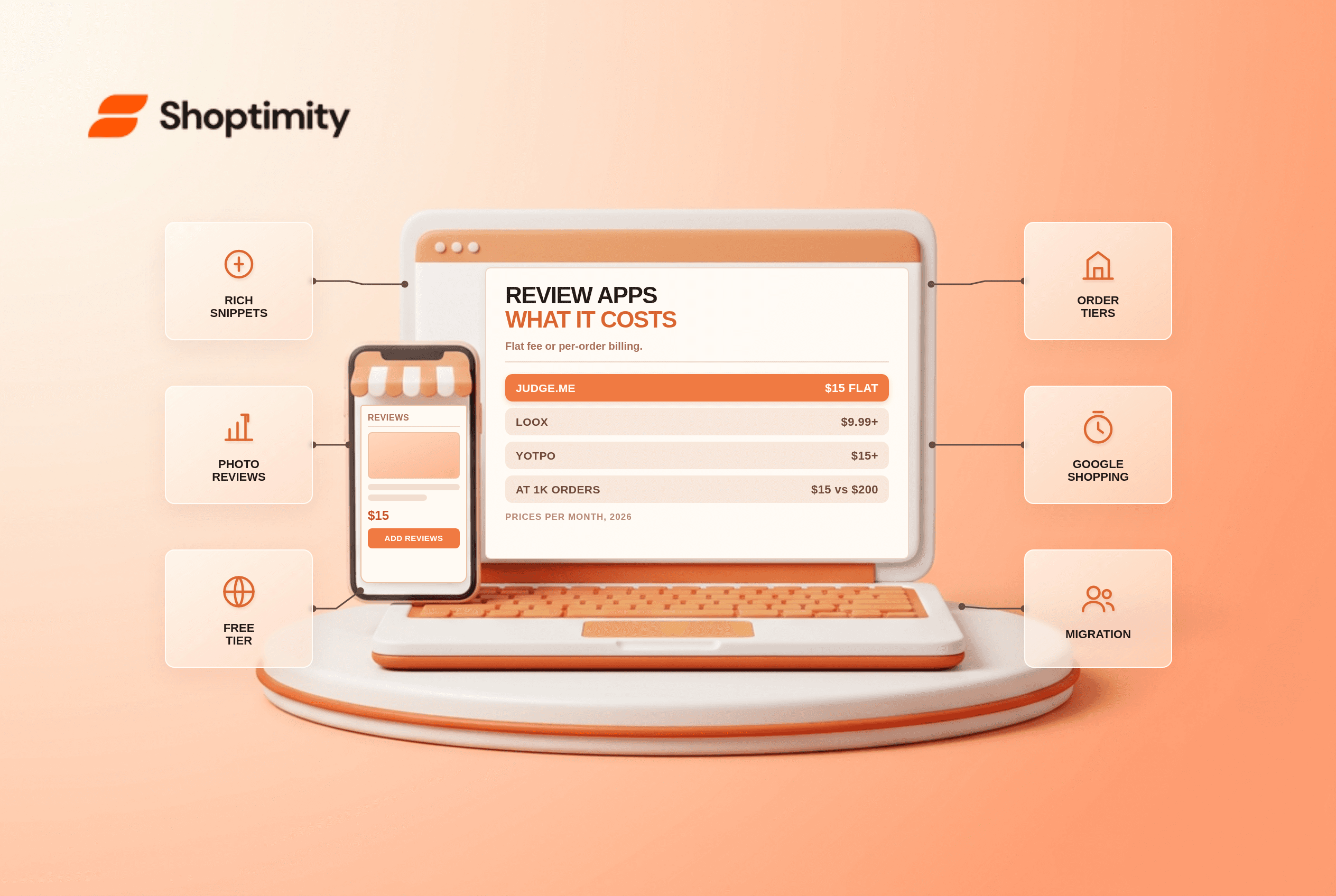
Judge.me is the cheapest way to run a Shopify review app, and it stays cheap as you grow. Its paid plan is $15 a month flat, with no order-volume cap. Loox and Yotpo cost less at launch and considerably more at scale, because both bill against the orders you process.
What each app charges in 2026
The entry prices are not the prices most stores end up paying. All three apps tier by volume, and only one flattens the curve.
| App | Free tier | Entry paid | At 1,000 orders a month | Bills on |
|---|---|---|---|---|
| Judge.me | Unlimited reviews, branded | $15 flat | $15 | Nothing |
| Loox | Trial, then paid | $9.99 | $35 to $50 plus overage | Orders |
| Yotpo | 50 orders a month | $15 to $24 | $89 to $169 | Orders |
Published figures vary between sources and months, so treat the middle column as a range to verify on each vendor's pricing page before you commit. Yotpo in particular quotes different starting points depending on which tier and add-on bundle you land in.
Why flat pricing matters more than entry pricing
At 100 orders a month, every app on this list is affordable. At 1,000 orders a month, the differences compound. Judge.me still charges $15. Loox lands near $50 plus overage blocks, and Yotpo's volume tiers put most mid-size stores between $89 and $169.
That gap is the whole argument. A review app is infrastructure, not a growth lever. You want it to cost the same in a record month as in a quiet one.
In our experience, stores rarely switch review apps because of features. They switch because the invoice doubled after a good quarter, usually in January, usually in the middle of planning a different budget.
What you actually need a review app to do
Four things. Serve valid review rich snippets so stars appear in search. Automate review requests after delivery. Support photo and video reviews. Handle discontinued products without breaking the widget.
Everything above that line is optional. Google Seller Ratings, loyalty modules, SMS integrations and AI review summaries are nice, and none of them decide whether a shopper trusts your product page. The catch is that the optional layer is exactly where the volume pricing sits for Loox and Yotpo, so you end up paying by order for a layer that is expensive against the free tier you started on.
Judge.me covers the four essentials on its free tier and adds Google Shopping support on the paid plan. Yotpo's advantage is breadth: reviews, loyalty and SMS from one vendor, with the integration work already done. Loox's advantage is presentation, and for fashion and beauty catalogs a strong photo wall does measurable work, which is why its App Store listing leads with customer galleries.
The rich snippet question, and why it decides the choice
Stars in search results come from structured data, and structured data is easy to get wrong. A review app can be installed, collecting reviews, and still emit no usable schema because a theme change removed the block, or because reviews render inside an iframe.
Check your product pages in a structured data tool before you blame the app. Our guide to missing review stars after a theme change covers the three usual causes and how to confirm which one you have.
Choosing between the three
Pick Judge.me if you want valid stars, automated requests and the lowest total cost, and you do not need one vendor for loyalty and SMS.
Pick Loox if your category sells on visuals and you will actually use the photo wall on product pages. Budget for the volume tier you expect in twelve months, not the one you are in today.
Pick Yotpo if you want reviews, loyalty and SMS under one contract, and your order volume justifies enterprise pricing. Below 500 orders a month, the case is thin.
Then read how to collect reviews without gaming them. The collection method matters more to conversion than the widget, and a wall of undated five-star reviews with no photos reads as fake. According to Shopify's own guidance on product reviews, verified buyer status and recency both shape how shoppers read a review section.
Ready to build a faster, higher-converting store?
Every Shoptimity theme ships with conversion widgets built in — so you get speed and features without stacking apps.
7-day free trial · all themes included · cancel anytime
Continue Reading
Built for Shopify: What the Badge Guarantees, and What It Does Not
The badge caps how far an app can drag your storefront speed and bans theme-file edits. What it cert...
Shopify Returns Apps: What Each Costs and When the Fee Pays
Native returns are free, apps run $19 to $340 a month. The exchange-conversion maths that decides wh...
Shopify Subscriptions vs Recharge: The Cost Math for 2026
Native is free with no revenue share. Recharge costs $99 a month plus a percentage. The break-even, ...